
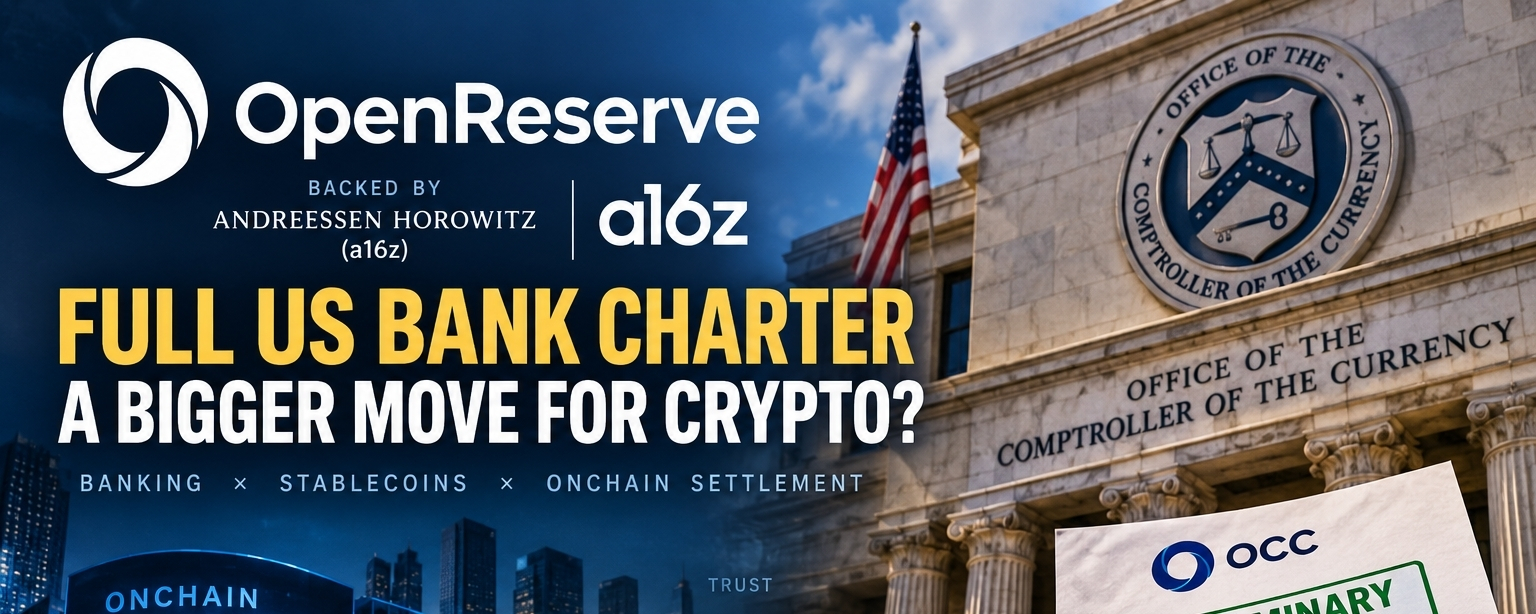

The charter is the story: trust versus full national bank
Most crypto firms that have pursued an OCC charter have sought a trust charter. OpenReserve asked for the full national bank version — and that choice matters more than the approval headline.
The news first, briefly, then the part that stays useful after the news goes stale.
Reported on September 3 and 4, 2026: the Office of the Comptroller of the Currency (OCC), the US federal agency that charters national banks, gave early-stage approval to two companies seeking to form US national banks — Revolut and OpenReserve Holdings. OpenReserve is backed by Andreessen Horowitz (a16z), following a $25 million seed round, and is focused on onchain settlement. Both companies have crypto and stablecoin-related services in their plans.
A charter is permission to be a bank, and the type of charter determines what that bank can do.
A bank charter is the legal authorization to operate as a bank at all. It isn't branding. It sets the perimeter: what the institution may hold, what it may promise customers, and who supervises it.
Many crypto firms that have pursued an OCC charter have sought a trust charter. Decrypt reports that OpenReserve went the other way and picked a full national charter, which "clears a path toward insured deposits and conventional lending alongside stablecoin issuance."
Worth reading that list twice, because in crypto those three functions usually sit in separate entities. Insured deposits means customer money covered by a deposit insurance scheme rather than resting on the institution's own promise. Conventional lending means ordinary loans on the bank's own book. Stablecoin issuance means being the entity that mints the token and owes the redemption.
Then notice the verb. "Clears a path toward" is not "has." Nothing in the reporting I'm working from says insurance has been granted, names a lending product, or names a stablecoin.
Approval-stage words are load-bearing
Five reports, four descriptions of the same regulatory action. The Block and Cointelegraph: preliminary. CoinDesk: provisional, an initial OK to operate. The Block, on Revolut: conditional. Decrypt's headline: approval, no qualifier.
The most telling phrase is Revolut's own, quoted by The Block — an "important step toward" becoming a US bank. Companies pick their adjectives with care. Toward is a direction, not an arrival.
The habit worth keeping: in a regulatory headline, find the qualifier and the verb before you find the excitement. Preliminary, conditional and provisional all mean another gate exists. And none of these five reports lists the conditions attached, a timeline, or an opening date — so I can't tell you what the conditions are, and I won't pretend otherwise.
Why "onchain settlement" is the phrase to notice
Settlement is the unglamorous end of a payment: the point where value actually moves and the obligation is discharged, as distinct from the moment your app flashes a confirmation. In conventional finance that final leg lands on the books of banks and intermediaries. The idea behind onchain settlement is that the final record lives on a blockchain instead.
That's the focus The Block attributes to OpenReserve's bank. Which chain, which asset, which customers, and how any of it meets the balance sheet — the research doesn't say. Those blanks stay blank.
My reading, labelled as mine
If one supervised bank can hold insured deposits, lend, and issue a stablecoin, then reserve backing and the redemption promise sit inside a single supervised entity instead of being stitched across a chain of counterparties. That's a different shape from the custody-plus-partner-bank arrangements crypto has mostly relied on. Whether the different shape works better depends on execution: capital, risk management, whatever conditions the OCC attached, and whether the bank opens at all.
The counter-argument
Supervision moves risk around; it doesn't remove it. A chartered, supervised, insured bank can still make bad loans or misjudge liquidity. "Regulated" describes who is watching, not how things turn out.
A charter is a permission, not a business. Nothing in this reporting shows a live product, a customer, a deposit, or revenue. The $25 million seed round tells you a funding round closed — not how much capital the bank itself will hold, because the research doesn't say.
And two companies in one news cycle is a data point, not a trend.
What would turn this from a headline into something concrete
Final approval rather than preliminary, with the conditions visible. A disclosed opening date. Capital figures for the bank, not a seed round for the holding company. A settlement product with a named chain and asset. Deposit insurance actually in place.
Until then, the accurate sentence is: a gate was cleared.
One practical warning. None of these five reports mentions a token, a listing, an airdrop, or a sale of any kind. If you see one attached to this name, treat that as a reason for suspicion and go to the company's own official channels rather than any link that finds you.
Not financial advice, and no view here on what you should own. I'm working from five news reports dated September 3 and 4, 2026 — read them, and the OCC's own materials, before you decide anything.
Sources:
https://www.theblock.co/news/regulation/2026-09-04-andreessen-horowitz-backed-openreserve-secures-preliminary-occ-approval-for-national-bank-charter-413528�
https://cointelegraph.com/news/revolut-openreserve-occ-approval-national-bank-crypto-plan?utm_source=rss_feed&utm_medium=rss&utm_campaign=rss_partner_inbound�
https://decrypt.co/377458/openreserve-occ-approval-full-service-national-bank�
https://www.theblock.co/news/regulation/2026-09-03-revolut-takes-important-step-toward-becoming-a-us-bank-with-conditional-occ-approval-413474�
https://www.coindesk.com/policy/2026/09/03/u-s-banking-agency-gives-blockchain-bank-openreserve-initial-ok-to-operate�