
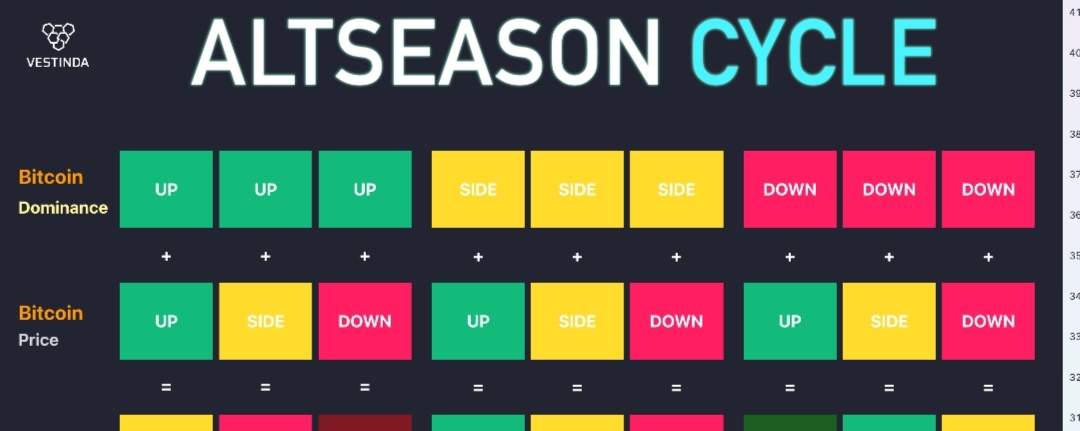

Altcoin season is one of the most exciting phases of the crypto market. It happens when a large number of altcoins begin outperforming Bitcoin, often producing stronger percentage gains as capital spreads across the market.
But a true altcoin season usually does not appear from nowhere. Several market conditions often need to line up before momentum can shift strongly toward smaller cryptocurrencies.
Bitcoin normally sets the stage first. A strong Bitcoin rally can bring new liquidity and attention into crypto. After BTC makes a significant move and begins consolidating, traders may start looking for higher-return opportunities elsewhere.
Bitcoin dominance is another important signal. It measures Bitcoin’s share of the total crypto market. If dominance starts declining while the overall crypto market remains strong, it can indicate that capital is rotating from Bitcoin into altcoins.
Ethereum can also play an important role. Historically, stronger ETH performance relative to BTC has sometimes accompanied broader interest in altcoins. If Ethereum begins gaining momentum, traders often become more confident exploring other Layer-1s, DeFi tokens and smaller projects.
Liquidity is the fuel behind an altcoin rally. Rising stablecoin activity, stronger spot trading volume and fresh capital entering crypto can create better conditions for a broad market expansion. Without enough liquidity, rallies may remain concentrated in only a handful of coins.
Market narratives matter too. AI, real-world assets, DeFi, Layer-1 networks, gaming and other sectors can attract capital at different stages of a cycle. Altcoin season does not necessarily mean every token rises together; money can rotate rapidly from one narrative to another.
Another factor is market confidence. When Bitcoin becomes less volatile and investors feel more comfortable taking risk, capital can move further down the risk curve. Large-cap altcoins may move first, followed by mid-cap and smaller projects if momentum continues.
However, traders should be careful when prices begin moving vertically. Altcoins can rise extremely quickly, but they can also correct much harder than Bitcoin. Chasing a coin simply because it is pumping can turn a profitable market into an expensive lesson.
The biggest signals to watch are therefore Bitcoin stability, falling BTC dominance, ETH strength, increasing liquidity and broader participation across altcoins. No single indicator confirms an altcoin season on its own.
The next altcoin season could create major opportunities, but the real question is not simply “When will altseason start?” It is “Is capital actually rotating into the wider crypto market?” When that rotation becomes broad and sustained, that is when things can get interesting.