
XRP is falling, but its biggest traders aren't behaving like they're giving up. Ethereum is telling a very different story — and that divergence could be more important than the daily price chart.
The cryptocurrency market is currently presenting investors with a puzzle.
Bitcoin is hovering around $64,800, XRP is near $1.05, and Ethereum is trading around $1,900. On the surface, all three remain under pressure compared with their earlier 2026 levels.
But beneath the prices, the behaviour of large holders is becoming increasingly interesting.
The latest on-chain data suggests that XRP whales are continuing to participate during the decline, while Ethereum has entered a much more uncomfortable position: its market price sits below the estimated realized price of its holder base.
That creates three very different market conditions.
XRP is being absorbed.
Ethereum is being capitulated.
Bitcoin is being defended.
The question is which of those conditions comes first to matter.
XRP's price is weak but whale activity isn't disappearing
XRP has fallen dramatically from the roughly $2.30–$2.40 area seen earlier this year to around $1.10.
Normally, a decline of that magnitude would raise concerns about large holders abandoning the asset.
The on-chain picture is more complicated.
CryptoQuant's spot average-order data has continued to show unusually large XRP transactions, suggesting that whales remain active in the market. Earlier analysis also found large-holder activity strengthening while retail participation remained comparatively cautious.
But there is an important distinction that investors should not miss:
Whale activity does not automatically mean whale accumulation.
Large orders can represent buying or selling.
What makes the current XRP setup interesting is the combination of continued large-order activity and a market that has not collapsed through the $1 area.
That looks more like supply being absorbed than a clean panic exit.
It is not proof that XRP is preparing for a breakout. But it does suggest that the market's largest participants have not simply walked away.
The real XRP question: who's absorbing whom?
This is where the story becomes deeper than simply saying “whales are buying the dip.”
A whale can buy because it believes an asset is cheap.
But a whale can also buy because it is providing liquidity while another large participant sells.
That is why price response matters.
If large XRP orders continue appearing while downside pressure weakens, the market may be moving through an absorption phase.
If price instead continues falling despite those large orders, the interpretation changes: whales may be providing liquidity to sellers rather than accumulating for a longer-term move.
That distinction will become clearer through spot volume, exchange flows, taker CVD and price reaction around major support levels.
And there is another piece of evidence worth watching.
U.S. XRP ETFs have attracted institutional capital even while XRP has remained significantly below its early-year highs. Recent reporting put cumulative ETF inflows at roughly $1.47 billion, showing that investment demand through regulated products has not simply disappeared alongside the price decline.
That creates an unusual market structure:
Institutional exposure can increase while the token price remains weak.
That is not necessarily bullish but it is certainly worth watching.
Ethereum has a completely different problem
Ethereum's story is more painful.
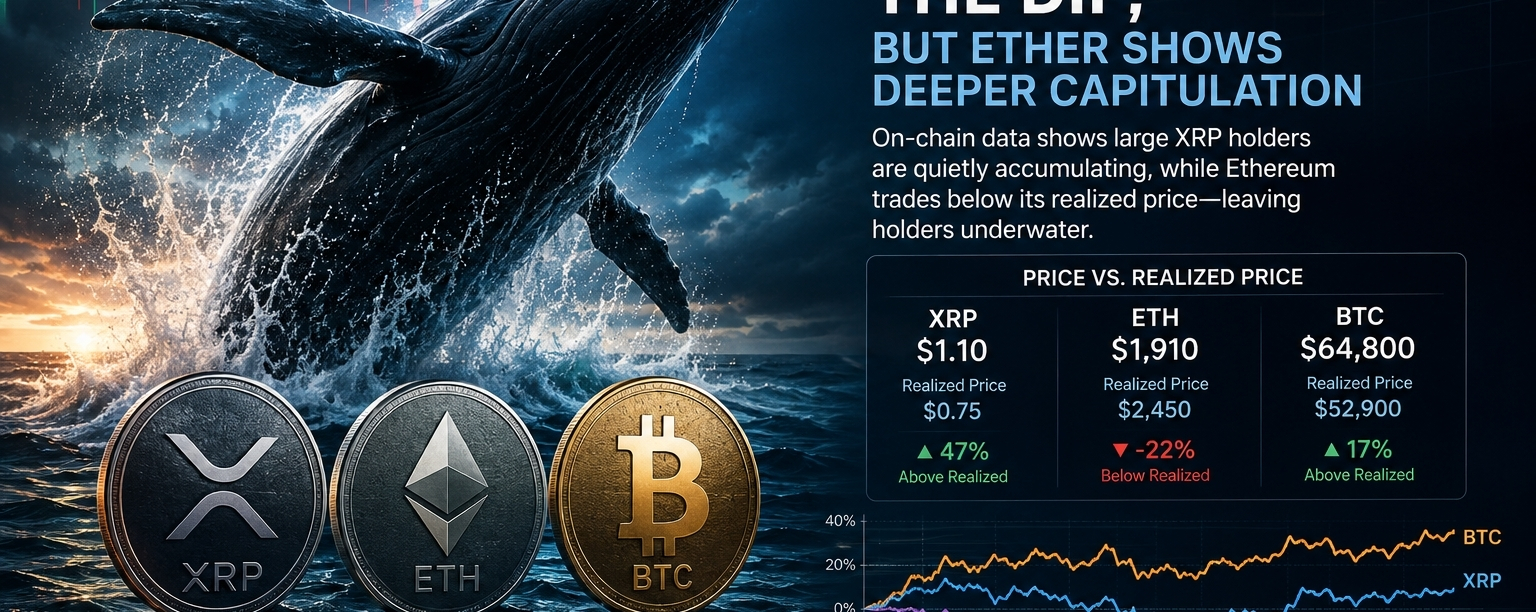
ETH is trading around $1,900, while its realized price is estimated near $2,450.
Realized price is not a traditional support or resistance level. It represents the volume-weighted average price at which circulating coins last moved on-chain. When market price falls below realized price, the aggregate holder base is considered to be sitting in unrealized loss.
That makes Ethereum's current position particularly significant.
Bitcoin, by comparison, remains well above its roughly $52,900 realized price.
XRP is also above its estimated realized value of roughly $0.75.
So among these three assets, ETH is the outlier.
It is the only one where the current market price is below the estimated aggregate cost basis of its holders
That is what makes the Ethereum setup simultaneously bearish and potentially interesting.
Capitulation can create opportunity but it doesn't call the bottom
This is where crypto narratives often become too simplistic.
“ETH is below realized price” does not mean Ethereum must immediately rally.
It means a significant portion of the holder base is underwater.
That can create two opposing forces.
The first is capitulation.
Investors who have lost confidence may finally decide that waiting for a recovery is no longer worthwhile. That can create additional selling pressure and potentially push price even further below realized value.
The second is valuation-driven accumulation.
Investors who believe the market has become excessively pessimistic can begin buying from those sellers.
The eventual bottom is created when the second force becomes stronger than the first.
That is why realized price should be treated as context, not a magic floor.
Ethereum's whale structure adds another layer
The distribution of ETH among large wallets is also changing.
The data supplied by CryptoQuant shows substantial growth among wallets holding 10,000–100,000 ETH, while the very largest holders have also rebuilt positions after falling sharply during 2025.
At the same time, the 1,000–10,000 ETH cohort has declined from its January peak.
That suggests Ethereum is not simply experiencing uniform selling.
Instead, ownership is being redistributed.
Some large holders appear to be increasing their exposure while another group has reduced theirs.
That matters because the identity of the marginal seller can influence what happens next.
If smaller whales are exiting into stronger hands, the decline can eventually become an accumulation event.
If larger holders are distributing into weaker demand, the market may have further to fall.
Again, the price reaction has to confirm the on-chain story.
Bitcoin is quietly telling the market something too
Bitcoin's position is less dramatic.
Large-holder balances, excluding exchange and mining-pool addresses, have recovered from their late 2025 lows and were reported around 3.06 million BTC, although still below the previous cycle peak.
The more important point is that Bitcoin remains above realized price.
That means its aggregate holder base is in a fundamentally different position from Ethereum's.
And that could help explain why BTC continues to behave as the market's relative safe haven within crypto while ETH and XRP fight their own battles.
Recent market data also shows Bitcoin stabilizing around the $64,000 area even as Ethereum's recovery remains weaker.
Three coins. Three different market stories.
The current structure can therefore be summarized in a much more useful way than simply ranking daily percentage gains.
🐋 XRP The Absorption Test
Large orders remain active and institutional demand has persisted, but the market has not yet converted that activity into a decisive breakout.
Bullish confirmation: accumulation accompanied by rising spot demand and a sustained break above resistance.
Warning: large orders continue while price keeps falling and exchange inflows accelerate.
🔥 Ethereum The Capitulation Test
ETH is trading below realized value, placing its holder base in a much deeper unrealized loss environment than BTC or XRP.
Bullish confirmation: selling exhaustion followed by sustained spot accumulation.
Warning: realized value losses deepen alongside increasing exchange deposits and forced selling.
🟠 Bitcoin The Resilience Test
BTC remains above realized price and continues to hold a significantly stronger cost-basis position than ETH.
Bullish confirmation: renewed institutional demand and a sustained move through resistance.
Warning: losing major support while whale balances begin contracting again.
The bigger story isn't whales. It's liquidity.
There is a temptation in crypto to treat whale wallets as an oracle.
They aren't.
Large holders can be wrong. Wallet movements can have multiple explanations. Exchange transfers can represent preparation for selling, custody changes, internal restructuring or other activity.
The more powerful signal comes when on-chain behaviour, spot demand, derivatives positioning, ETF flows and price structure all point in the same direction.
That is not happening decisively yet.
And that may be the most important conclusion from the current data.
XRP is showing evidence of absorption, but not yet a confirmed reversal.
Ethereum is showing deep valuation stress, but being underwater does not guarantee a bottom.
Bitcoin is showing relative resilience, but resilience must eventually translate into demand if the broader market is going to follow.
What could trigger the next major move?
The market is now approaching a point where several signals could collide.
For XRP, traders will be watching whether the accumulation narrative develops into genuine spot demand and whether the token can reclaim the levels that previously rejected the recovery.
For Ethereum, the critical question is whether below-realized-price trading attracts long-term buyers or instead becomes the starting point for another liquidation wave.
For Bitcoin, the test is whether institutional demand can overpower the persistent macro and liquidity headwinds that have kept crypto from fully participating in the broader risk rally.
The market does not need another headline.
It needs confirmation.
And if XRP's whales continue absorbing supply while Ethereum's capitulation begins to exhaust sellers, the next major crypto rotation may already be forming beneath the surface.
The whales may be moving first. The price chart just hasn't decided what their movements mean yet.