
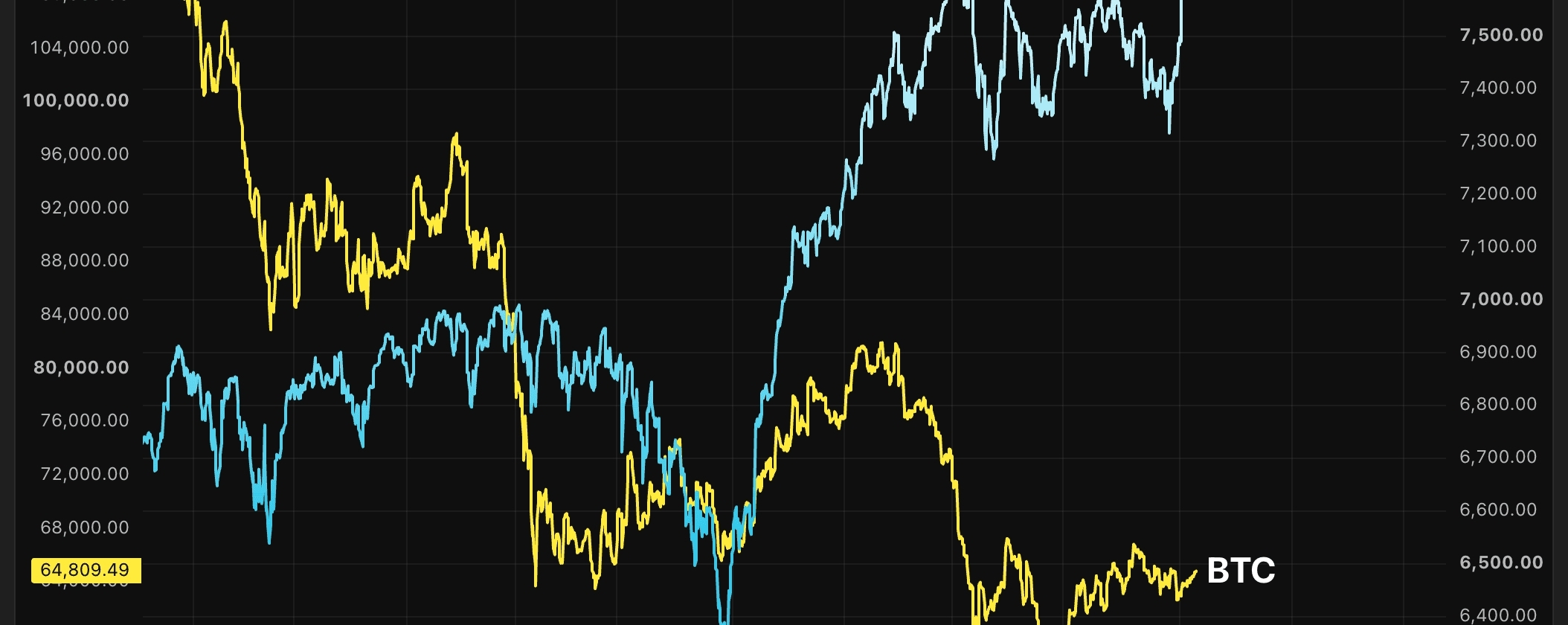
Bitcoin is struggling to keep pace with Wall Street, despite a powerful risk-on rally in U.S. equities. The divergence highlights a changing relationship between traditional markets and crypto — and raises questions about what Bitcoin needs to break higher.
U.S. stocks are having a strong August, but Bitcoin has largely refused to join the party.
The S&P 500 has climbed roughly 3.12% this month, adding an estimated $2.1 trillion to its market capitalization and pushing its total value to around $70.5 trillion. The Nasdaq and Dow Jones have also remained firmly supported.
Bitcoin, meanwhile, has gained only around 2% this month and continues to trade near the $64,000–$65,000 area.
That disconnect is notable because Bitcoin has increasingly traded alongside traditional risk assets since the 2020 market crash. Yet the latest stock-market rally appears to be driven by factors that do not necessarily translate into cryptocurrency demand.
AI Is Driving Stocks — But Not Bitcoin
One of the biggest reasons for the divergence is the composition of the equity rally.
The latest move higher in U.S. stocks has been heavily concentrated in artificial intelligence, semiconductor and mega-cap technology companies.
Those sectors have little direct exposure to Bitcoin.
As a result, investors can be aggressively buying equities without necessarily increasing their exposure to crypto.
The distinction matters. A broad-based improvement in global risk appetite could potentially lift stocks and Bitcoin together. But when capital is flowing specifically toward AI and semiconductor companies, the transmission into crypto becomes much weaker.
Falling Oil Prices Could Eventually Help Bitcoin
Another important development is the renewed decline in oil prices and expectations that energy markets could normalize as conditions around the Strait of Hormuz improve.
Lower oil prices are generally supportive of equities because they can reduce costs for businesses.
For Bitcoin, however, the impact is more indirect.
Lower energy prices could reduce inflationary pressure, potentially influencing expectations for Federal Reserve monetary policy. If markets eventually begin pricing in a less restrictive Fed, liquidity-sensitive assets such as Bitcoin could benefit.
But that process takes time.
For now, uncertainty surrounding the Federal Reserve's next moves continues to keep investors cautious.
Crypto Has Its Own Problems
Bitcoin's underperformance isn't entirely about stocks.
The cryptocurrency market is also dealing with several crypto-specific pressures.
Recent concerns include the reported $120 million Coldcard exploit, uncertainty surrounding the Clarity Act, and reports involving Strategy's Bitcoin holdings.
These developments have weighed on sentiment and contributed to a more cautious market environment.
At the same time, the supply of major stablecoins has declined.
USDT supply reportedly fell from approximately $190 billion in April to $183 billion, while USDC declined from roughly $79.5 billion to $72 billion.
That matters because stablecoins provide an important source of liquidity within crypto markets.
If investors can earn attractive real returns through traditional fixed-income markets, there is less incentive to keep capital sitting inside crypto.
Bitcoin's Four-Year Cycle Is Also Affecting Investor Behaviour
Perhaps one of the most interesting factors is the market's belief in Bitcoin's traditional four-year cycle.
Some traders now expect Bitcoin to experience a significant bottom around October.
That expectation itself may be influencing behaviour.
Rather than aggressively buying Bitcoin during the current stock-market rally, some traders appear to be waiting for a potential correction later in the year.
This creates a curious situation: the expectation of a future Bitcoin bottom could actually be helping prevent traders from positioning aggressively today.
But there is another interpretation.
Bitcoin has remained relatively resilient despite a still-hawkish Federal Reserve environment. If monetary policy becomes less restrictive than expected, the market may discover that Bitcoin's anticipated cycle bottom has already occurred.
ETF Demand Needs to Prove Itself
Institutional Bitcoin demand is another major piece of the puzzle.
U.S.-listed spot Bitcoin ETFs recently recorded an outflow of approximately $61.5 million, interrupting a weak period of inflows.
However, this week's ETF flows have reportedly turned positive, bringing in approximately $626 million the strongest weekly inflow figure since early May.
The question now is whether that demand can continue.
A few positive sessions are not enough to establish a new trend. Sustained ETF inflows would provide stronger evidence that institutional investors are returning to Bitcoin.
The Key Levels Traders Are Watching
Bitcoin is currently caught in a relatively narrow range.
Market observers are watching approximately $63,000–$63,400 as support, while $64,500–$66,000 represents an important resistance area.
A decisive move above the upper resistance zone could change the short-term market structure and potentially attract momentum buyers.
Conversely, a breakdown below the $63,000 region would reinforce concerns that Bitcoin remains vulnerable to another leg lower.
Bitcoin Needs Its Own Catalyst
The bigger story is that Bitcoin can no longer simply rely on Wall Street's strength to generate upside.
The S&P 500 has demonstrated that investors are willing to take risk — but that risk appetite is currently being directed toward AI, semiconductors and mega-cap equities rather than crypto.
Bitcoin therefore needs a catalyst of its own.
That could come from stronger ETF inflows, improving liquidity, regulatory clarity, stablecoin growth, easier monetary policy or renewed institutional demand.
Until then, Bitcoin's inability to follow a surging S&P 500 suggests that the crypto market is still waiting for its next major narrative.
The Bottom Line
The current divergence does not necessarily mean Bitcoin is permanently disconnected from stocks.
Instead, it shows that not every risk-on rally is created equally.
Wall Street can add trillions in value while Bitcoin remains trapped below $65,000 when the money is concentrated in sectors with little direct connection to crypto.
For Bitcoin, the next major move may therefore depend less on whether stocks continue higher and more on whether crypto-specific liquidity and institutional demand return with enough force to break the current range.
Bitcoin is not necessarily being left behind. The market may simply be waiting for its own reason to move.