
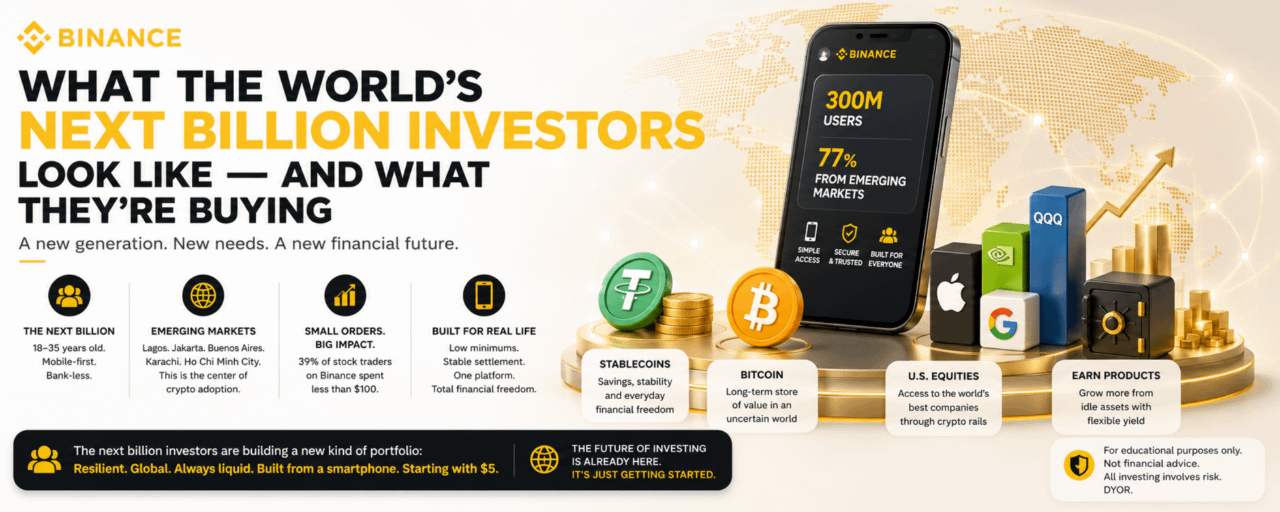
The financial industry has spent decades imagining the next major wave of investor adoption as coming from developed markets — more Americans opening brokerage accounts, more Europeans diversifying into alternatives, more Japanese savers moving out of cash. That picture is wrong. The next billion investors are already here, and they are not where traditional finance expected them to be.
Who They Are
They are in Lagos, Jakarta, Buenos Aires, Karachi, and Ho Chi Minh City. They are between 18 and 35 years old. They own a smartphone before they own a bank account. Many of them live in economies where the local currency has lost significant value within their lifetime — not as an abstract economic concept, but as a lived experience of watching savings erode.
77% of Binance's 300 million users are from emerging markets across Southeast Asia, Africa, and Latin America. That is not a demographic footnote. That is the center of gravity of global crypto adoption — and it tells you something important about what these users need from financial products.
They are not looking for the 11th brokerage app or the fourth robo-advisor. They are looking for a stable store of value, a way to send money across borders without losing 6% in fees, and access to investment opportunities that their local financial infrastructure has never made available to them.
What They Are Actually Buying
Stablecoins — first.
The dominant asset class for the next billion investors is not bitcoin. It is dollar-denominated stablecoins. In markets with persistent inflation — Argentina, Nigeria, Turkey, Egypt — stablecoins function as a practical savings tool. They give users access to dollar stability without requiring a U.S. bank account. On Binance, stablecoin holders now make up 28% of users with balances above $10, up from just 4% in 2020. In emerging markets specifically, that figure rises to 36%.
Brazil's crypto market illustrates the pattern clearly. Stablecoins account for up to 90% of the country's total crypto volume — driven not by speculation, but by demand for a currency that holds its value.
Bitcoin and major assets — as savings, not speculation.
When these users do buy bitcoin, they are frequently buying it the way a previous generation bought gold: as a hedge against local currency risk, held for the long term rather than traded actively. The average order size on Binance Stocks in its first week was below $100 for 39% of users — a pattern that repeats across crypto: small, regular purchases building a portfolio over time, not large speculative positions.
U.S. equities — through crypto rails.
The launch of Binance Stocks in June 2026 revealed something important about the demand profile of this user base: given accessible entry points, they buy the same assets as wealthy Western investors. NVDA, AAPL, GOOGL, QQQ — the top names traded in the first week reflected genuine portfolio-building intent. 25% of users who traded stocks in the first week were under 25 years old. These are not investors who discovered markets through a brokerage — they discovered them through crypto.
How They Are Onboarding
The mobile-first assumption is not just accurate — it is foundational. The next billion investors are not sitting at desktop trading terminals. They are using smartphones, often with variable internet connectivity, frequently in markets where English is not the primary language.
Products that work for this user base share several characteristics:
Low or zero minimums — the $5 fractional share threshold on Binance Stocks is a design decision, not a marketing choice. It reflects the actual capital available to the median new investor in emerging markets.
Stable settlement currencies — funding stock purchases with USDT rather than requiring a bank wire eliminates the single biggest friction point for cross-border investing.
Single-platform access — the next billion investors will not manage five separate accounts. They will manage one. The exchange that contains spot trading, earn products, stablecoin savings, payment rails, and equity access wins the relationship.
Trust signals that translate locally — Proof of Reserves, security ratings, and regulatory credentials matter to users who are making a significant financial decision relative to their income.
What Their Behavior Reveals About the Future
The next billion investors are not a scaled-down version of existing Western investors. They are a different investor archetype entirely — one that has been shaped by inflation, currency volatility, limited banking access, and mobile-native financial habits.
What they are building is not a portfolio that mirrors a Western retirement account. It is a portfolio designed for resilience: stablecoins for savings, bitcoin for long-term value storage, U.S. equities for growth exposure, and earn products for yield on idle assets. It is a diversified, globally exposed, always-liquid portfolio — built from a smartphone, starting with $5.
That portfolio architecture will eventually influence how wealthier investors think about asset allocation too. The financial behaviors being pioneered in Lagos and Jakarta today have a way of looking prescient in a decade.
The next billion are not waiting for traditional finance to include them. They already found another way in.
Disclaimer: This article is for educational purposes only and does not constitute financial advice. All trading and investment activities involve risk. Please conduct your own research before making any decisions.