
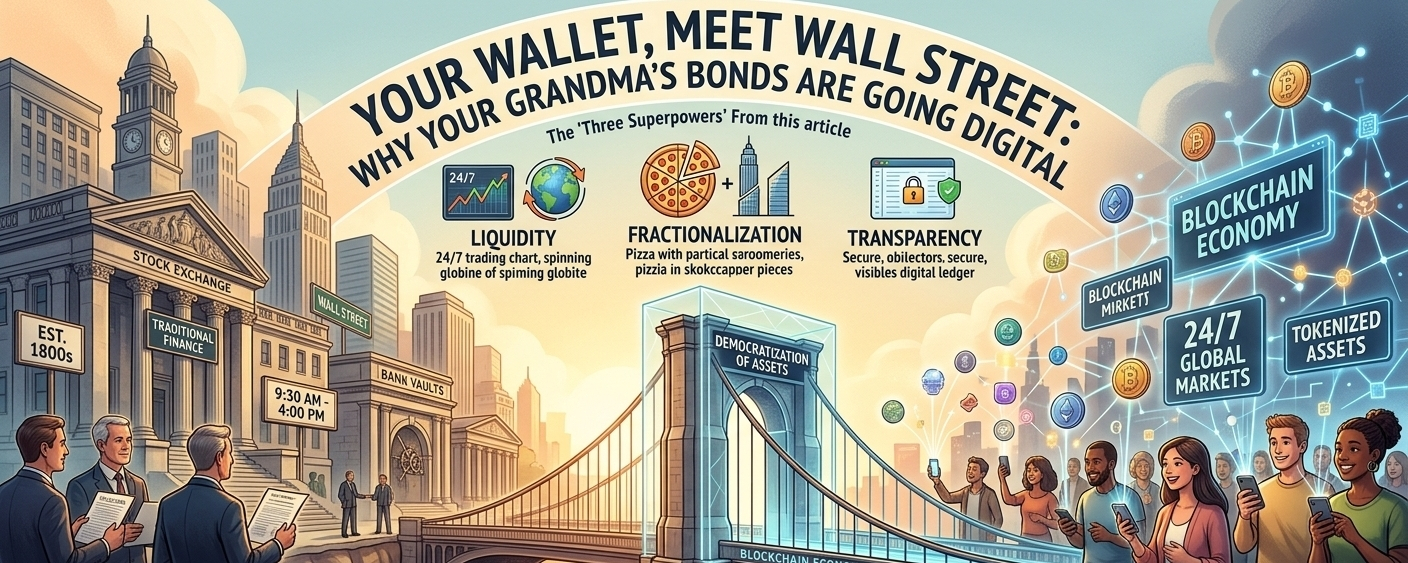

Imagine buying a slice of a Manhattan skyscraper the same way you buy a coffee with a tap on your phone. Imagine earning interest on a corporate loan to a Nigerian farmer while sitting in your pajamas. Imagine trading a share of Tesla at 3 AM on a Sunday.
This isn’t sci-fi. This is Real-World Assets (RWA) on the blockchain. And it is quietly doing to finance what Spotify did to CDs: making the old, clunky, and exclusive, new, fluid, and for everyone.
The "Old World" Problem
Right now, the financial system is a castle with a moat. To invest in a private credit fund, you need a net worth of over $1million. To buy a commercial real estate property, you need millions in cash and a team of lawyers. To trade bonds, you need a brokerage account that only operates 9:30 AM to 4:00 PM, Monday through Friday.
This system is illiquid (you can’t sell that building quickly), fragmented (your money is stuck in one country), and exclusive (it favors the rich).
Enter the Token
Think of a "token" as a digital deed. Instead of a piece of paper stored in a vault, this deed lives on a public, secure digital ledger (the blockchain).
Here is the magic: We can take that skyscraper, that corporate bond, or that government treasury bill, and "tokenize" it. We chop it into a million tiny digital pieces. Now, instead of needing $5 million to buy the whole building, you can buy $50 worth of it.
The Three Superpowers of RWA
1. Liquidity (The 24/7 Garage Sale)
In the old world, if you own a private bond and need cash before it matures, you’re stuck. In the new world, you list your token on a global exchange. A buyer in Tokyo can purchase it while you sleep in New York. Markets never close. Assets that used to take months to sell can now be traded in seconds.
2. Fractionalization (The Pizza Slice)
High-value assets are no longer "all or nothing." Want a slice of a US Treasury bill yielding 5%? Buy $100 worth. Want exposure to a private tech company's debt? Buy $500 worth. This opens the door for the retail investor—the everyday person—to access institutional-grade investments that were previously locked behind a velvet rope.
3. Transparency (The Unbreakable Receipt)
Blockchain doesn’t lie. Every transfer, every dividend payment, and every ownership record is visible on a public ledger. For the first time, you can actually see if the borrower is paying back the loan in real-time. This reduces fraud and builds trust in a system that has historically been opaque.
The Big Four: Where the Money is Flowing
Institutional giants like BlackRock and Franklin Templeton aren't ignoring this; they are leading it. Here is the breakdown of where billions are moving:
· Tokenized Treasuries (The "Risk-Free" Yield): This is the biggest winner so far. Instead of buying a US government bond through a bank, you buy a token that represents that bond. You earn 4-5% yield, but you can sell it instantly, any time of day. It’s like a savings account that actually pays interest, but with the speed of Venmo.
· Private Credit (The New Bank): Instead of a bank loaning money to a medium-sized business, a pool of investors (that's you) funds the loan via blockchain. The business gets money faster; you get interest rates (often 8-12%) that dwarf traditional savings accounts. Platforms are already facilitating billions in these loans.
· Real Estate (The Digital Landlord): Commercial properties are being turned into tokens. Investors earn rental income directly deposited into their wallets. No middleman property manager taking a 10% cut. Just pure, transparent rent collection.
· Stocks & Commodities: Tokenized Apple or Google shares exist now. You can trade them alongside crypto, instantly. Even gold is being tokenized, giving you the safety of precious metals with the ease of a crypto transaction.
The Elephant in the Room: "Is This Legal?"
Yes, and that is precisely why it is exciting. The big players aren't anarchists; they are regulators. The leading RWA projects work with the SEC and EU regulators. They use licensed custodians to hold the physical asset. The token is just the "receipt" for the real thing. Compliance is built into the code—meaning the token can be programmed to only trade with verified investors, keeping the regulators happy.
What This Means for You
You are no longer a spectator in the global economy.
· You can hedge inflation by earning yield on stable, safe assets like Treasuries.
· You can diversify by owning a piece of a real estate market in Dubai while living in Kansas.
· You can earn passive income from corporate loans that used to be reserved for hedge funds.
The pendulum is swinging. For decades, the financial system said, "You aren't wealthy enough to play." RWA says, "Bring your wallet."
The Final Takeaway
We are living through the "democratization of everything." Real-World Assets are the bridge between the volatile world of crypto and the stable, massive world of traditional finance. It is the best of both worlds: the safety and yield of Wall Street, combined with the speed, transparency, and 24/7 accessibility of the internet.
The skyscraper is now in your pocket. The bond is now in your phone. The question isn't if this will happen it's already happening. The question is: Are you ready to buy your slice?

$MKR
$CFG