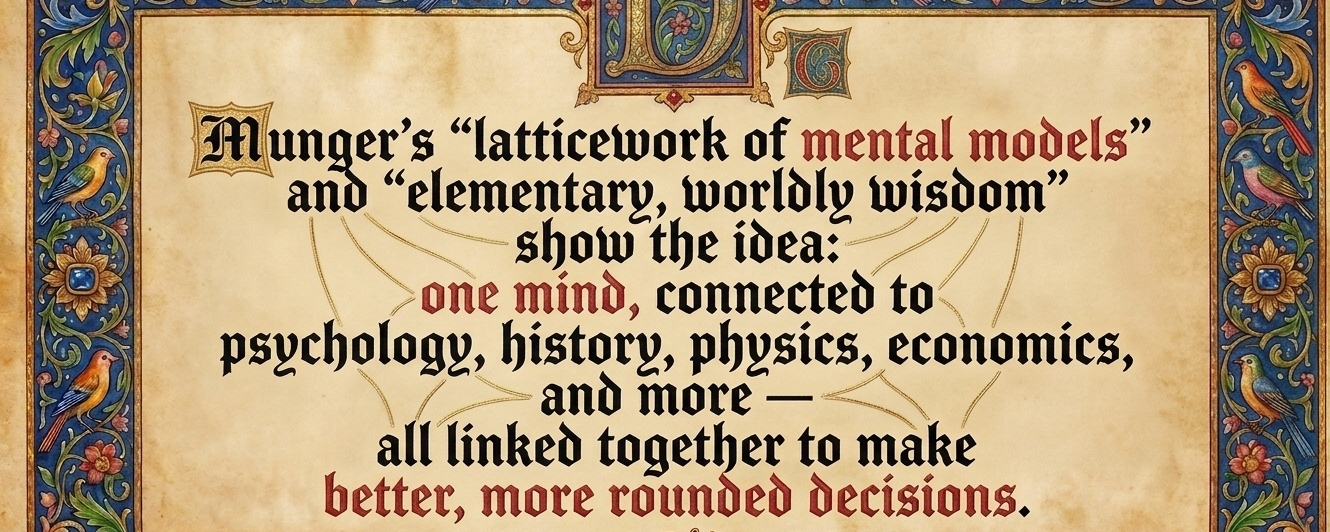
The Core Idea
Munger didn’t chase complex theories. He wanted simple, useful truths from different fields that actually work in real life.
Elementary = basic, first-principles.
Worldly = from the real world, not just textbooks.
Wisdom = knowing which ones matter and how to use them.
How He Built It: The Latticework of Mental Models
Instead of knowing a lot about one thing, Munger studied a little about a lot of things — and connected them.
His 3 main inputs:
1. Psychology → How humans misjudge, get biased, and make dumb decisions
2. History → What patterns repeat when companies, countries, or people succeed/fail
3. Physics→ How systems, leverage, and cause-effect actually work
He then combined them into a latticework — like a mental toolbox. So when faced with a problem, he’d pull 3-4 models from different disciplines and see where they all point.
Example: Investing in a company
- Psychology: Are people being overconfident?
- Economics: What are the incentives?
- Biology: Does this business have a “moat” like an ecosystem?
His Favorite Tool: INVERSION
Munger’s go-to method.
Normal thinking: “How do I succeed?”
Inversion: “How do I fail? Okay, now don’t do that.”
Why it works:
Problems are usually easier to solve backward. It’s easier to list all the ways to ruin your marriage, health, business, or investments... then avoid those.
Munger quote: “It is remarkable how much you can learn by thinking things through backward.”
Examples of Inversion:
- Want to be a good investor? First list: Don’t be greedy, don’t use leverage, don’t invest in what you don’t understand.
- Want a great career? First list: Don’t be unreliable, don’t burn bridges, don’t stop learning.
The Payoff
Most people try to add more knowledge. Munger tried to remove stupidity.
He believed if you avoid the big mistakes, the big wins take care of themselves.
In one line:
Success is less about being brilliant and more about consistently avoiding the obvious errors.