
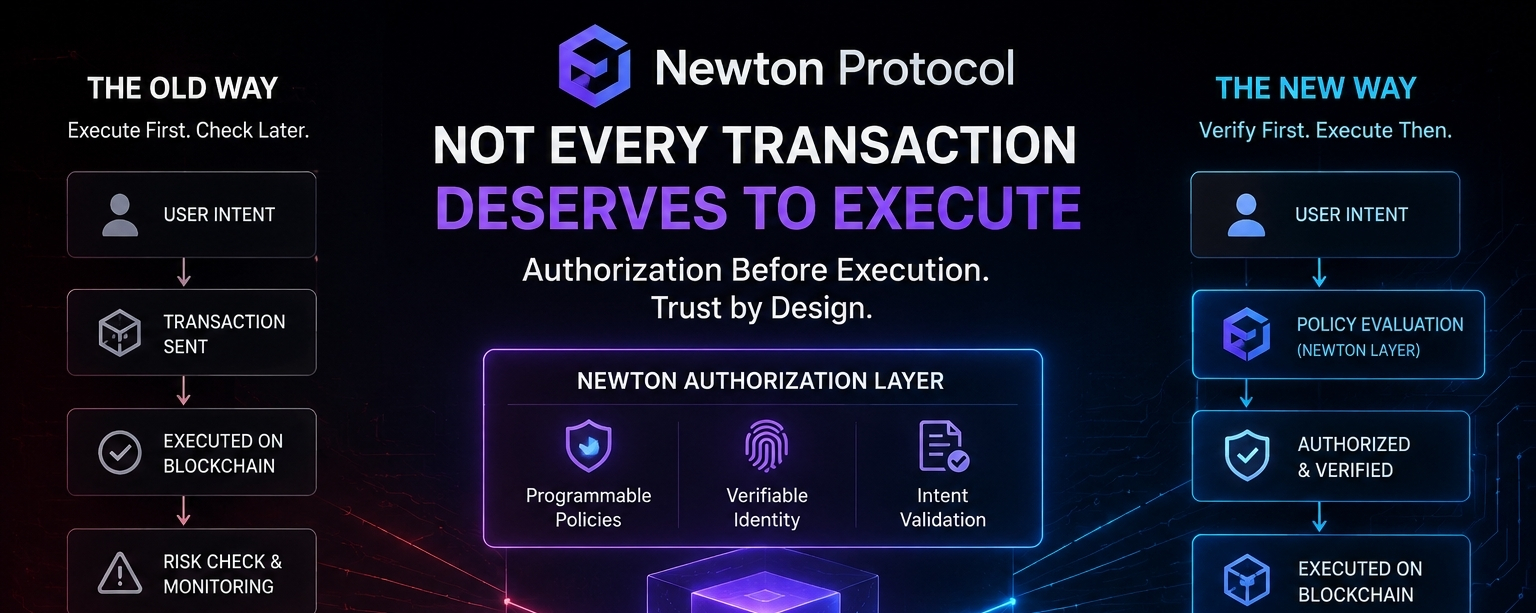

When Trust Moves Before the Transaction Why Newton Protocol Feels Different
Most AI and automation projects in crypto promise the same thing fewer clicks faster execution and less manual work.
When I first started reading about @NewtonProtocol I expected a similar narrative. Instead what stood out was not speed it was permission.
Newton is not simply trying to automate blockchain activity. It's introducing a framework that asks an important question before anything happens on-chain:
Should this action be allowed to happen at all?
That idea changes how I think about trust in decentralized systems.
For years, automation has largely meant handing an appliCation access to your assets and hoping it behaves as expected. A trading bot executes. A strategy runs. A vault rebalances. Only after everything settles do users discover whether the decision was actually the right one.
Newton approaches this differently.
Instead of allowing an AI agent or application to execute immediately every transaction intent can pass through programmable authorization policies before reaching the blockchain. The goal isn't just automation it is verifiable decision making.
What I find most interesting is that Newton keeps one piece of friction that many platforms try to eliminate.
The pause.
Rather than removing every checkpoint the protocol moves that checkpoint into infrastructure. Policies evaluate whether an action satisfies predefined rules before settlement, allowing verification to happen before value moves instead of after.
It's a subtle design choice but an important one.
The hesitation that once belonged to the user becomes part of the protocol itself.
That doesn't eliminate trust it restructures it.
Another aspect that caught my attention is how Newton treats identity within its network. Developers register their models operators stake to participate and authorization depends on predefined policies instead of blind execution.Not every autonomous action receives equal trust.Insteadbtrust becomes something that i learned verified and visible.
As AI agents become capable of managing wallets, treasury operations, payments, and investment strategies, this distinction could become increasingly important.
Speed alone won't be enough.
Automation without verification simply shifts risk somewhere else.What matters is whether automated decisions can be evaluated before they become irreversible.
That is why I think @NewtonProtocol is contributing something larger than another AI product or another blockchain.it is? building infrastructure where permission becomes programmable authorization becomes verifiable and trust becomes part of execution itself.
What stood out to me about Newton is that it treats authorization as something far bigger than a feature inside a single application. Every onchain protocol eventually faces the same question before assets move Should this transaction be allowed? Yet today most projects still build their own permission logic policy engines and authorization workflows from scratch.
The question I keep returning to is not whether AI agents will become more capable.It's whether we'll trust them more because they are smarter or because the infrastructure surrounding them makes every decision transparent verifiable and accountable.
That may ultimately be the difference between automation people experiment with and automation they rely on every day.
$NVDAB $NEWT #Newt #BinanceTurns9 #JuneCPIFedHike20% #USJuneCPIEasesTo3.8% #ChinaGoldJewelryPriceFallsToCNY1215PerGram