
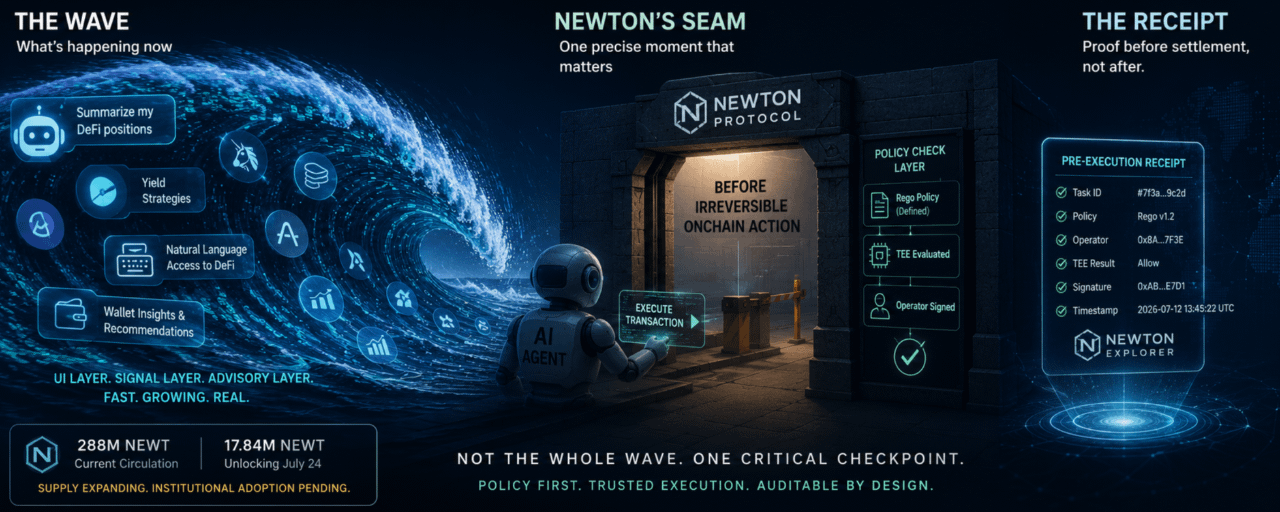
The topic assumes a wave and asks where Newton fits inside it. That framing is probably what made me slow down. Newton Protocol, $NEWT , #Newt , @NewtonProtocol gets positioned as infrastructure for the AI-meets-Web3 moment — and the marketing leans into that hard. But the more time I spent in the actual protocol mechanics, the more I noticed the wave and the product are moving at different speeds, in slightly different directions.
The AI-Web3 convergence happening right now is mostly UI and signal layer. LLMs summarizing transactions, generating yield strategies, providing natural language access to DeFi protocols, reading wallet history and making suggestions. That's real and it's accelerating. Newton doesn't touch any of it. Newton's actual position is narrower and more specific: it sits at the moment an autonomous agent needs to commit an irreversible onchain action, and someone with institutional or regulatory standing needs proof the action was authorized before settlement, not discovered after. The Newton Explorer at explorer.newt.foundation/mainnet makes that pre-execution receipt publicly queryable per task — operator signed, TEE-evaluated, Rego policy specified. That's not AI-Web3 convergence broadly. That's one very precise seam inside it.
The design choice that clarified this: Newton's policy language is Rego, not a custom DSL, not a smart contract extension. Rego is what enterprise compliance teams already use for access control inside traditional infrastructure. The implied user isn't a crypto-native AI agent developer. It's a team that already runs policy-as-code internally, now extending that same logic to cover their onchain exposure. With 288M NEWT in current circulation and another 17.84M unlocking July 24 across stakeholder categories, the token supply is expanding into an ecosystem that hasn't yet produced the institutional integrations the token's utility depends on.
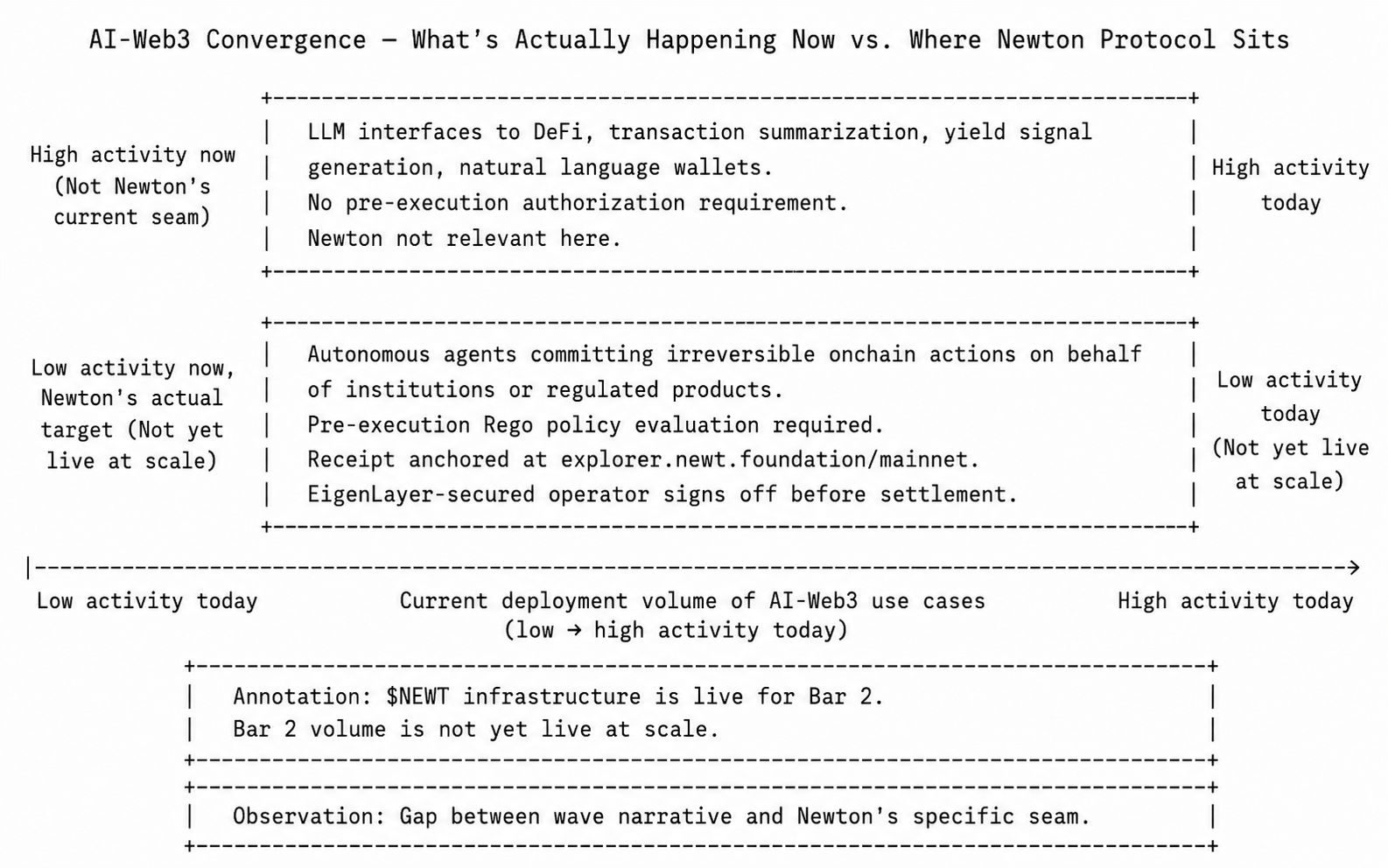
The quiet thing I kept returning to is how much of the convergence narrative flattens the actual timing problem. AI agents capable of making high-stakes autonomous onchain decisions — the ones where a pre-execution receipt genuinely matters — are not the majority of what's being deployed right now. Most live agent activity is still advisory or single-step. The use case Newton is built for may be arriving, but it's arriving slower than the infrastructure positioning suggests.
That gap between the wave's current form and the specific seam Newton occupies is worth sitting with. The protocol is coherent. The moment it's designed for is real. Whether the convergence story gets specific enough, fast enough, to meet it — that's the part that remains genuinely open.