
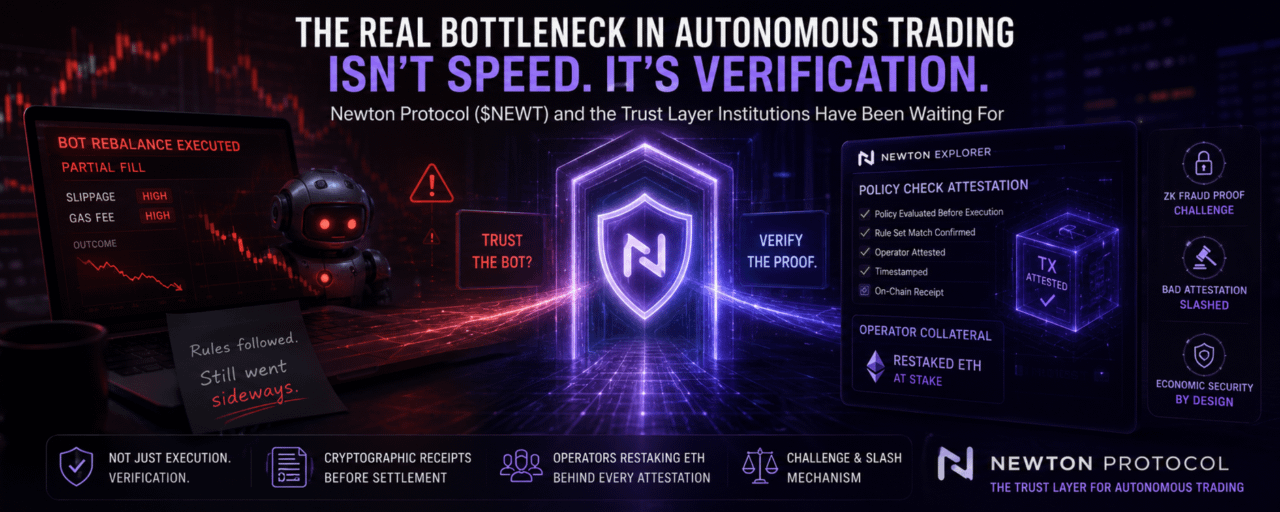
Had a weird morning. Opened my terminal to check a few positions, saw a bot had partially executed a rebalance I'd set up — did exactly what I told it to do, technically — but I hadn't accounted for the gas conditions at that hour and the slippage was worse than if I'd just done it manually. Classic automation problem. You set the rules, the machine follows them perfectly, and somehow it still goes sideways. I ended up closing the laptop and just... thinking about that for a while. Out of nowhere I found myself back inside Newton Protocol's ($NEWT ) documentation. Not for any specific reason. Just that morning's frustration sitting in the background. And then something clicked that I haven't been able to put down since.
Here's the assumption almost everyone makes about autonomous trading networks: the infrastructure problem is speed. Throughput. Execution latency. If AI agents are going to run trading strategies onchain, the thinking goes, you need rails that are fast enough to keep up. That's not wrong. But it's also not the actual bottleneck. The real bottleneck — the one that keeps institutions from putting real capital behind autonomous agents — is verification. Not "can the agent execute fast enough" but "can anyone prove the agent only did what it was authorized to do." That's the problem #NewtonProtocol is actually solving. And almost nobody is framing it that way. When an autonomous trading agent executes through Newton, the policy check isn't just a guardrail. It produces a signed, timestamped cryptographic receipt — logged to Newton Explorer — that proves the transaction was evaluated against a specific rule set before it settled. Not after. Before. And the operators signing off on that evaluation have restaked ETH as collateral behind every attestation. Per the authorization layer breakdown @newton_xyz published last week, anyone can challenge a bad attestation during the dispute window using a ZK fraud proof, and the operator gets slashed. So the security model isn't "trust the infrastructure." It's "verify the infrastructure, and penalize it economically if it lies." I thought the interesting part of Newton was the TEE execution. Turns out the interesting part is what happens when an operator gets it wrong.
Here's why that distinction matters for trading specifically. An autonomous trading network without verification is just... a more convenient way to get rekt by your own bot. Institutions know this. The reason most serious capital stays away from onchain automation isn't regulatory — it's epistemic. There's no way to prove after the fact that an AI agent acted within bounds, because the only record is the transaction itself. Not the decision. Not the policy evaluation. Just the outcome. Newton generates the decision record. That's the piece that was missing.
But here's the part that bothers me, and I've been sitting with it all afternoon. The verification infrastructure is live. Operators are running. Policy receipts are being generated. But the autonomous trading agents that would actually use this — the ones that would make the verification layer matter at scale — are still sitting in the roadmap. The Model Registry where developers publish agent strategies isn't live. The zkPermissions rollup that enforces spending rules cross-chain isn't live. So Newton has built the compliance record-keeping system for a trading network that doesn't fully exist yet. That's either brilliant positioning — get the trust layer in place before the agents arrive so there's no adoption friction — or it's a timing problem dressed up as a strategy. And I genuinely can't tell which one it is right now. The operator count is thin. Mainnet beta is weeks old. A slashing mechanism only works as a deterrent when there's enough collateral at stake to actually hurt. Early on, that's more theory than practice.
What I keep coming back to is this: if you accept that verification is the real bottleneck for autonomous trading — not speed, not throughput, but proof — then the entity that owns the verification layer owns something genuinely scarce. You can build faster execution rails. You cannot easily replicate a collateralized, decentralized operator network that produces audit-grade receipts at the transaction level. That's a durable position if the agent economy arrives. It's an expensive waiting room if it doesn't. $NEWT is trading at a fraction of its all-time high. The market is clearly pricing uncertainty, not certainty. Which is probably the right call for now. Anyway. My bot finished the rebalance while I was writing this. Slippage was fine this time. Maybe I just needed better conditions, not better infrastructure. Or maybe that's exactly the kind of thing a well-designed policy could have caught before it executed. $NEWT #Newt @NewtonProtocol