
I’ve spent enough months in crypto to know that infrastructure usually matters most when nobody is talking about it. When a protocol operates seamlessly, abstracting away its underlying complexity, the market tends to take it for granted. That exact thought stayed with me while I closely looked into Newton Protocol recently. In the current market cycle, there is an overwhelming amount of noise surrounding automated intelligence, algorithmic strategies and AI-driven yield generation. However, the deeply overlooked point in this entire narrative is that AI-driven strategies will only gain lasting, institutional grade acceptance if their execution environment is just as trustworthy as their analytical outputs.
We have entered an era where strong predictions alone do not create confidence. It is easy to market a black-box model that boasts impressive predictive accuracy or optimized trading signals on paper.
But sophisticated market participants understand that high-quality outputs mean absolutely nothing when users cannot verify the actual environment producing them.
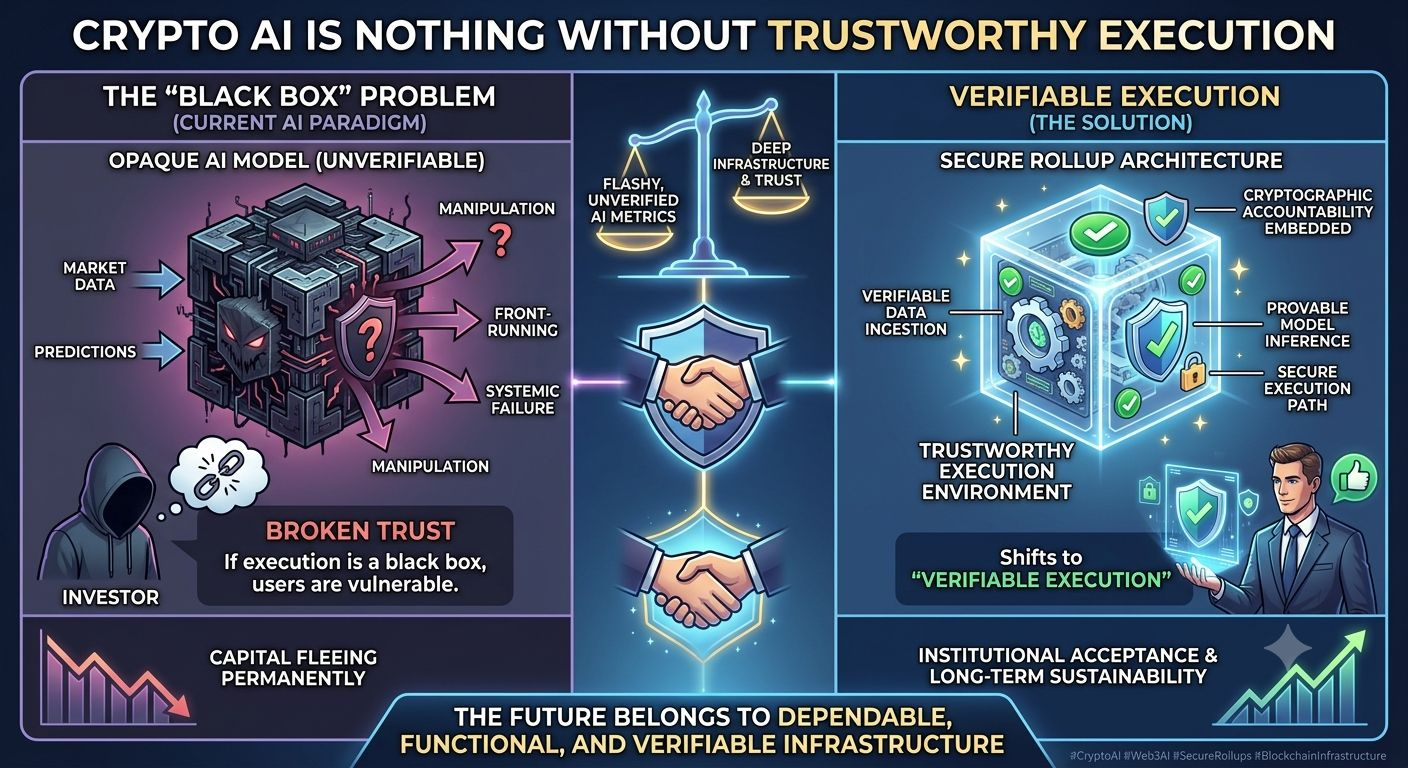
If the underlying data ingestion, model inference or execution path is opaque, the system remains vulnerable to manipulation, signal front-running and systemic failure. This is precisely where the architecture of a secure rollup becomes revolutionary.
A secure rollup addresses this deeper architectural concern by embedding cryptographic accountability directly into the underlying system instead of treating it as a marketing afterthought. It shifts the paradigm from "blind trust" to "verifiable execution."
Throughout my time observing market microstructure, execution quality and various protocol cycles, I have seen markets recover from poor performance much more easily than from broken trust.
If a trading strategy faces a drawdown due to unexpected market volatility, capital is patient enough to wait for a structural recovery. But if the infrastructure itself is exposed as a black box that lacks verifiable integrity, capital flees permanently. Trust is the rarest liquidity pair in Web3, and once it is drained, it cannot be bought back.
Of course, the major trade-off here is that building stronger verification layers and provable execution environments inherently increases technical complexity. In the early stages, this added friction inevitably slows down mass adoption. It requires deeper research, more rigorous testing and a willingness to forgo immediate, flashy user metrics in favor of long-term structural integrity. This delicate balance between speed and security is rarely exciting to speculative retail markets, but it is usually necessary for building sustainable sovereign infrastructure.
In the long run, dependable, functional and verifiable infrastructure will shape the trajectory of crypto far more than increasingly sophisticated, yet completely unverifiable, automation. The future does not belong to the loudest protocols, but to the ones that make their complex security layers completely invisible and inherently bulletproof.
As we look at the next phase of decentralized applications, we must ask ourselves which side of the ledger we want to be on. Are we chasing the short-term premium of flashy, unverified AI metrics or are we allocating attention to the quiet, foundational layers that ensure execution privacy and cryptographic truth?
@NewtonProtocol $NEWT #Newt #Labs #EVAA #MYX #CryptoInfrastructure #Web3AI #SecureRollups