
I've been in crypto long enough to watch mediocre technology attract millions of users.
I've also watched genuinely brilliant systems slowly disappear because almost nobody built on them.
At some point, you stop asking which protocol has the better architecture.
You start asking a far more uncomfortable question.
What if the market simply doesn't want what you're building?
That thought kept coming back to me while I was reading about Newton Mainnet Beta.
At first, it looked like a familiar milestone.
Another protocol moving from whitepapers into production.
Another infrastructure team shipping developer tools, documentation, and a vision for the future.
Crypto has seen this story hundreds of times.
But the more I thought about it, the more I realized something.
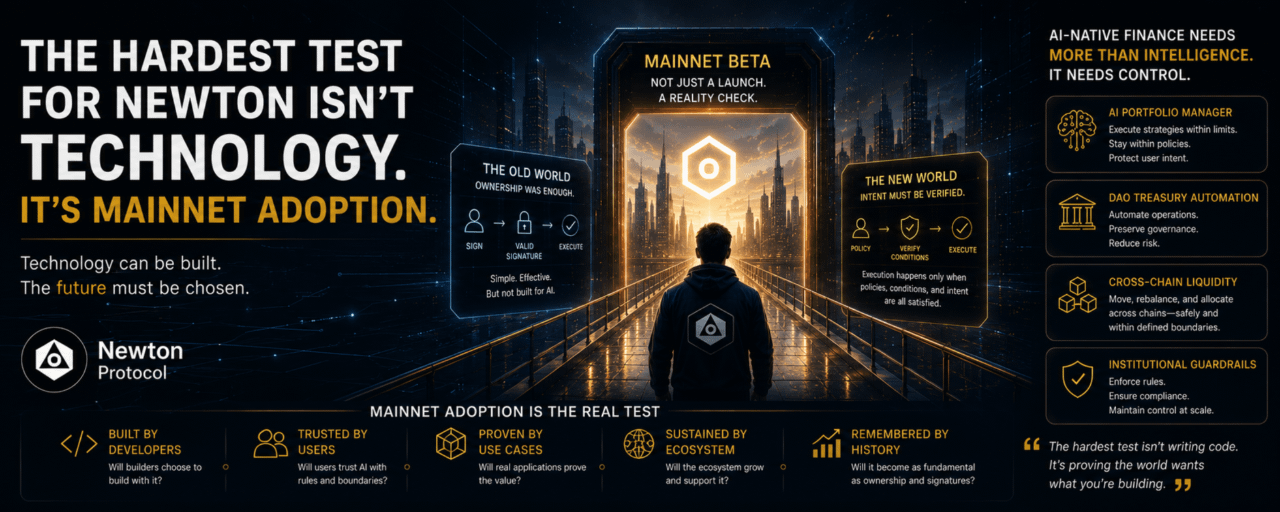
Mainnet Beta isn't really testing Newton's technology.
The architecture already exists.
The code already runs.
The documentation already explains how the system is supposed to work.
What Mainnet Beta is actually testing is something much harder.
It's testing whether Newton's assumptions about the future are correct.
Because Newton is built on a very specific belief.
It assumes that AI won't remain a passive assistant.
It assumes that software will eventually manage wallets, rebalance portfolios, coordinate liquidity, execute transactions, and make increasingly important financial decisions on behalf of humans.
More importantly, it assumes that existing blockchain infrastructure isn't designed for that world.
That's a bold assumption.
And bold assumptions are exactly what markets tend to challenge.
For most of crypto's history, ownership was enough.
If a wallet signed a transaction, the network accepted it.
Simple.
Elegant.
And surprisingly effective.
But autonomous systems complicate that model.
An AI agent can make thousands of decisions without ever becoming tired. It can monitor markets twenty-four hours a day. It can coordinate actions across multiple protocols and multiple chains.
At that point, a signature stops answering the most important question.
The problem is no longer:
"Can this transaction happen?"
The problem becomes:
"Should this transaction happen?"
Newton's answer is programmable authorization.
Policies.
Behavioral boundaries.
Execution rules.
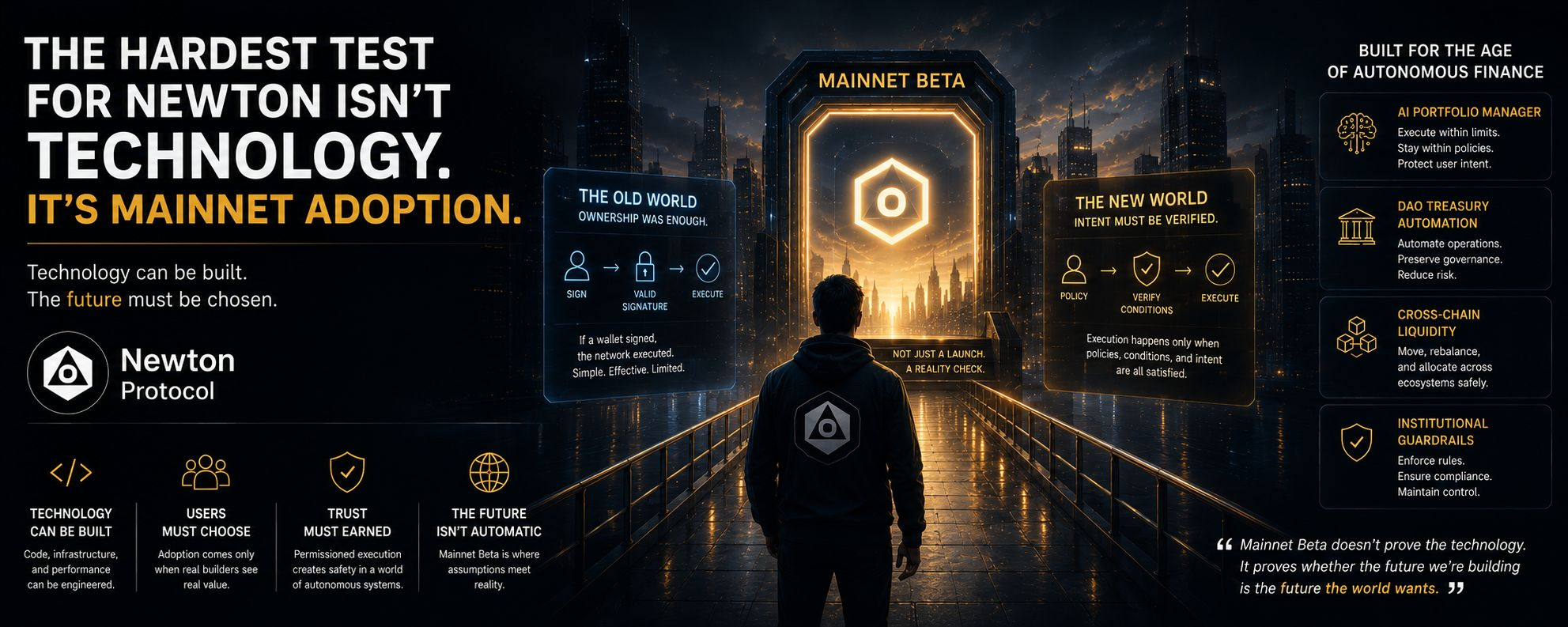
An attempt to embed governance directly into the transaction flow instead of treating governance as something external.
Conceptually, I think it makes a lot of sense.
But crypto history has made me suspicious of ideas that make sense too early.
Because technology doesn't win simply because it's correct.
Sometimes it wins because timing is right.
And sometimes it loses because reality arrives more slowly than expected.
That's why I think Mainnet Beta matters so much.
Not because it proves Newton works.
But because it forces Newton's assumptions to collide with reality.
Imagine you're building an AI-native financial application.
You already have access to increasingly powerful models.
You already have wallets.
You already have smart contracts.
You already have oracle networks.
Now someone asks you to integrate an additional authorization layer.
Your first reaction probably isn't philosophical.
It's practical.
You ask yourself:
"Does this solve a problem painful enough to justify the added complexity?"
That question, more than any benchmark or throughput metric, will determine Newton's future.
Because developers are pragmatic.
They don't adopt infrastructure because it's intellectually elegant.
They adopt infrastructure because it unlocks products they couldn't reasonably build before.
If programmable authorization allows entirely new categories of applications to emerge, adoption will follow.
If it merely adds friction, the market will move on.
That's the brutal honesty of infrastructure.
Whitepapers rarely fail.
Conference presentations rarely fail.
Architecture diagrams rarely fail.
Mainnets fail.
Because mainnets meet developers.
They meet users.
They meet edge cases.
They meet competing priorities.
They meet deadlines.
And that's where technical assumptions become economic reality.
One thing I find particularly interesting is that Newton isn't trying to compete in the race to build the smartest AI.
That race is already crowded.
OpenAI, Anthropic, Google, and countless startups are pushing intelligence forward at extraordinary speed.
Newton is making a different bet.
It is betting that intelligence alone won't be enough.
That sooner or later, autonomous systems will require constraints, permissions, and verifiable rules before people trust them with meaningful value.
Maybe that assumption is correct.
Maybe it isn't.
Crypto has a long history of building infrastructure for futures that arrived years later than expected.
It also has a history of underestimating how quickly behavior can change once new tools become available.
That's why I don't think Mainnet Beta is the end of Newton's story.
I think it's the beginning of its most difficult chapter.
Because building technology is only half the challenge.
The harder challenge is convincing developers to rethink how autonomous systems should behave.
Convincing users to trust infrastructure they may never see.
Convincing the market that authorization should eventually become as fundamental as ownership itself.
And history suggests that the technologies that truly reshape industries rarely succeed because everyone immediately understands them.
They succeed because, over time, people stop imagining how they ever operated without them.
Whether Newton reaches that point is impossible to know.
But that's exactly what Mainnet Beta is trying to discover.
Not whether the technology works.
Whether the future Newton is preparing for is actually the future that's coming.
@NewtonProtocol $NEWT #newt
