
Had a weird few hours where everything felt slightly off. Not the market specifically, just... the noise around AI and crypto had this recycled quality. Same sentences, different project names. So I closed most of my tabs and ended up doing something I almost never do — I just started reading code.
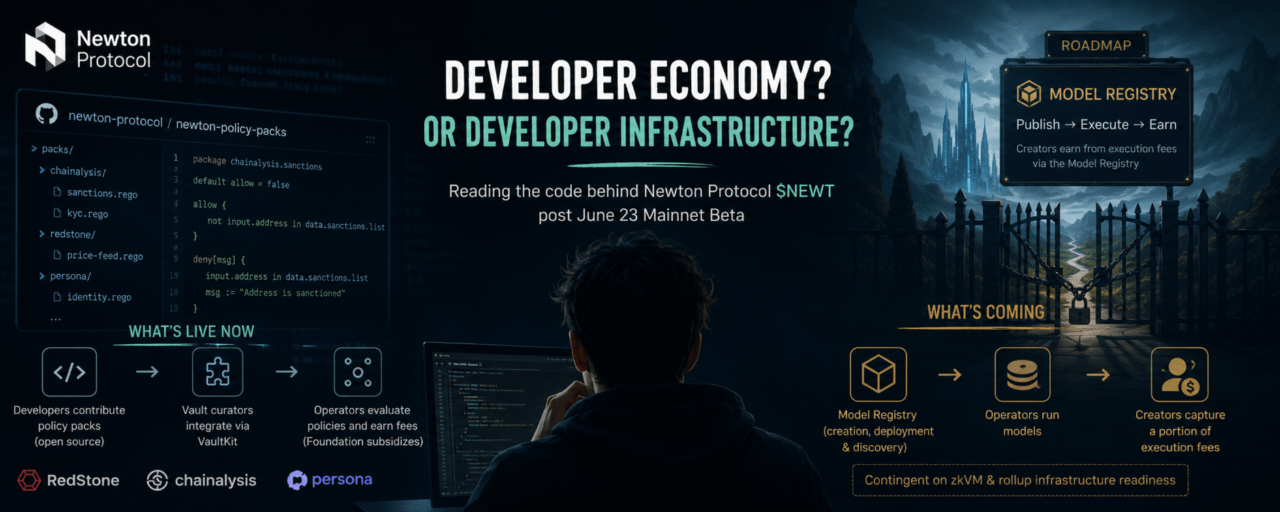
Went to the Newton Protocol $NEWT GitHub. @NewtonProtocol had pushed the newton-policy-packs repo live around the same time as the June 23 mainnet beta on Base and Ethereum. Open source, public, composable building blocks that vault curators and developers can use to construct enforcement policies. RedStone contributed price feed logic. Chainalysis contributed sanctions screening. The structure was clean. And I started reading through it thinking — okay, here's the developer economy in action. #Newt
But something kept nagging at me and it took a while to name it.
The phrase "developer economy" implies a specific thing. Not just that developers can build — it implies they can build, deploy, and then capture value from what they built. The App Store model. The creator earns when the creation gets used. That loop is what makes something an economy rather than just a commons.
What's actually live right now is the commons part. Developers contribute policy packs to an open repository. Vault curators integrate them via VaultKit. The Newton operator network evaluates transactions against those policies and earns fees. The foundation subsidizes those fees initially while validator infrastructure matures. But the developer who wrote the Rego logic that a hundred vaults are now enforcing — they're not capturing a slice of those evaluations. There's no fee routing back to the policy author in the current architecture.
I thought I was missing something. Spent probably twenty minutes looking for a contributor reward mechanism in the docs. Checked the transparency report. Checked the VaultKit SDK. Didn't find it.
The monetization layer for developers specifically requires the Model Registry — where a developer publishes an agent model, operators run it, and some portion of execution fees flows back to the creator. That's the "creation, deployment, and discovery" economy the framing describes. And the Model Registry is roadmap. Not imminent-roadmap with a hard date, but roadmap contingent on the broader zkVM and rollup infrastructure being ready.
So the current state is: developers are building the infrastructure that operators and institutional vault curators monetize. The developer themselves sit upstream of the value capture, not inside it. That's not nothing — open infrastructure gets built this way all the time. But it's a meaningfully different proposition than "developer economy."
Here's the part that genuinely bothers me though. The Rego policy language is a smart choice — it's what enterprise IT teams already use, it lowers the barrier for non-crypto-native compliance engineers to contribute. But that same choice means the people most likely to contribute right now are data vendors and compliance firms, not independent developers building AI strategies. RedStone, Chainalysis, Persona — these aren't indie developers trying to monetize a clever agent model. They're enterprises contributing to a shared layer that makes their core product more integrated.
So who exactly is the developer economy for, in practice? If the contributors are mostly data firms and the monetization layer for individual developers doesn't exist yet... the "AI strategy creator" persona that the narrative centers is mostly a future customer, not a current participant.
That might be fine. You build the infrastructure, the developer economy follows. But there's a gap between the story and the current state that matters if you're a developer trying to decide whether to invest time building on this now.
And I keep thinking — what happens to the open-source policy packs when the Model Registry does launch and fee capture becomes real? Do contributors retroactively get something? Does the incentive structure shift in ways that make the commons harder to maintain?
Didn't find an answer to that in the docs. Probably worth asking.
Anyway, market's still doing whatever it's doing. I'll probably keep watching the repo commits — that'll tell me more about what kind of developers are actually showing up than any roadmap slide will.