
@NewtonProtocol $NEWT #Newt
I opened Newton Protocol late in the evening.
The plan was simple. Read the overview, glance through the documentation, maybe take a few notes, then move on.
Instead, I ended up reading for much longer than I expected.
Not because everything made immediate sense. It didn't. A few sections sent me back to earlier pages. I caught myself rereading things, not because the writing was complicated, but because I wanted to be sure I wasn't filling in the gaps with my own assumptions.
I've noticed that's easy to do with AI projects.
Sometimes we see familiar words—agents, automation, infrastructure—and our brains assume we already know what the project is about.
I didn't want to do that here.
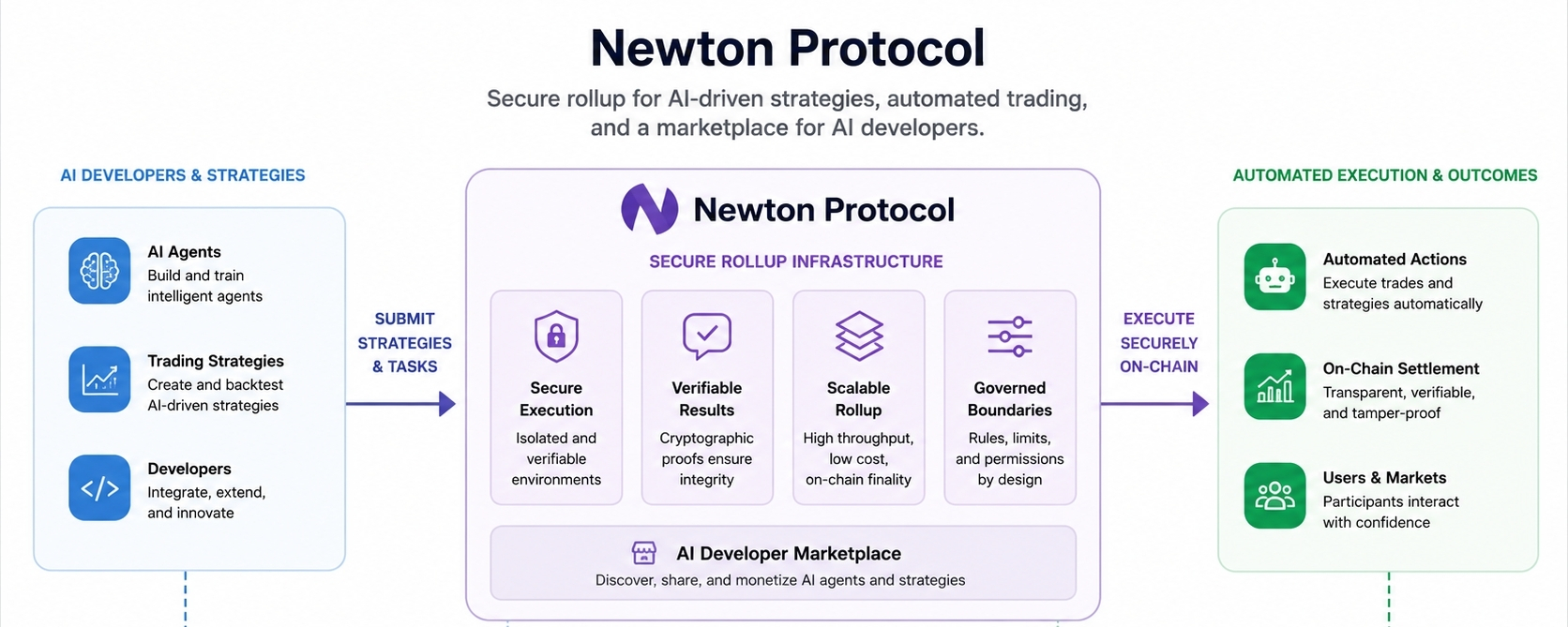
Newton Protocol describes itself as a secure rollup for AI-driven strategies, automated trading, and a marketplace for AI developers.
That's the straightforward explanation.
But somewhere during those few hours, I stopped thinking about the description and started thinking about something else.
I realized we've become very comfortable talking about what AI can do.
What I don't hear nearly as often is a conversation about what AI should be trusted to do on its own.
That feels like a much more difficult question.
Imagine asking an AI to help write an email. If it makes a mistake, you delete a sentence and move on.
Now imagine asking that same AI to manage part of a financial strategy or execute actions automatically.
Suddenly the conversation changes.
It's no longer just about intelligence.
It's about confidence.
It's about whether the system behaves in ways that people can understand and rely on.
That was the thread I kept following while reading.
I don't know if everyone would come away with the same impression, but it's the one that stayed with me.
What I appreciated was that Newton Protocol seemed to spend as much time thinking about boundaries as it did about capability.
That doesn't make for flashy headlines.
It probably won't be the sentence people quote on social media.
But it might be the part that matters most if AI ever becomes something we depend on instead of something we simply experiment with.
Of course, it's much easier to describe these ideas than to build them.
Real systems are rarely as clean as diagrams.
People use technology in unexpected ways.
Markets change.
Assumptions fail.
Rules that seem obvious today eventually run into situations nobody predicted.
I don't think any protocol escapes that.
And honestly, I don't expect one to.
By the time I finished reading, I wasn't left with the feeling that I'd found a perfect solution.
I was left with a notebook full of questions.
Oddly enough, I think that's why I enjoyed reading it.
The projects I remember aren't always the ones that promise the most.
They're usually the ones that quietly make me rethink something I hadn't paid enough attention to before.
For me, Newton Protocol wasn't really about AI.
It was about what happens when we start asking software to carry real responsibility.
That's a conversation I suspect we're only beginning to have.