
Some projects leave you with pages of notes.
Others leave you with a single question that refuses to go away.
Newton Protocol did the second.
I didn't sit down expecting that. In fact, I almost ignored it. The words AI, blockchain, and automation have become so common that I've learned to be careful. They can describe something genuinely thoughtful, or they can just be another way of saying, "Look how futuristic this is."
So I started reading with low expectations.
A few hours passed before I realized I wasn't reading to understand the technology anymore. I was reading because I was trying to understand the problem it was actually solving.
And I think those are two different things.
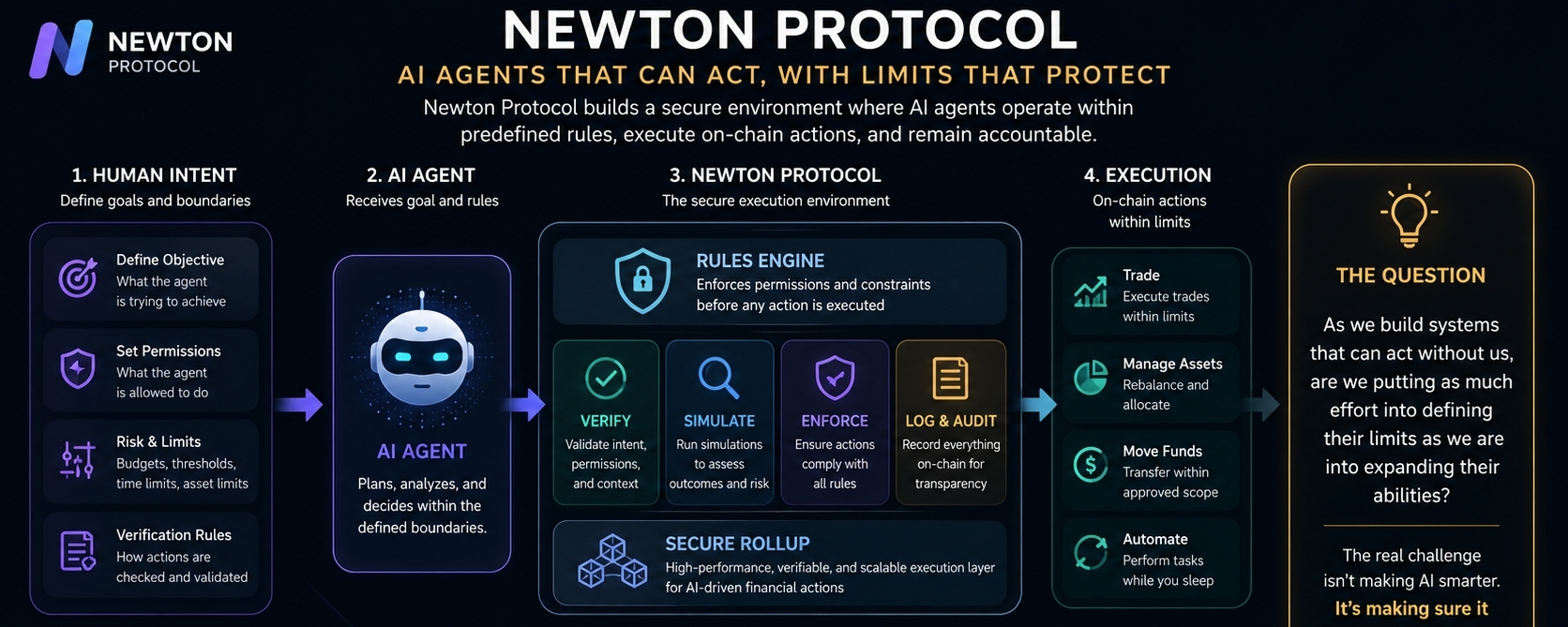
On paper, Newton Protocol is about AI agents, automated trading, and a secure rollup where those systems can operate. That's the straightforward explanation.
But that's not what caught my attention.
What caught my attention was the quiet assumption behind it.
If software is going to act for us, then maybe the real challenge isn't making it smarter.
Maybe the real challenge is making sure it knows where to stop.
That sounds almost too simple to write down.
But the longer I thought about it, the more important it felt.
We've become incredibly comfortable letting software make small decisions for us. Our phones finish our sentences. Maps choose our routes. Streaming apps decide what we'll probably watch next.
None of that feels unusual anymore.
We barely notice it.
But the next generation of software won't just recommend things. It'll move money, manage assets, execute transactions, and make choices while we're asleep.
That feels different.
Not because it's scary.
Because the consequences are real.
From what I understood, Newton Protocol is trying to build a system where AI agents don't simply receive permission and run freely. Instead, they operate within rules that are defined before they begin. Those rules matter just as much as the intelligence of the agent itself.
I kept coming back to that idea.
Not because it's flashy.
Because it feels responsible.
For a long time, the conversation around AI has been about capability. Every new model is faster, smarter, or more efficient than the last.
Very few conversations begin with a different question:
"What shouldn't this system be allowed to do?"
Maybe that's the question we've been asking too late.
Of course, it's much easier to describe a philosophy than it is to turn it into software.
That's where my curiosity became a little more cautious.
Any system built around permissions, verification, and security also becomes more complex. Complexity isn't automatically bad, but it does have a habit of creating new problems while solving old ones.
The people building these systems understand them.
Will everyone else?
I'm not sure.
And I don't think pretending to know the answer would be honest.
One thing I've learned after reading enough technical papers is that good ideas rarely arrive fully finished.
They arrive incomplete.
They improve because people question them, test them, and occasionally discover where they were wrong.
I actually hope Newton goes through that process.
Because ideas that survive honest criticism usually become stronger.
When I finally closed my laptop, I noticed something.
I couldn't remember every technical detail I'd read.
But I remembered how the project made me think.
That's usually the difference between information and understanding.
Information fades.
A good question stays with you.
The question Newton left me with wasn't about AI.
It wasn't about crypto either.
It was this:
As we build systems that can act without us, are we putting as much effort into defining their limits as we are into expanding their abilities?
I still don't have an answer.
But after spending time reading, I think it's probably the right question to keep asking.