Two Companies, One Name
I lost a Saturday to Newton's press archive.
Not because I had to. Because I wanted to know whether the current story matched the old one.
It didn't.
That's not unusual. Crypto has a terrible memory. Projects rewrite themselves all the time. Last year's roadmap quietly becomes this year's "early vision." The old landing page disappears. Everyone pretends the new one was always the plan.
I've seen this before.
The Newton that showed up in late 2024 barely resembles the Newton talking about mainnet today.
Back then, the pitch was simple. Maybe too simple.
Too many chains. Too many wallets. Too much friction.
Newton, alongside Magic Labs and Polygon, wanted to flatten all of that into something ordinary. One wallet. One balance. One network stitched together by AggLayer and Polygon CDK. Passport was the centerpiece. The technology wasn't the product. The feeling was.
Users weren't supposed to think.
That wasn't a criticism. It was the whole idea.
The best infrastructure is usually invisible.
At least that's what everyone tells themselves.
Then something changed.
The strange part isn't that Newton pivoted. Every startup pivots. Most just call it "iteration" because it sounds less expensive.
The strange part is how quietly the first version disappeared.
Read enough of the old coverage and you start noticing ghosts. Polygon everywhere. AggLayer everywhere. Passport everywhere.
Then...nothing.
The names vanish.
The language changes.
The problem changes.
By the time the 2026 mainnet beta arrives, Newton has become something else entirely.
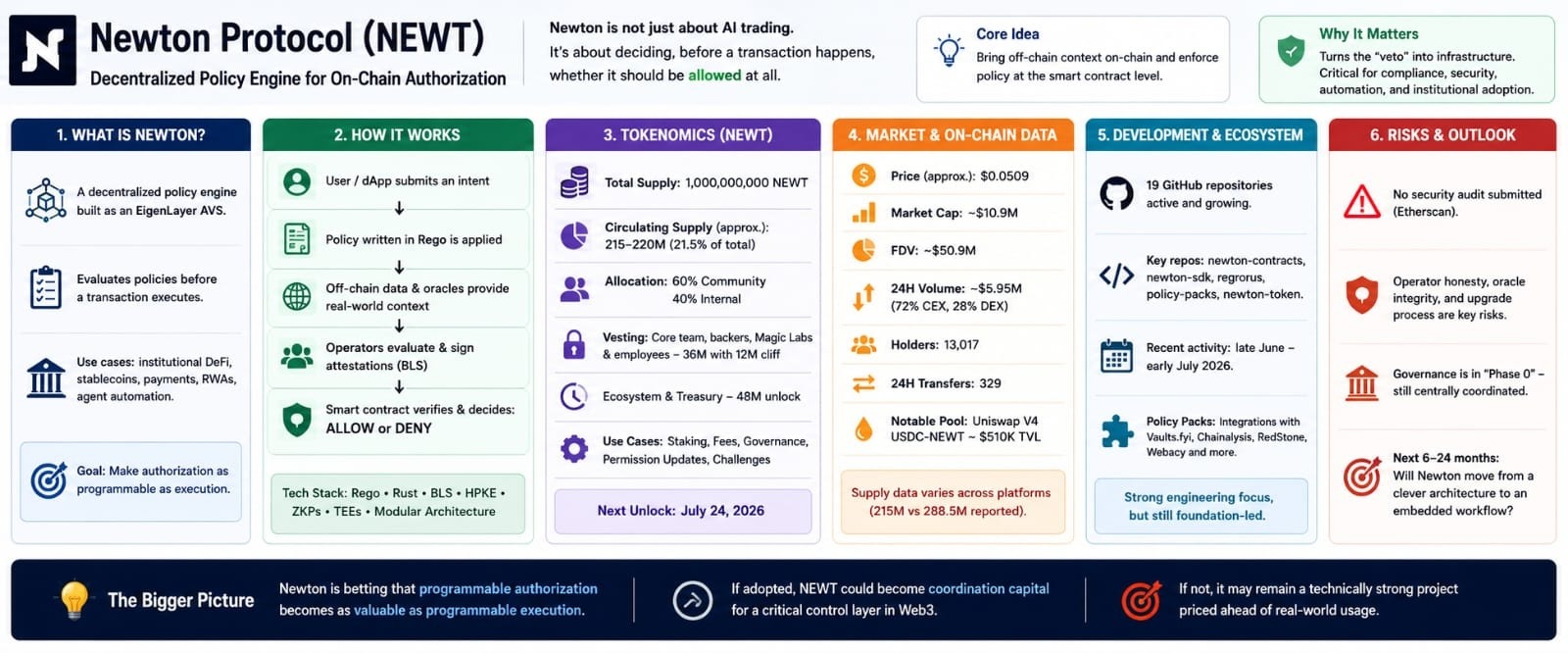
Now it's an authorization layer.
Policy.
Compliance.
Risk.
Identity.
The protocol sits between intention and settlement. Every transaction gets checked before it moves. Chainalysis. Hexagate. RedStone. Credora. Webacy. EigenLayer. Succinct. It's a stack built for people who worry about audits instead of wallet UX.
Different audience.
Different business.
Different company, if we're being honest.
Here's the thing.
The industry likes to pretend that products mature in straight lines. Reality is messier than that. Companies don't usually discover what they're building until they've already built something else.
Newton feels like one of those stories.
The first chapter tried to make crypto disappear.
The latest chapter tries to make crypto behave.
Those aren't the same ambition.
One removes friction.
The other adds rules.
That distinction matters more than the branding.
Because rules are where the money usually ends up.
Retail users complain about gas fees. Institutions complain about policy failures. Guess which customer writes bigger checks.
It isn't hard to see why Newton moved.
The harder question is whether this new identity has staying power.
Compliance infrastructure sounds durable. Until regulations change. Until data providers disagree. Until one oracle says "safe" and another says "don't touch it." Then the neat diagrams start looking fragile.
Every control layer inherits someone else's uncertainty.
That's the fine print.
And crypto has never been very good at printing the fine print.
I don't think Newton is selling vapor.
I also don't think today's story should erase yesterday's.
The archive says the company has already replaced one core thesis with another. That doesn't make the current thesis wrong. It just makes me read every confident sentence with a little more caution.
Confidence ages badly in this industry.
Archives don't.
That's why I still read the old press releases.
Not because they're always right.
Because they're usually honest in ways the latest landing page isn't.
Maybe not intentionally.
But honestly enough.
The broader lesson isn't really about Newton.
It's about how technology companies reinvent themselves.
They almost never announce the moment they stop believing in yesterday's idea. They simply stop mentioning it. The vocabulary shifts first. Then the diagrams. Then the architecture. Finally, everyone behaves as though the old story never existed.
It's a quiet kind of amnesia.
Effective, too.
Unless someone bothers to read from page one.
That's what I did.
And after a weekend with Newton's archive, I came away with a different impression than I expected.
Not because I found a contradiction.
Because I found evolution without much explanation.
Maybe that's how real companies work.
Maybe that's just how crypto cleans up after itself.
Either way, I trust archives more than launch posts.
Every time.