
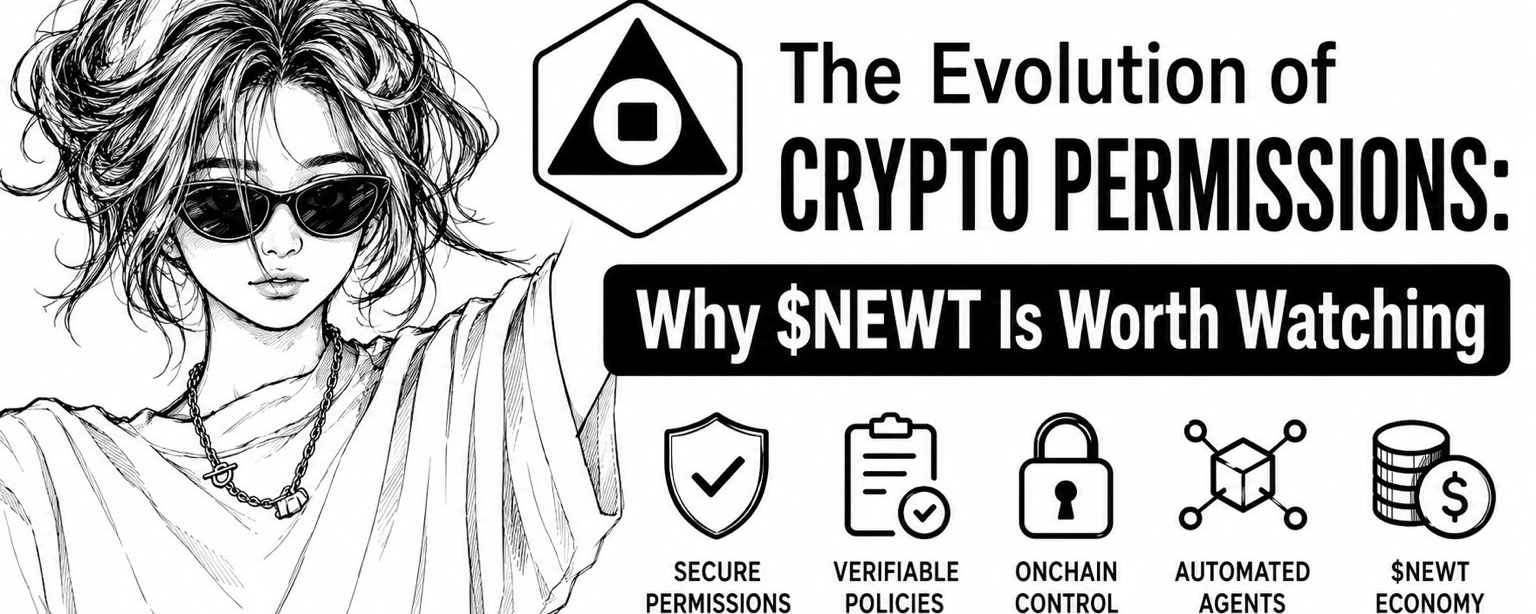

I keep coming back to a simple question: as crypto gets more automated, who actually controls the keys to that automation? Over the last cycle, I’ve watched users hand more power to bots, copy-trading tools, and offchain scripts just to keep up. It works until it doesn’t. A missed revoke function, a bad API key, or a loosely permissioned wallet can turn convenience into risk fast. That’s why @NewtonProtocol via NEWT caught my attention. It isn’t just another utility token story. It’s tied to a part of crypto infrastructure that feels increasingly hard to ignore.
The underlying problem is bigger than most people admit. Onchain activity has become too complex for manual execution, especially across DeFi, cross-chain flows and automated strategies. So users rely on bots, sign blanket approvals, or trust middleware they barely understand. That creates a messy tradeoff: either stay fully self-custodied but inefficient, or gain speed by outsourcing control. We’ve already seen how dangerous vague permissions can be. Unlimited token approvals, fragile automation scripts, and centralized relayers all introduce attack surfaces. As wallets evolve into command centers for agents and apps, permission design starts to matter as much as custody itself.
What @NewtonProtocol seems to be building is an authorization layer rather than just another execution layer. That distinction matters. From what I’ve studied, NEWT sits at the center of a system where permissions can be issued, updated, and revoked onchain, specifically for automated agents operating under verifiable constraints. The protocol uses programmable permissioning what it describes as zkPermissions and session based controls so an agent can act within a narrow scope instead of receiving broad, open-ended authority. The architecture appears designed around verifiable automation, combining policy rules with cryptographic proofs and smart-contract enforcement. In practice, that means a user or protocol could allow an agent to perform a limited action say, rebalance, execute recurring buys, or interact under preset compliance and spending rules without giving that agent permanent freedom over funds. NEWT isn’t just the token attached to that system; it powers fees, permission management, staking and the network’s coordination layer.
What impressed me most is that Newton seems focused on a real structural bottleneck, not a cosmetic UX patch. A lot of crypto tooling still treats permissions as an afterthought. Newton is making them the product. That feels directionally right to me, especially if AI agents and autonomous finance keep gaining traction. I also like that the design appears modular enough for protocols, DAOs, and individual users rather than one narrow use case. Still, I’m watching execution risk closely. Permission systems sound elegant on paper, but adoption depends on developer integration, user understanding, and whether the added verification overhead remains practical. I’m also cautious whenever a token has to support multiple roles at once fee asset, staking asset, governance asset because value capture can get blurry. Compared with older approval based wallet flows, though, this model feels meaningfully more advanced.
I don’t think the market has fully priced in how important permission architecture could become over the next few years. Maybe NEWT ends up niche, maybe it becomes foundational. What I do know is that the projects worth watching usually solve a problem users only notice after it breaks. I’m curious to see whether Newton gets there before the rest of the market catches on.$THE $LAB
