
Spent part of yesterday afternoon doing something I do when I'm procrastinating on actual decisions — just reading technical docs for projects I'm already loosely following. No particular reason. Market had been doing its slow-drift thing and I couldn't find an entry worth committing to, so I started reading through Newton Protocol's architecture notes instead.
I'd been loose on the rollup design specifically. I knew $NEWT was involved, I knew the Keystore thing was somewhere in the stack, but I'd been grouping it mentally with other L2 infrastructure plays — faster execution, cheaper gas, more throughput. The usual rollup story.
That was wrong. And the moment I figured out it was wrong, I had to put my phone down for a second.
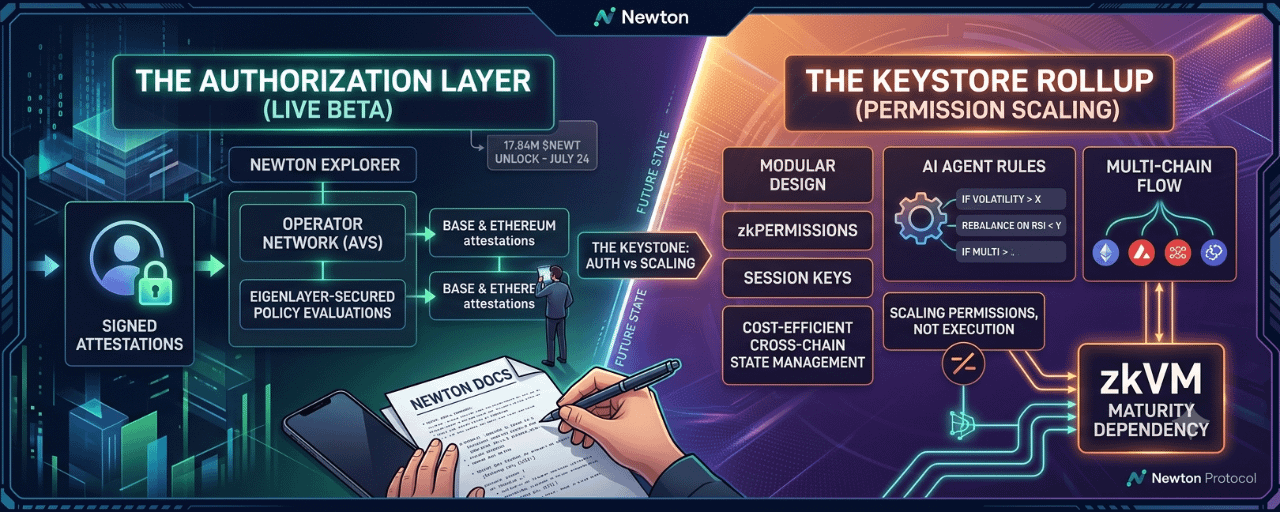
Newton's Keystore Rollup isn't built to scale execution. It's built to scale permissions.
Those are not the same thing. Not even close.
Here's what I mean. When most people hear "rollup for AI applications," they picture something like a high-throughput execution layer — agents making thousands of trades per second, DeFi logic running cheaper and faster because the compute is offchain and only the proofs hit mainnet. That's the rollup mental model most of us have been trained on by two years of L2 narratives.
What Newton is actually designing is a rollup whose specific job is storing and updating user permission state. zkPermissions. Session keys. Rules like "this agent can only trade if volatility exceeds X" or "rebalance when RSI drops below Y." That permission state needs to be accessible across multiple chains without rewriting it everywhere, and doing that onchain at scale with zero-knowledge proofs gets expensive fast. The Keystore Rollup is built to make that permission management cost-efficient across chains. Not to execute strategies. To authorize them.
I sat with this for a few minutes. It's a genuinely different product than what the "scalable AI applications" framing implies.
But here's where I got uncomfortable, and I'm still sitting with this.
The Keystore Rollup isn't live. The Newton docs list it clearly as upcoming, and specifically note it's contingent on the maturation of zkVM frameworks — external dependencies, not just internal build time. What is live since the June 24 mainnet beta is the EigenLayer-secured operator network running policy evaluations on Base and Ethereum. That part works. The Newton Explorer shows signed attestations from real transactions. But that's the authorization layer, not the rollup. The rollup — the part that would actually enable cost-efficient cross-chain zkPermissions at the scale the AI agent economy supposedly needs — is still ahead.
So when the topic is "rollup design for scalable AI applications," the honest answer is: the design exists and it's genuinely different from what you'd assume, but the thing doing work right now isn't the rollup. It's the AVS network. And those are two different architectural layers doing two different jobs.
I had a friend who kept saying he was "building" a strategy all last cycle. Turns out he was building a spreadsheet about a strategy. Both things can be true at once — the design is real and the live deployment is also real — they're just not the same milestone.
The distinction matters more than it sounds. If the value of $NEWT scales with permission throughput across chains — zkPermissions issued, updated, revoked as agents run — then the token's utility curve is tied to when the rollup ships, not when the authorization layer shipped. Those could be the same quarter. They could be a year apart. The docs don't specify, and the external dependency clause is doing real work in that sentence.
A 17.84M NEWT unlock lands July 24. Market's been absorbing unlocks unevenly all cycle.
I'll probably just keep watching the docs for any update on zkVM readiness. That'll tell me more than the price chart will.
@NewtonProtocol #Newt