
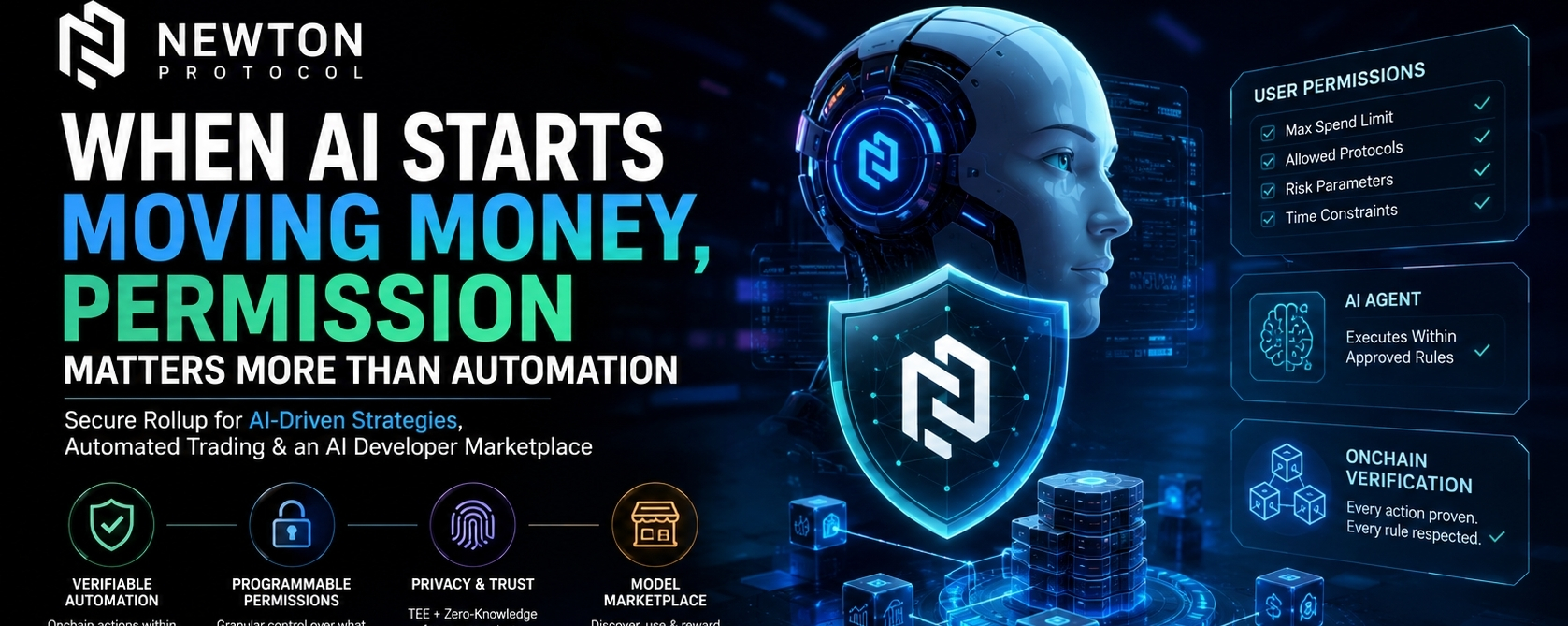
Every time I see a new AI crypto project, I ask myself the same question: what happens after the model produces an answer? Generating an investment idea is easy compared with allowing software to execute transactions on someone's behalf. That second step is where the real trust problem begins, and it's where Newton Protocol caught my attention.
Many blockchain discussions focus on making AI agents smarter. Newton Protocol takes a different route. Instead of asking how autonomous an agent can become, it asks a more practical question: how do we give software enough authority to act without giving it unlimited control?
That distinction may sound subtle, but it changes the conversation entirely.
The protocol is built around verifiable onchain automation. Rather than relying on centralized bots or blind trust, it aims to let users delegate specific permissions to AI-driven agents under predefined conditions. In simple terms, an agent isn't supposed to have a permanent blank cheque. It receives clearly defined boundaries for what it is allowed to do, while cryptographic technologies such as trusted execution environments and zero-knowledge proofs are intended to make those permissions more trustworthy and privacy-conscious.
I think that's a healthier direction than simply chasing increasingly autonomous AI.
Automation becomes valuable only when users remain confident that their own rules are still being respected. Otherwise, every additional layer of intelligence also introduces another layer of uncertainty.
This becomes especially relevant for automated trading and other recurring onchain strategies. Markets don't stop moving simply because a user goes offline. Automation can remove friction, but only if there is confidence that execution remains aligned with the user's intent rather than whatever an external operator decides.
Newton Protocol tries to make that intent programmable.
Viewed from a broader perspective, the protocol isn't only about AI agents. It's about creating an authorization layer between human decisions and automated execution. That layer may prove more important than many people currently appreciate.
Crypto has spent years building decentralized settlement. AI is accelerating decision-making. Yet the space between deciding and executing often remains surprisingly fragile.
If that bridge is weak, better AI doesn't necessarily produce better outcomes.
Another design choice that deserves attention is the planned model registry and marketplace for AI developers. Good AI infrastructure needs incentives that extend beyond end users. Developers building useful models need a path toward recognition and compensation, while operators running those models should also have incentives to behave responsibly.
Newton's approach attempts to connect those participants through an onchain marketplace supported by the protocol's native mechanics. Rather than treating AI models as isolated software, it creates an environment where developers can publish models, operators can provide services around them, and incentives become more transparent over time.
That idea feels more sustainable than assuming every useful AI tool will always remain inside a single company's ecosystem.
Of course, a marketplace by itself doesn't guarantee quality.
One of the harder questions is whether participants can consistently identify reliable agents without making discovery overly complicated. Any open ecosystem eventually faces the challenge of balancing accessibility with trust. A marketplace full of automation is only as useful as the confidence users have in selecting the right tools.
That isn't a flaw unique to Newton Protocol. It's a challenge that nearly every decentralized AI network will need to solve.
There's another point I found interesting.
Much of today's AI conversation revolves around replacing human involvement. Newton's design feels more like structured delegation than replacement. Users define permissions, automation performs approved actions, and verification helps demonstrate that execution stayed within those limits.
That difference matters because financial activity usually requires accountability.
People rarely hesitate to let AI draft an email. They're far more cautious when AI starts moving digital assets, managing positions, or interacting with financial protocols.
Confidence comes less from intelligence than from predictable boundaries.
The NEWT token also reflects this broader architecture rather than existing solely as a speculative asset. Within the protocol, it is intended to support network security through staking, serve as the native gas token, participate in the model registry's economic design, and eventually contribute to governance as decentralization progresses. Those functions connect the token to network activity instead of separating it from the protocol's operation.
Whether adoption ultimately reaches meaningful scale will depend on execution rather than architecture alone. Developers need straightforward integration, operators need sustainable incentives, and users need confidence that programmable permissions genuinely reduce risk without making automation unnecessarily complex.
Those aren't marketing challenges. They're product challenges.
That's why I think Newton Protocol is more interesting than another AI narrative built around bigger models or faster inference.
Its central question isn't whether AI can make decisions. It's whether people can safely authorize those decisions without surrendering control.
As AI becomes increasingly capable of interacting with blockchain networks, that question may turn out to be far more important than how intelligent the agent appears on paper. Intelligence attracts attention. Well-defined permission, verification, and accountability are what give automation a chance to earn lasting trust.
