

For most of Bitcoin's history, one event has dominated every market conversation: the halving. Every four years, the network cuts the reward miners receive for creating new blocks, reducing the supply of newly issued Bitcoin. This predictable event has often been followed by strong price rallies, leading many investors to believe the halving is the biggest force behind Bitcoin's long term growth.
Michael Saylor sees the future differently.
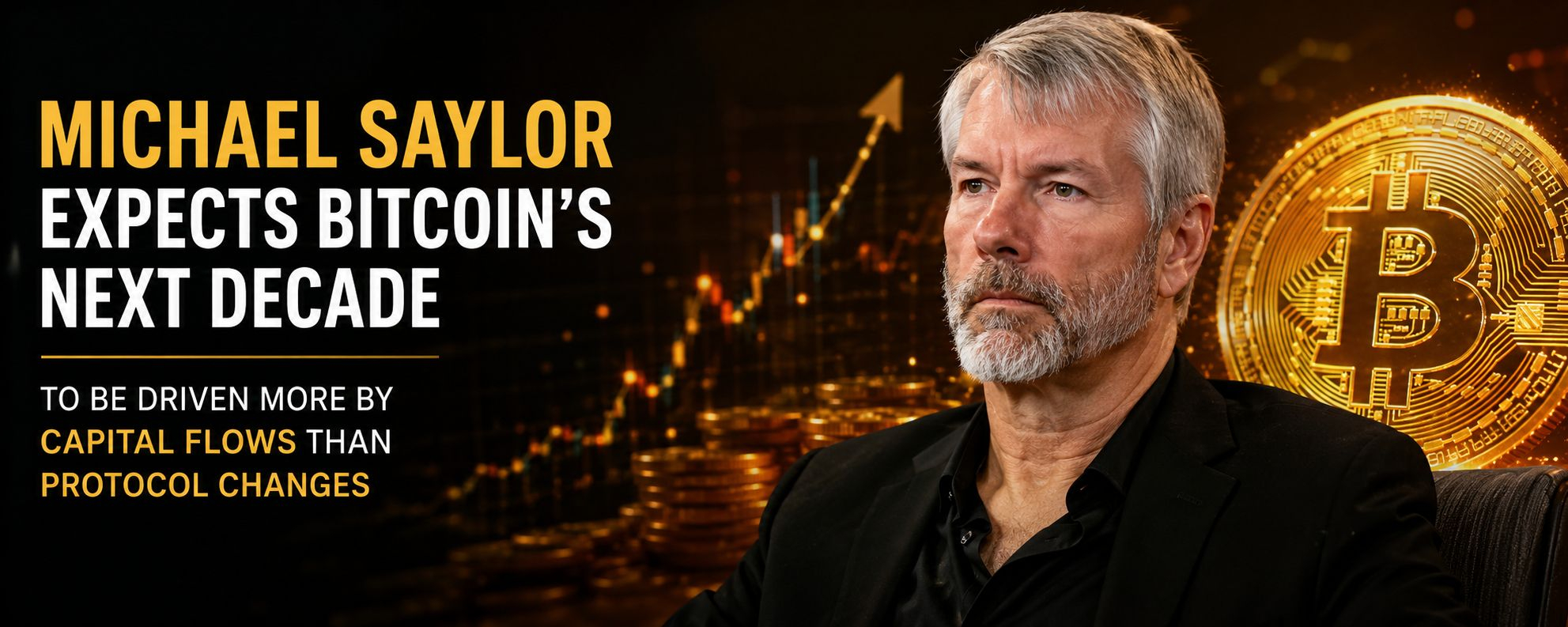
The longtime Bitcoin advocate believes the market is entering a new chapter where capital entering the ecosystem will matter far more than changes to Bitcoin's protocol. In his view, Bitcoin has already matured into a global financial asset, and the next decade will be defined by adoption from institutions, corporations, governments, and investors rather than technical upgrades.
Bitcoin Is Entering a New Era
When Bitcoin was first introduced, its success depended on proving that decentralized digital money could actually work. Developers focused on security, miners strengthened the network, and early adopters helped build confidence in an entirely new financial system.
Today, Bitcoin is no longer an experiment.
It has become an asset that attracts interest from some of the world's largest financial institutions. Investment firms, public companies, banks, and even governments are exploring ways to include Bitcoin in their long term strategies.
Saylor believes this shift changes everything.
Instead of asking how Bitcoin's technology will evolve, investors should start asking where the next wave of global capital will come from.
Why Capital Matters More Than Code
Bitcoin's protocol was designed to remain stable.
Its fixed supply of 21 million coins, decentralized security, and transparent monetary policy are already among its strongest features. Unlike many blockchain projects that frequently introduce new upgrades, Bitcoin moves carefully and changes only when there is broad agreement across the network.
According to Saylor, this stability is exactly what large investors want.
Institutional investors are not looking for constant experimentation. They want an asset with predictable rules that cannot be changed overnight. Bitcoin's consistency has become one of its greatest strengths, allowing it to earn trust across global financial markets.
The Growing Influence of Institutions
Over the past few years, institutional participation has increased dramatically.
Public companies continue adding Bitcoin to their balance sheets as a long term reserve asset. Asset managers now offer regulated investment products that give traditional investors easier access to Bitcoin. Banks are expanding custody services, while financial firms are developing new products built around digital assets.
These developments create steady demand that extends far beyond retail trading.
Instead of relying only on individual investors during bull markets, Bitcoin is now attracting capital from organizations capable of investing billions of dollars over many years.
This is the trend Saylor believes will shape Bitcoin's future.
The Halving Is Still Important
Saylor is not suggesting that the halving no longer matters.
Reducing the creation of new Bitcoin will always play a role in limiting supply. However, as more than 94 percent of all Bitcoin has already been mined, future reductions in new supply may have less impact than the growing demand from global investors.
In simple terms, supply continues to shrink, but demand may become the much larger driver of long term price growth.
Bitcoin as Digital Capital
One of Saylor's most consistent arguments is that Bitcoin should not be viewed primarily as a payment network.
Instead, he believes Bitcoin has become digital capital.
Its role is to preserve wealth, protect purchasing power, and provide a secure asset that can be owned anywhere in the world without relying on a central authority.
This perspective has become increasingly popular among institutions that see Bitcoin as a long term store of value rather than a tool for everyday spending.
Stability Creates Trust
Many blockchain networks compete by introducing faster speeds, lower fees, or new features.
Bitcoin follows a different philosophy.
Its greatest innovation may be its refusal to change unnecessarily.
Every update goes through extensive review and community discussion before being accepted. This conservative approach helps maintain confidence in the network and reduces the risk of unexpected problems.
For investors managing billions of dollars, reliability often matters more than rapid innovation.
Challenges Ahead
While Saylor remains optimistic, he acknowledges that Bitcoin's next phase will bring new challenges.
As more financial products are built around Bitcoin, transparency and responsible custody will become increasingly important. Investors will expect clear proof that assets are fully backed, while regulators will continue shaping the rules governing digital asset markets.
Global economic conditions, interest rates, and government policies will also play a larger role in determining how much capital flows into Bitcoin over time.
Looking Beyond Technology
Bitcoin's next decade may look very different from its first.
Instead of focusing on software upgrades or mining rewards, the conversation could center on institutional investment, corporate treasury adoption, sovereign wealth funds, and global capital allocation.
If these trends continue, Bitcoin's growth may be driven less by changes inside the network and more by the expanding number of people and organizations choosing to make it part of their financial future.
Final Thoughts
Michael Saylor believes Bitcoin has reached a point where its technology no longer needs to prove itself. The network has demonstrated resilience, security, and predictability for more than fifteen years.
The next challenge is not improving the protocol. It is attracting the world's capital.
If institutions, corporations, and governments continue increasing their exposure to Bitcoin, the coming decade could mark its transition from a successful digital asset into one of the most important financial assets in the global economy.