

I'm watching something interesting unfold in crypto lately. Most headlines celebrate new blockchains, faster transactions, or bigger funding rounds. But every now and then, a story appears that reminds me the strongest technology in the world is only as safe as the people constantly trying to break it for the right reasons.
That is exactly what happened with Aptos.
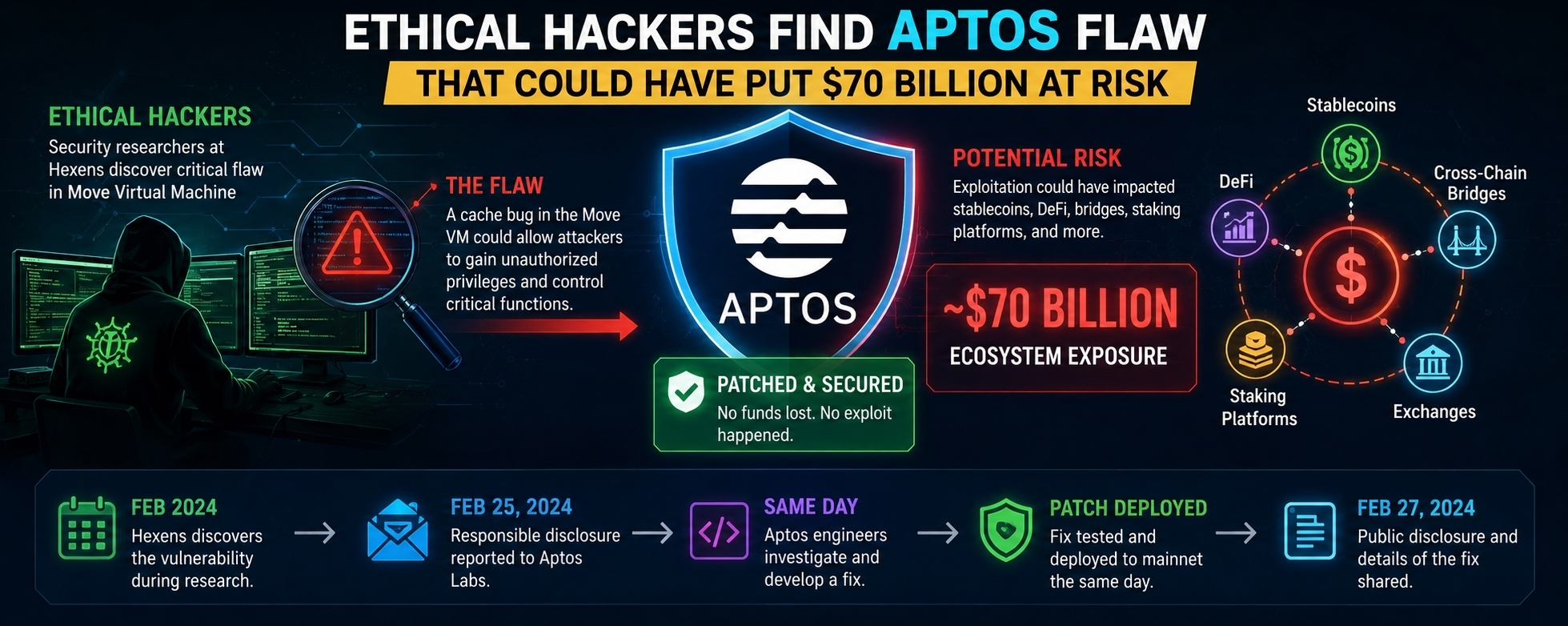
A group of ethical hackers quietly uncovered a flaw that, if discovered by criminals first, could have put an ecosystem connected to roughly 70 billion dollars in digital assets under serious threat. Nothing was stolen. No panic spread across the market. Most users never even realized how close the industry may have come to a major security crisis. That quiet ending is exactly what makes this story worth paying attention to.
A Discovery That Almost No One Saw Coming
Earlier this year, blockchain security researchers at Hexens began examining the inner workings of Aptos. Their goal was not to attack the network but to understand whether hidden weaknesses still existed beneath its highly optimized architecture.
What they eventually found was not a problem inside a single application or smart contract. It was buried much deeper inside the Move Virtual Machine, the execution engine responsible for running every smart contract on the network.
Infrastructure level bugs are rare, but when they appear, they tend to affect everything built on top of them.
According to the researchers, a flaw in how cached resources were handled could create a situation where the system confused one resource for another. That sounds like a small programming mistake, yet its consequences could have been enormous.
Instead of respecting permission boundaries, an attacker might have been able to gain privileges that should never be accessible.
That possibility immediately raised alarms.
Why This Was Different From Typical Crypto Hacks
Most blockchain hacks target individual projects.
Sometimes it is a bridge.
Sometimes a lending protocol.
Sometimes a wallet.
This situation was different because the vulnerability existed below all of those applications.
Every decentralized application running on Aptos relies on the Move Virtual Machine.
If the execution engine itself becomes compromised, many independent projects can suddenly inherit the same risk.
Researchers believed this could potentially expose systems connected to stablecoins, decentralized finance protocols, staking platforms, cross chain infrastructure, and exchange integrations.
That is where the widely discussed 70 billion dollar figure comes from.
It was never a claim that Aptos itself was securing 70 billion dollars in locked assets.
Instead, the researchers estimated the broader value connected through infrastructure that could theoretically be affected if privileged components became compromised.
A Surprisingly Affordable Experiment
One detail that stood out to me was how inexpensive the research environment actually was.
The team reportedly spent around three thousand dollars building a testing network designed to closely resemble the real Aptos blockchain.
They recreated validator behavior, transaction traffic, network conditions, and staking distribution as accurately as possible.
After repeatedly testing the exploit, the vulnerability reportedly succeeded in most attempts.
Perhaps even more surprising was the estimated cost of launching such an attack.
The researchers suggested that individual attempts might only require hundreds of dollars, making the exploit economically realistic if someone with malicious intentions had discovered it first.
That realization changes the conversation.
People often imagine billion dollar attacks requiring billion dollar resources.
Sometimes they only require a single overlooked software bug.
Responsible Hackers Made All the Difference
The biggest reason this story has a positive ending is because the researchers followed responsible disclosure instead of chasing personal profit.
After confirming their findings, Hexens privately informed Aptos Labs through its security disclosure program.
The response came quickly.
Engineers investigated the report, developed a fix, tested it, and deployed the update before anyone outside the security teams even knew the vulnerability existed.
No assets disappeared.
No emergency shutdown happened.
No users lost their funds.
In an industry where security incidents often become public only after millions have already vanished, this quiet resolution deserves recognition.
Aptos Offers Its Own Perspective
While Aptos acknowledged the vulnerability and immediately fixed it, the company also offered a more cautious interpretation of the overall risk.
According to Aptos, the bug was real, but successfully exploiting it under live network conditions would likely have been much more difficult than the testing environment suggested.
That disagreement is not unusual.
Security researchers often evaluate worst case scenarios to understand maximum possible impact, while development teams focus on how likely those scenarios are to happen in production.
Both perspectives matter.
One measures potential damage.
The other measures practical probability.
Together they help improve security.
The Bigger Lesson for Blockchain
The story extends far beyond one blockchain.
As crypto becomes increasingly interconnected, networks no longer exist in isolation.
Stablecoins move between chains.
Liquidity flows through bridges.
Trading platforms interact with multiple ecosystems simultaneously.
That means vulnerabilities inside one network can sometimes ripple far beyond its own users.
The more connected crypto becomes, the more valuable infrastructure security becomes.
The strongest ecosystem is no longer the one with the highest transaction speed.
It is the one that can detect problems before attackers do.
Ethical Hackers Are Becoming Crypto's Quiet Heroes
People often associate hackers with stolen funds and devastating exploits.
But ethical hackers represent the opposite side of that story.
They search for weaknesses before criminals can find them.
They spend weeks analyzing code that millions of people will never read.
Most of their biggest successes become invisible because disasters never happen.
That may be the greatest compliment their work can receive.
Nobody notices the catastrophe that never arrived.
Final Thoughts
The Aptos incident is not really a story about a bug.
It is a story about preparation, transparency, and cooperation.
A vulnerability with potentially enormous consequences was discovered by researchers who chose responsibility over profit. Developers responded quickly instead of denying the problem. Users continued using the network without ever experiencing disruption.
Crypto often makes headlines because something goes wrong.
This time, the headline exists because everything went right.
That may not generate the same excitement as a billion dollar hack, but it is exactly the kind of story that gives confidence in how the blockchain industry is slowly maturing. As networks continue to grow and billions of dollars move across interconnected systems every day, quiet victories like this may become even more important than the biggest technological breakthroughs themselves.