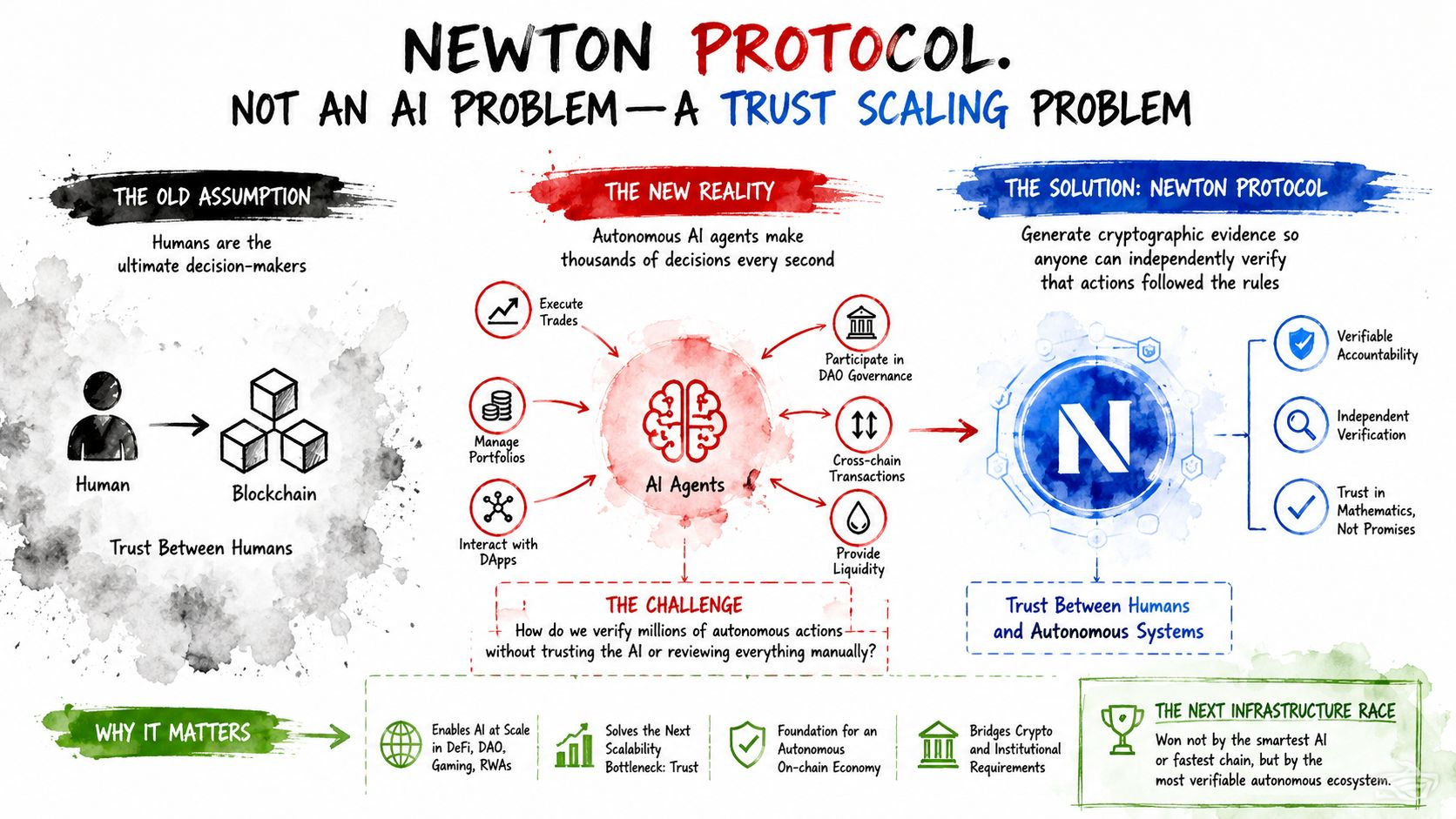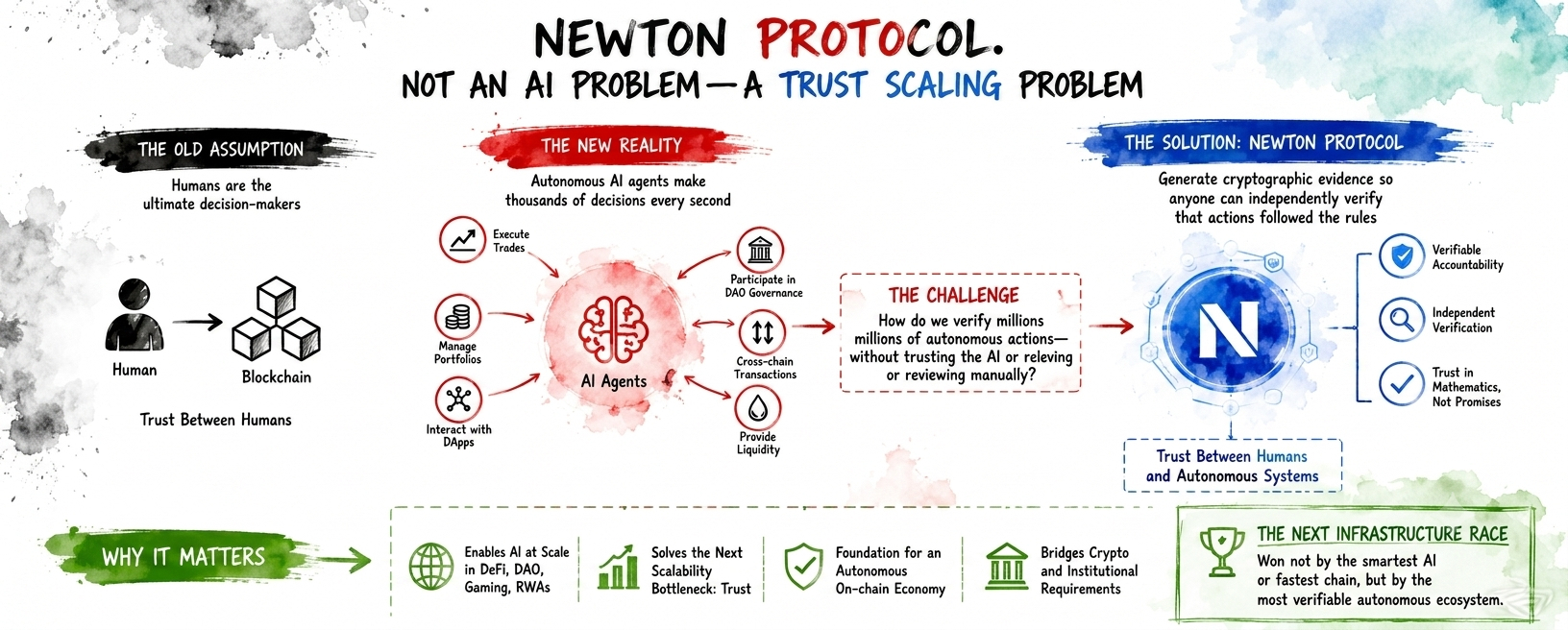
The history of blockchain is often described as a story of decentralization, but I think that's only half the picture. Its deeper achievement has been the ability to scale trust without relying on centralized institutions. Bitcoin allowed strangers to exchange value without banks. Ethereum expanded that idea by enabling programmable agreements without intermediaries. Yet beneath these innovations lies an assumption that has rarely been questioned: humans remain the ultimate decision-makers.
That assumption is beginning to break.
Much of today's discussion around AI in crypto focuses on making autonomous agents smarter. We hear about AI executing trades, managing portfolios, interacting with decentralized applications, and even participating in DAO governance. Intelligence has become the headline. But I believe the market is overlooking a more fundamental constraint. As AI becomes capable of making thousands of decisions every second, intelligence will not be the scarce resource. Trust will.
This is why I think Newton Protocol is often misunderstood. It is frequently categorized as AI infrastructure, but its real ambition appears much broader. Rather than trying to improve how AI thinks, it attempts to improve how the rest of the ecosystem can trust what AI has done. That shifts the conversation from computational capability to verifiable accountability a distinction that could become increasingly important as autonomous systems become more deeply integrated into blockchain networks.
Consider a simple scenario. Imagine a DAO treasury worth hundreds of millions of dollars managed by autonomous AI agents. Those agents rebalance assets, provide liquidity, vote on governance proposals, and execute cross-chain transactions around the clock. The challenge is not whether the AI can perform these actions efficiently. The challenge is whether token holders, auditors, or institutions can independently verify that every action followed predefined rules without manually reviewing thousands of decisions. At that scale, human oversight becomes economically and practically impossible.
Traditional blockchains were designed to verify transactions, ownership, and state changes. They excel at proving what happened. Autonomous AI introduces a different requirement: proving why an action was taken and whether it followed authorized instructions. These are fundamentally different verification problems. Simply recording transactions on-chain does not automatically provide confidence that an autonomous agent behaved as intended before those transactions were executed.
This is where Newton Protocol introduces an interesting architectural idea. Instead of asking users to trust increasingly complex AI systems, it focuses on generating cryptographic evidence that autonomous actions can be independently verified. In effect, trust shifts away from confidence in the AI itself toward confidence in the verification process surrounding it. That mirrors one of blockchain's oldest principles: systems become more reliable when trust is placed in mathematics rather than promises.
The implications extend well beyond AI. If autonomous agents eventually become active participants in DeFi, decentralized governance, gaming, supply chains, or tokenized real-world assets, trust itself could become the next scalability bottleneck. Blockchains have spent years increasing throughput through Layer-2 networks, modular architectures, and more efficient consensus mechanisms. Yet none of these innovations solve the problem of verifying millions of autonomous decisions occurring every day. Processing activity and proving trustworthy behavior are separate infrastructure challenges.
That does not mean Newton Protocol's path will be straightforward. Building verification infrastructure before widespread autonomous AI adoption carries execution risk. Crypto history is filled with technologies that arrived years before demand materialized. There are also practical trade-offs. Cryptographic verification introduces additional computational overhead, developers must integrate new standards, and competing protocols may eventually embed similar capabilities directly into blockchain architectures. Success will depend not only on technical design but also on whether the industry concludes that verifiable AI should become a default expectation rather than an optional feature.
Perhaps the most important insight is that Newton Protocol reflects a broader shift in blockchain's evolution. The first generation of crypto focused on removing the need to trust financial intermediaries. The next generation may focus on removing the need to blindly trust autonomous decision makers. Those are related problems, but they are not the same.
For that reason, I no longer see Newton Protocol primarily as an AI project. I see it as an experiment in scaling digital trust for an autonomous economy. If that vision proves correct, the next major infrastructure race in crypto may not be about building the smartest AI or the fastest blockchain. It may be about building the ecosystem where autonomous intelligence is the easiest to verify. In the long run, that could prove far more valuable than intelligence alone.