
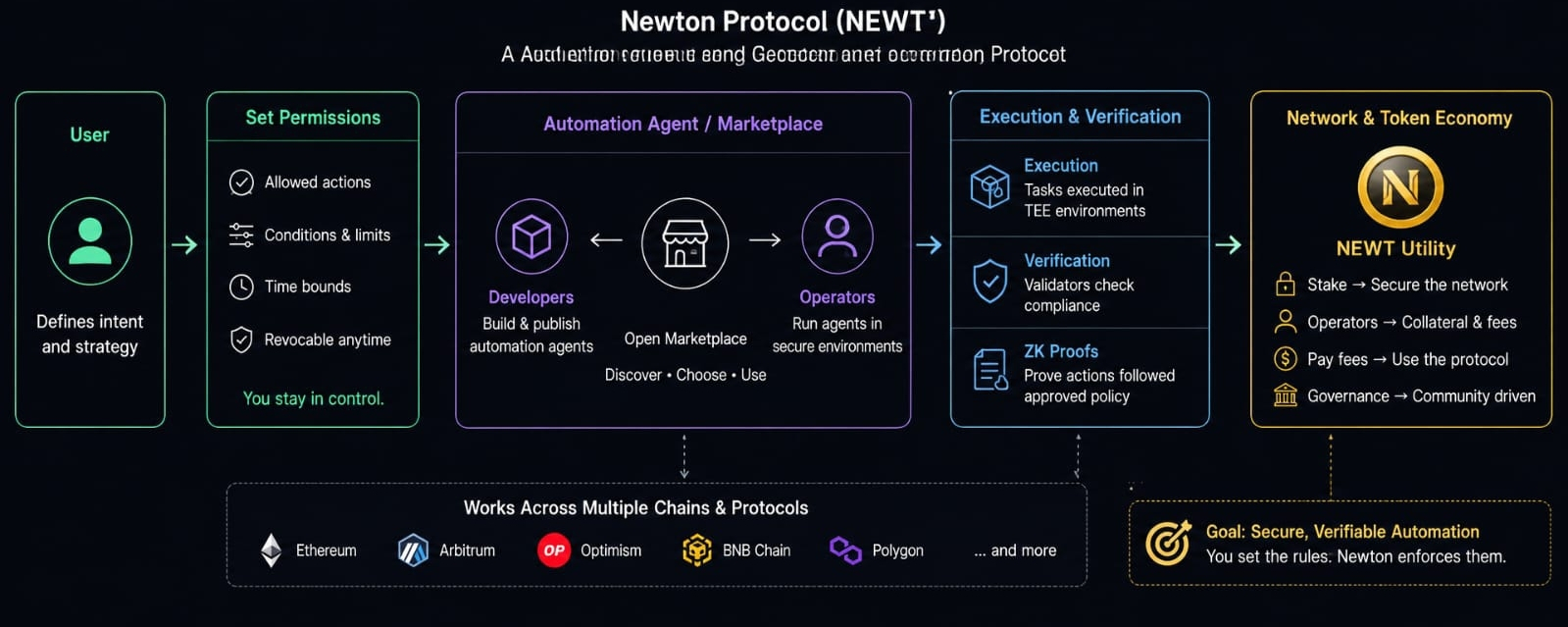

Newton Protocol is one of those projects that made me stop scrolling, not because it promised AI, but because it was trying to fix something that has been quietly broken in crypto for years. Everyone loves talking about autonomous agents and automated strategies, but almost nobody talks about the part that actually matters. How do you let software touch your assets without giving it enough power to drain your wallet? That's the mess Newton is trying to clean up.
Look, anyone who's spent enough time on-chain has probably collected a graveyard of wallet approvals. You connect to a protocol once, sign a few transactions, forget about it, and six months later you can't even remember what still has permission to move your tokens. It happens to everyone. Crypto keeps getting smarter, yet the way we hand out trust still feels stuck in the early days.
The thing is, automation was never the hard part. We've had bots for years. Trading bots. Yield bots. Rebalancing bots. Every cycle brought another wave of them. The problem was always trust. Every time someone said, "Just let this bot manage your portfolio," my first thought wasn't about returns. It was whether I'd wake up to an empty wallet because I signed one approval too many.
That's where Newton feels different.
Instead of asking you to trust the agent, it tries to limit the agent. That sounds simple. It really isn't. Under the hood, the protocol is built around permissions instead of blind access. You decide what an automated system is allowed to do, and those boundaries stay in place. If an action falls outside those rules, it doesn't happen. It's not flashy. It's just necessary.
Honestly, that's the kind of infrastructure crypto has needed for a long time. We spend so much time chasing the next narrative that we forget how much of this industry still runs on duct tape and assumptions. Everyone wants AI to trade better. Very few people are asking whether AI should even be trusted with private assets in the first place.
Newton doesn't pretend the answer is unlimited automation.
It tries to make automation accountable.
That distinction matters.
The architecture itself reflects that mindset. Execution doesn't automatically mean trust. Operators run tasks, validators verify them, and cryptographic proofs make sure everything stays inside the rules that users originally approved. Most people won't care about the technical details, and honestly they shouldn't have to. What matters is that the system isn't asking for blind faith. Crypto has had enough of that already.
I also like that the project isn't built around one single AI model that's supposed to solve everything. Developers can create their own automation agents, publish them, and let users decide what they actually find useful. That feels far healthier than pretending one algorithm is somehow smarter than every trader, investor, or treasury manager on the internet.
Of course, none of this is easy.
Building secure automation is probably one of the hardest infrastructure problems in crypto right now. It's not enough to write good smart contracts. You have to think about execution, verification, permissions, incentives, and security all at once. Miss one piece and the entire thing starts to fall apart.
That's probably why there aren't many projects seriously trying to solve it.
The NEWT token fits into that infrastructure instead of feeling like something added later because every crypto project needs a token. Validators stake it, operators use it within the network, governance gradually becomes decentralized, and the protocol economy grows around actual activity rather than existing as a disconnected asset. Whether that translates into long-term value is another question entirely. Crypto has never been great at rewarding infrastructure early.
Look, the market will probably keep chasing louder narratives. That's just how this space works. AI hype comes and goes. Memecoins explode. Liquidity moves somewhere else. Another shiny trend takes over. Meanwhile the boring plumbing underneath either gets built properly or it doesn't.
Newton feels like it's working on the plumbing.
Maybe that's why it doesn't immediately grab everyone's attention.
Maybe that's exactly why it's worth paying attention to.