
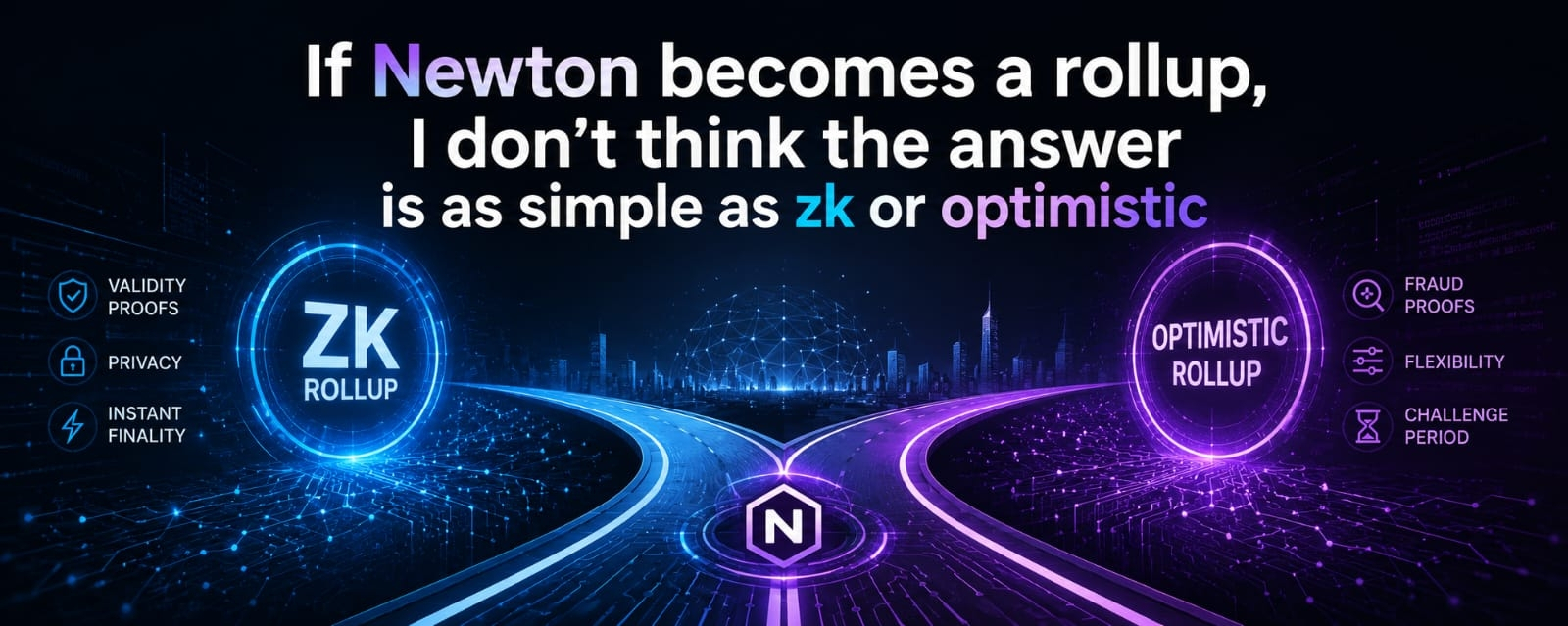
I’ve been around crypto long enough to get tired whenever a new project is immediately pushed into the same old boxes.
Is it zk?
Is it optimistic?
Is it an AVS?
Is it a rollup?
Is it modular?
Those questions matter, but they can also become a way to avoid thinking.
With Newton, I think the more useful question is: if an AI agent is going to move money, what do we actually need to check before we let it act?
That is where this starts to feel different.
A normal rollup is mostly about execution. Did the transaction follow the rules? Was the state updated correctly? Can users trust the settlement path?
AI finance has another problem. The transaction can be technically valid and still be a terrible idea. An agent can follow the rules and still take too much risk. It can move quickly, react to a signal, rebalance a position, or enter a trade before the user even understands what happened.
So I don’t think Newton’s future design should be judged by a simple zk versus optimistic debate.
ZK makes sense when the claim is clean. Prove a wallet stayed under a risk limit. Prove a policy matched. Prove a condition was met without exposing the whole strategy.
But proving that an AI made a “good” decision? I don’t buy that. Markets are messy. Models are messy. A trade can be smart and still lose money. It can be reckless and still win.
Optimistic systems have their own issue. They give room for disputes, but AI trading often happens in moments where waiting too long creates a new kind of risk. By the time a challenge finishes, the market may already have moved on.
That is why Newton is more interesting to me as a control layer than as just another execution layer.
The pieces that matter are not only the rollup pieces. They are the policy rules, outside data checks, operator attestations, verification flow, and challenge paths. All of that points to one simple question: should this action be allowed before capital moves?
That question feels boring until something breaks.
And in crypto, things usually feel boring right up until they matter.
I keep noticing how much of the AI-agent conversation is still focused on speed and automation. Faster agents, smarter agents, more autonomous agents. Fine. But we already have enough ways to move assets quickly. What we do not have enough of is restraint.
Who says no?
Who checks the limits?
Who proves the agent stayed inside the user’s rules?
Who handles the gray areas where outside data, timing, and intent do not fit neatly into a proof?
That is why a hybrid model feels more realistic.
Use AVS-style verification for fast permission checks.
Use zk proofs where the claim is narrow and provable.
Use optimistic challenges where the situation is messy and needs dispute resolution.
Not every risk should be handled with the same tool.
I’m not sure Newton gets all of this right. Early crypto designs always look cleaner before real users, real incentives, and real market stress show up. I’ve seen plenty of smart architectures become fragile once money starts moving through them.
But the problem Newton is pointing at feels real.
If AI agents are going to trade, rebalance, allocate, and interact with DeFi for users, the market will need more than faster settlement. It will need a layer that can slow the agent down when something looks wrong.
So if Newton becomes a rollup, I don’t think the best version is purely zk, purely optimistic, or purely AVS-verified.
The useful version is probably a mix.
Not a rollup that proves AI is smart.
A rollup that proves AI was not allowed to ignore the rules.