
Zero-Knowledge Proofs in Newton Protocol: A Beginner's Guide
Most explainers of zero-knowledge proofs in crypto start from the same place: proving you know something without revealing what you know, usually framed as a trust-minimization tool for strangers transacting on a public ledger. Newton Protocol uses ZK proofs too, but the framing that keeps surfacing once you dig into the litepaper is different enough to be worth sitting with. The line that stood out was almost a throwaway: receipts and zero-knowledge proofs, where every policy evaluation produces a cryptographic receipt, and "when privacy is essential," zero-knowledge proofs confirm compliance without revealing the underlying credential or transaction metadata. Essential is doing a lot of work in that sentence. It implies ZK isn't the default path — it's the path you reach for specifically when something needs to stay hidden.
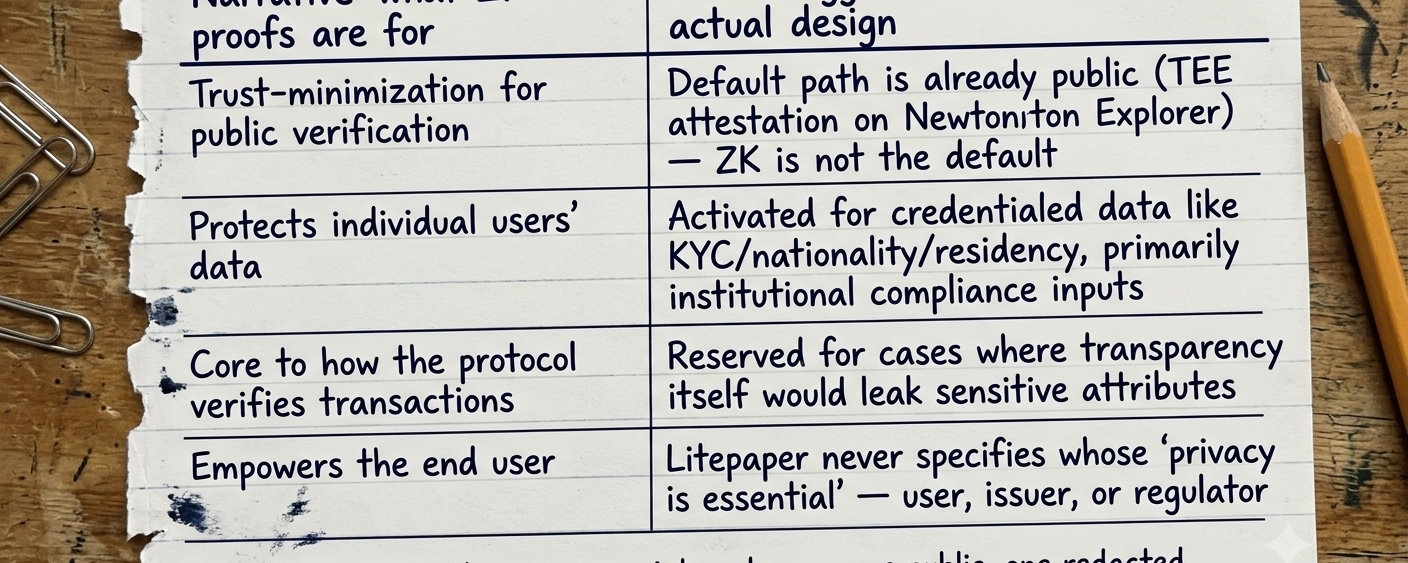
That's worth unpacking because it inverts the usual pitch. In most DeFi contexts, ZK proofs get introduced as a scaling or trust tool — batch a thousand transactions, prove the batch is valid, let anyone verify without re-executing anything. The public gets more confidence with less computation. In Newton's architecture, the more common evaluation path runs through the TEE-secured operator network producing attestations that a policy check happened correctly, verifiable openly through the Newton Explorer. ZK proofs get layered in specifically for the subset of checks where the input data — an identity credential, a KYC attribute, a transaction's underlying metadata — needs to stay off the public record entirely. So the two verification mechanisms aren't doing the same job with different math. One is a public compliance receipt. The other is a redaction tool that still produces a receipt, just one that hides what it checked.
The design choice becomes clearer once you look at what triggers it. Newton's Persona integration, for instance, connects validated identity attributes — age, nationality, residency — into the policy engine so jurisdictional checks happen at the transaction level. The documentation is explicit that this happens without exposing personal data onchain, and separately notes that Newton's TEEs ensure identity attributes inform policy outcomes without being written to any public ledger. Somewhere in that pipeline, when the compliance requirement calls for genuinely sensitive attributes rather than simple pass/fail conditions, the SP1 zkVM programs get invoked instead of the standard Rego-based evaluation. The pattern that emerges is: default enforcement is transparent and publicly auditable, and ZK gets reserved for the moments where transparency itself would be the compliance failure — where showing your work would leak exactly the personal data the check was supposed to protect.
That's a genuinely sensible engineering decision. It's also a quiet tell about who the protocol is actually built for. A retail user delegating a swap doesn't typically need their nationality or KYC status hidden from a public explorer — they'd probably rather not have it collected at all. The use case where "prove compliance without revealing the credential" becomes essential is almost always institutional: a stablecoin issuer proving to a regulator that every mint passed jurisdictional screening, an RWA platform proving investor eligibility to an auditor without publishing investor identities, a fund proving accreditation checks ran without disclosing its investor list to competitors. ZK, in this context, isn't protecting the individual from the institution. It's protecting the institution's operational data from the public, while still letting the institution assert compliance to a regulator who's satisfied by a valid proof rather than raw records.
There's a specific kind of relief in seeing that clearly, and also a specific kind of unease. The relief is that the cryptography is doing exactly what it says — nothing about the ZK layer in Newton looks hand-wavy or performative, the SP1-based approach is a real, checkable proof system, and "verifiable without disclosure" is a legitimately hard problem solved reasonably well here. The unease is noticing how naturally the ZK narrative gets absorbed into the same "trustless, permissionless, user-empowering" language that surrounds the rest of crypto, when the actual beneficiary of this specific privacy mechanism is more often the compliance department than the end user. It's not deceptive, exactly. It's just that the marketing vocabulary was built for a different subject and never got updated when the subject changed.
I found myself rereading the "when privacy is essential" phrase a few times, mostly because it never specifies essential to whom. Essential to the user whose data would otherwise be exposed? Essential to the institution that can't afford a compliance leak? Essential to regulatory requirements that mandate confidentiality of certain records? All three answers are plausible and none of them are stated. That ambiguity isn't necessarily a flaw in the protocol — most compliance infrastructure genuinely serves overlapping interests, and a proof that protects a user's nationality from public view is also, incidentally, protecting the issuer from a data liability. But it does mean the "beginner's guide" version of this feature, the one that gets simplified into "ZK proofs keep your data private," glosses over whose privacy problem is actually driving the design.
What stays with me is less the cryptography and more the org chart implied by it. A protocol whose default verification path is public and whose private path activates specifically for credentialed, regulated data is a protocol built around institutional compliance workflows first, with individual privacy as a structural byproduct rather than the stated design goal. Whether that's a fair way to build compliance infrastructure is a separate question from whether it's being described accurately — and reading the docs, it's hard to tell if the "essential" threshold for triggering ZK is set by user preference, regulatory mandate, or institutional risk appetite, since the litepaper never quite says which lever gets pulled first.