
I was standing in line at the grocery store yesterday, watching the cashier scan items one by one with mechanical precision. The rhythm felt comforting until I noticed how the whole system slowed when one barcode refused to register. A small glitch, a quiet inefficiency, and suddenly the line of impatient people grew. It reminded me how much we depend on invisible layers of coordination that we rarely question.
Later that afternoon, while completing the CreatorPad campaign task and typing into the protocol description field, something shifted. The screen prompted for specifics on intelligent routing and adaptive mechanisms, and in that moment of trying to articulate how Newton Protocol handles decision-making across layers, the friction hit. What if the intelligence we're chasing in crypto doesn't emerge from removing all control, but from carefully placing it where humans and machines meet? That thought unsettled me more than any market dip ever has.$NEWT
The uncomfortable truth is that we've built an entire culture around the idea that decentralization is the ultimate virtue, the cure for every failure of trust. We repeat it like a mantra: more nodes, fewer points of failure, pure permissionless magic. Yet when you sit with the actual mechanics of building something intelligent—systems that need to observe, adapt, and optimize in real time—the purity starts to crack. True intelligence demands memory, context, and sometimes privileged access to information that can't always live transparently on-chain for everyone at once. It's not glamorous to admit, and it risks sounding like a betrayal of first principles, but pretending otherwise leads to brittle projects that perform decentralization theater while quietly relying on off-chain crutches anyway.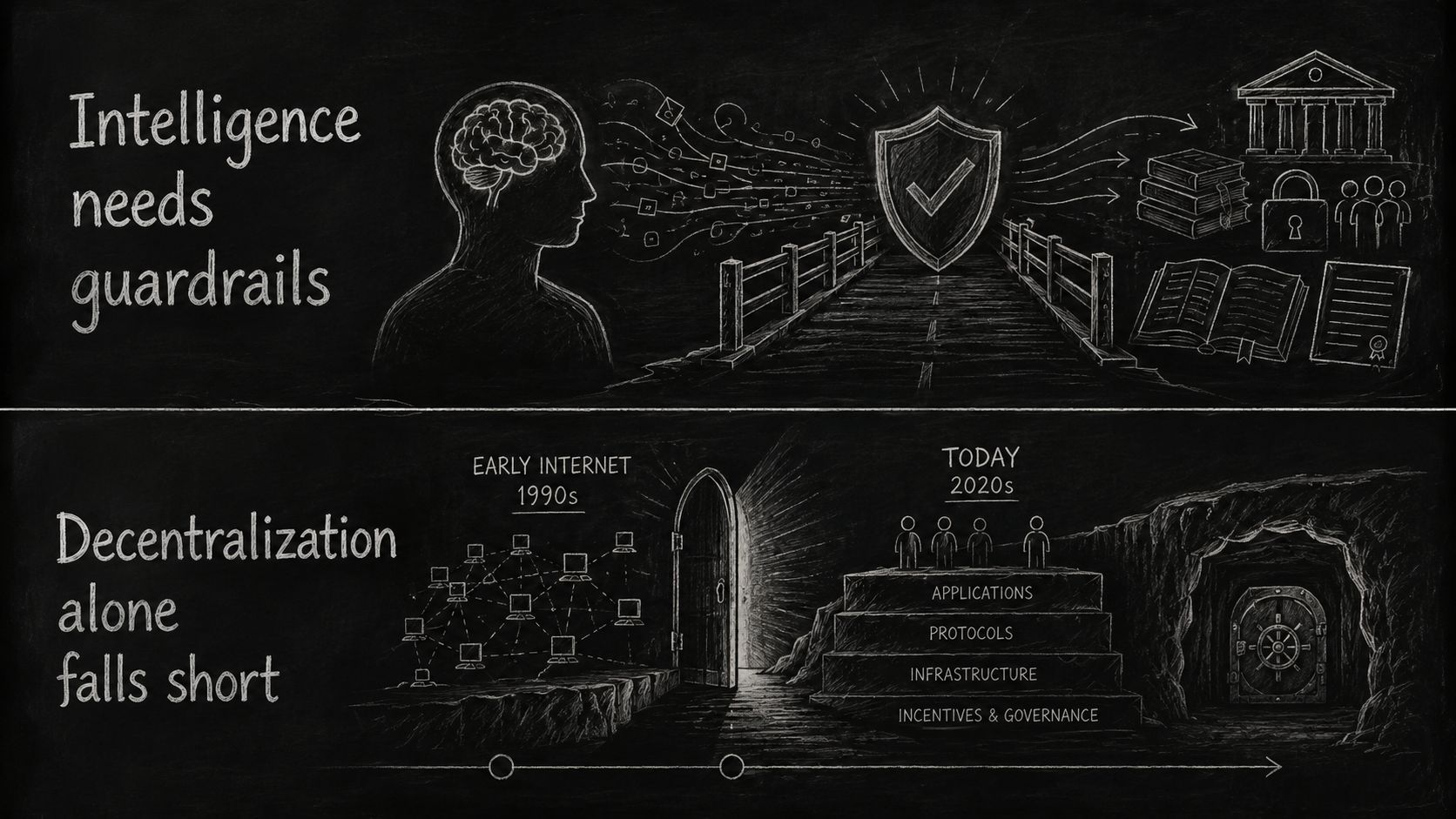
This isn't about returning to old corporate gatekeepers. It's about recognizing that intelligence and radical transparency can pull in opposite directions. A protocol that learns from usage patterns needs reliable data feeds. One that routes value intelligently might require temporary arbitration layers that aren't fully visible or contestable in the moment. The crypto belief that "code is law and everything else is compromise" starts to feel like a comforting story we tell ourselves rather than a practical architecture for complex, evolving systems. We've seen it play out in slower, more painful ways: bridges that collapse under unexpected conditions, DAOs paralyzed by governance theater, oracles that become single points of failure despite the rhetoric. The discomfort comes from realizing that scaling intelligence might mean designing better, more accountable points of coordination rather than dissolving them entirely.
Newton Protocol stands out here not because it promises revolution, but because its infrastructure seems built around this tension. In the campaign task details, the emphasis on adaptive layers and intelligent components forced me to confront how their approach navigates the space between pure decentralization and functional decision-making. It doesn't shout about it, but the design quietly acknowledges that smart systems need structure—guardrails that evolve without pretending the guardrails don't exist. This feels different from the usual narrative where every new chain claims to be the most decentralized yet delivers familiar bottlenecks.
The broader implication stretches beyond any single project. If we keep measuring success only by how many validators run the software or how resistant it is to any form of coordination, we might optimize for the wrong resilience. Real-world problems—cross-chain coordination, data availability under load, responsive upgrades—don't always yield to purist solutions. They reward protocols willing to engineer thoughtful asymmetries: places where visibility is high but intervention is constrained and auditable. It's a subtler craft, less heroic in the stories we tell, but potentially more durable.
Yet this leaves an open tension. If intelligence requires accepting some managed imperfection, how do we build trust in those management layers without recreating the centralized failures we fled in the first place? The question lingers because the alternative—clinging to decentralization as an absolute—might keep us scanning the same stubborn barcodes forever, waiting for the line to move. @NewtonProtocol ,$NEWT ,#Newt