
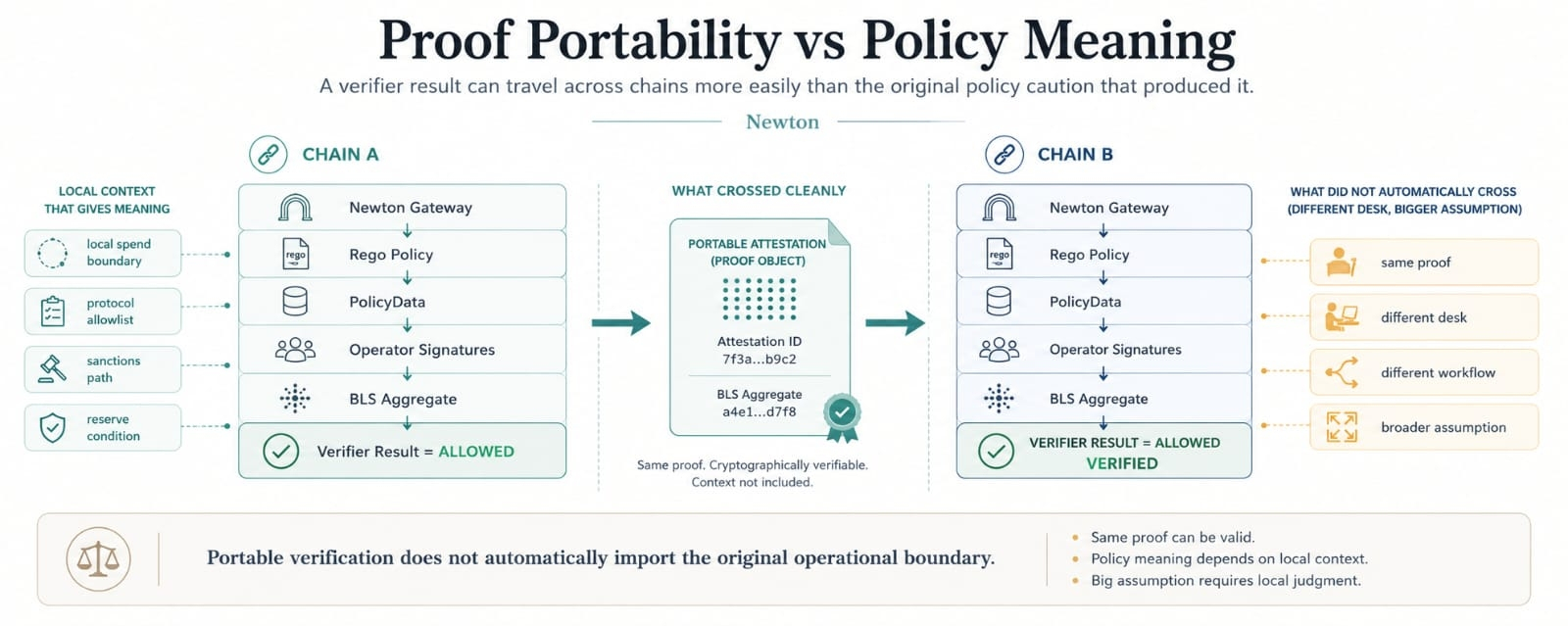
I was staring at a clean Newton verifier result on the wrong chain... and it was doing way too much social work.
Same proof. Different desk. Bigger assumption.
Anyways.
Thats what kept bothering me.
Not whether attestation verified. It did. Cleanly. Newton protocol Gateway took the task, Rego read the policy, PolicyData pulled in the outside state, operators signed, BLS aggregate landed, verifier on the other side said yes. Fine. Good. Very portable. That’s the part everyone likes.
The ugly part came after.
Because the second that same result shows up on another chain... people start reading more into it than Newton ever promised. Not even broader clearance, really. Broader confidence. That's worse.
fine.
Say one team clears a task on Ethereum under a local spend boundary, one protocol allowlist, one sanctions path, one reserve condition they actually know how to interpret because they were in the room when the tolerance got set. Fine. Messy, but local. They know what “allowed” means there because they remember the edge cases. They remember which compromise got made. They remember why one venue stayed in the allowlist and another one got cut.
Then the same clean Newton result lands somewhere else. Base, Arbitrum, whatever. Different desk. Different workflow. Different appetite. Same verifier result sitting there looking calm enough that nobody wants to be the first person to say maybe this yes was narrower than it looks.
Same verifier result. Different desk. Bigger assumption.
That’s where Newton starts getting more interesting to me. And more annoying too. TBH.
Because Newton's chain-agnostic part is real. Newton protocol's lightweight verifier path is real. The proof crosses fine.
Nice.
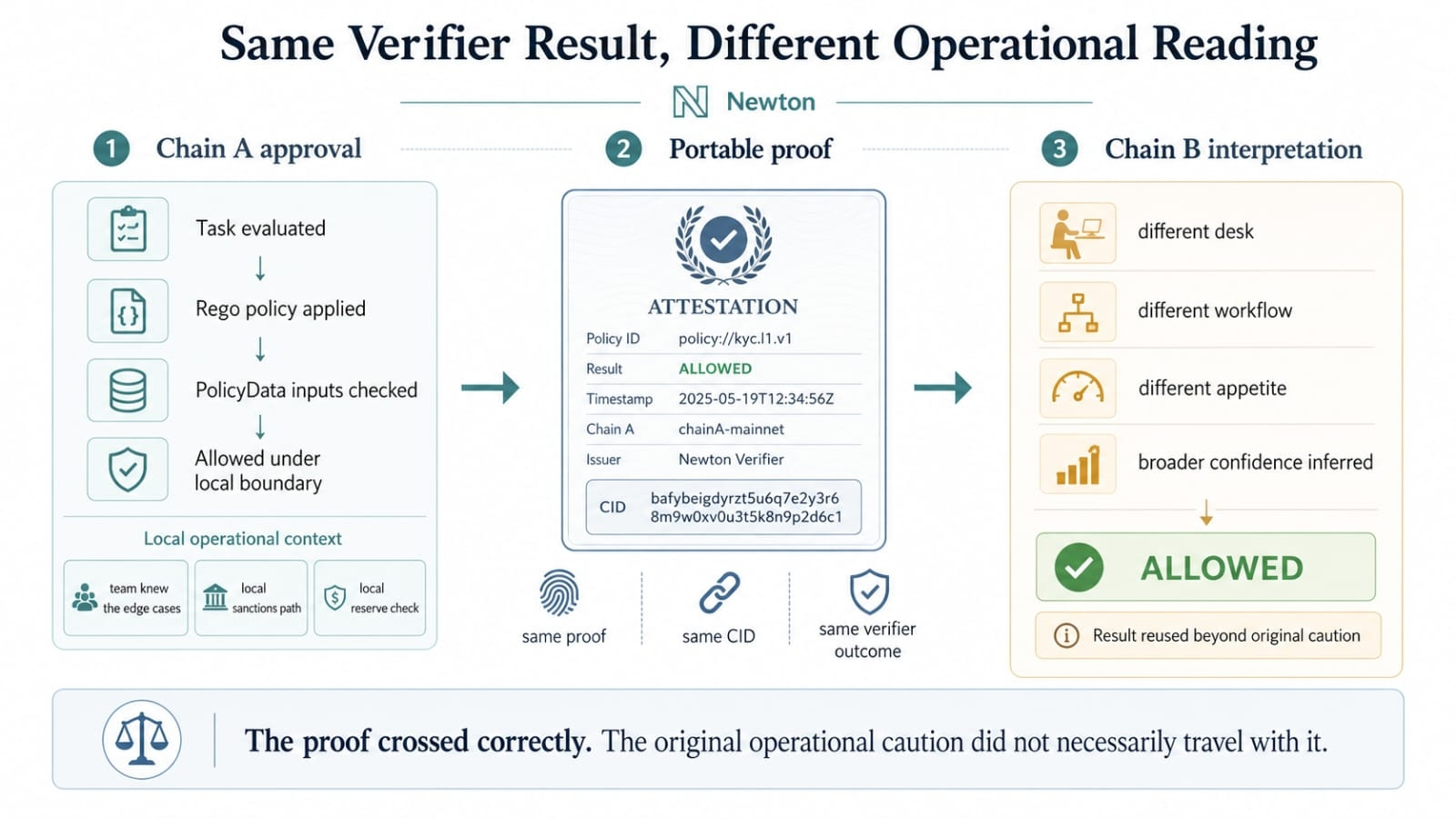
Newton’s verifier path stays clean. The PolicyData inputs do not suddenly become universal just because the attestation verified on chain B. Still doesn’t mean the original caution crossed with it. Still doesn’t mean the spend boundary traveled. Still doesn’t mean the receiving workflow inherited the same mood, the same tolerance, the same local discomfort that made the first team comfortable enough to let it pass.
Half the time they just inherit the green result and call that enough.
But people act like it did.
Of course they do.
Verifier goes green and everyone starts behaving like meaning came with it.
Didn’t.
I keep picturing one boring ops path on chain B treating that clean Newton result like broad approval instead of local clearance under chain A’s assumptions. Not because anyone is reckless exactly. Worse than that. Because the proof looks respectable, the PolicyClient path is clean, the verifier contract says yes, and suddenly no one feels like reopening the original policy boundary just to ask whether it was ever supposed to travel this far.
Nice little portability story.
Bad room.
And once that happens the blame surface gets stupid fast. Team A says the proof only covered what their Rego and PolicyData inputs said on chain A. Team B says the attestation looked sufficient to proceed. Someone else says if the policy CID was portable enough to verify here then obviously the decision was meant to be reusable here too. Great. Very adult. Meanwhile nobody can say whether chain A’s reserve check was ever supposed to mean anything on chain B. Meanwhile Newton’s result is already doing social work on chain B by then, and the task already moved, and now everyone is pretending the disagreement started after execution instead of at the exact moment somebody confused cross-chain verification with cross-chain meaning.
That’s the bruise.
Same yes. Different room.
I’ve sat in versions of that room before. Not Newton specifically. Same disease though. One team says “allowed under this policy” and the next team quietly hears “safe enough.” By the time anyone notices the gap, the action already settled and now review wants one human answer for a problem that has already been flattened into verifier receipts, operator signatures, and a policy CID nobody in the receiving workflow really knew how to read in local terms.
Great. Still not the same approval.
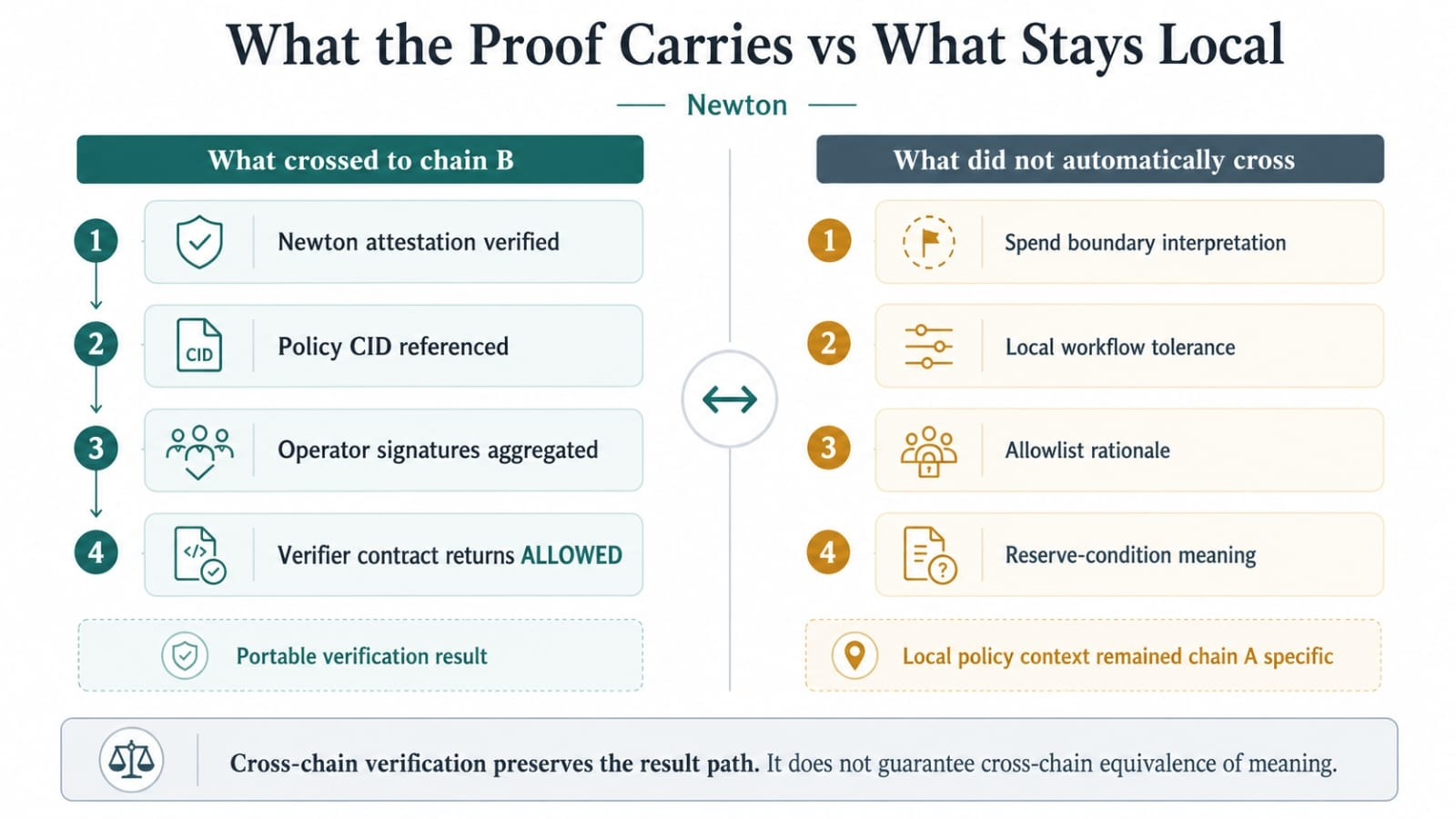
And Newton makes this easier to flatten because Newton’s multichain path stays too clean. Gateway route. PolicyData. Rego. Operator signatures. BLS. Verifier on chain B.
Clean trail. Bad import.
Meanwhile nobody in that room can agree whether the original outside inputs were local facts, portable facts, or just one chain’s way of calming its own workflow down before the result got reused somewhere else.
That’s the part I can’t get past.
Not interoperability in the abstract. Not multichain in the boring pitch-deck sense. The uglier part. The moment a proof verifies on @NewtonProtocol correctly on the wrong side of an operational boundary and everybody starts smuggling in confidence that was never in the attestation to begin with.
Alright.
proof crossed. Fine. I’m still not sure who decided the original boundary crossed with it too.