
Artificial intelligence seems to be everywhere in crypto right now. Almost every week there's another project promising smarter AI agents, automated trading, or decentralized AI services. I enjoy following the trend, but lately I've been asking myself a different question: who actually controls these AI agents once they're handling real assets on-chain?
That question feels much more important than whether an AI can execute trades a few milliseconds faster.
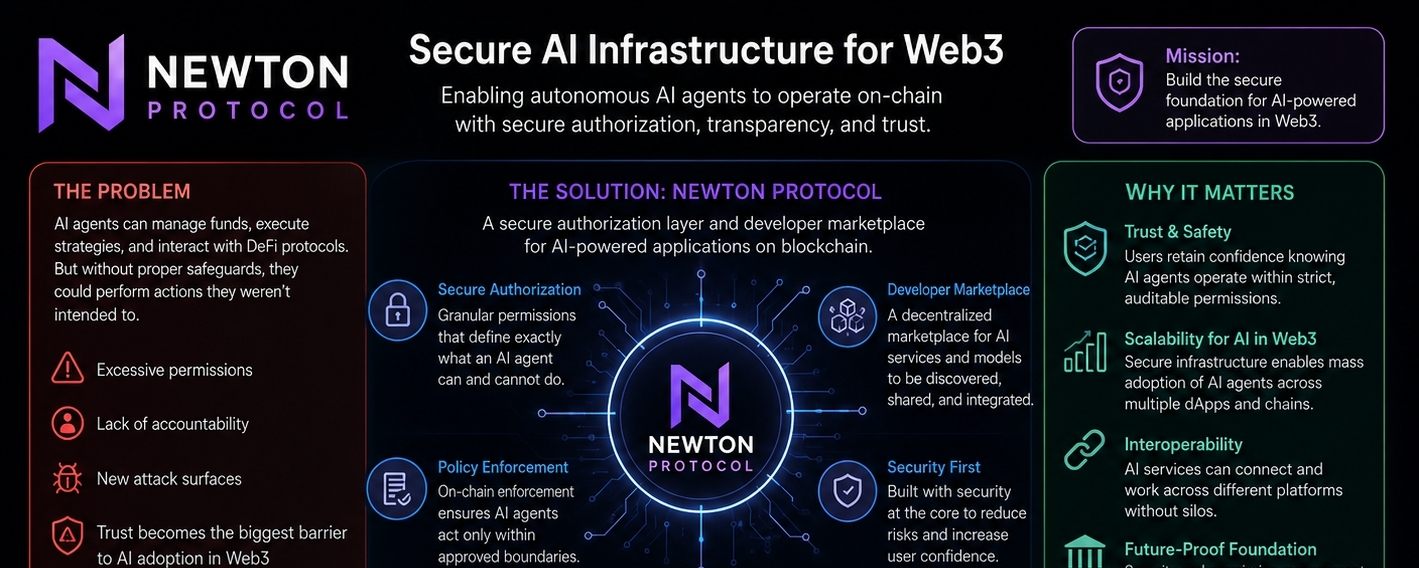
When I first came across Newton Protocol (NEWT), I almost dismissed it because it isn't marketed as another flashy AI application. After digging deeper, though, I realized it's focused on something much less exciting on the surface—but potentially far more important over the long run. Instead of building another AI tool, Newton Protocol is trying to create secure infrastructure where AI-powered applications can safely operate on blockchain networks.
To me, that's a much bigger conversation than simply making AI "smarter."
The biggest challenge with autonomous AI isn't intelligence. It's trust.
If an AI agent can manage a portfolio, execute DeFi strategies, or move funds between protocols, users need confidence that it can't suddenly perform actions it wasn't supposed to. That's where Newton Protocol's idea of secure authorization stands out.
Rather than giving AI unlimited control, the protocol is designed around clearly defined permissions that determine exactly what an AI can and cannot do. I think that's a healthier direction for the industry because automation should reduce repetitive work—not remove accountability altogether.
One thing I've noticed while following the recent AI narrative is that many investors pay attention to the applications but rarely think about the infrastructure supporting them. It reminds me of how blockchain scaling solutions were once overlooked until network congestion became impossible to ignore.
Infrastructure usually isn't exciting at first.
But once adoption grows, everyone suddenly realizes how essential it is.
Another feature that caught my attention is Newton Protocol's marketplace for AI developers. Instead of building isolated AI models that exist in their own ecosystems, developers could potentially create reusable services that interact with different blockchain applications.
If that ecosystem develops successfully, I can imagine it encouraging collaboration instead of fragmentation. Developers gain access to a larger audience, while projects can integrate specialized AI services without reinventing everything from scratch.
Of course, none of this guarantees success.
Crypto has no shortage of technically impressive projects that struggled because they couldn't attract developers or meaningful adoption. Newton Protocol still needs an active community, practical integrations, and consistent execution if it wants to become part of the broader Web3 infrastructure stack.
Security is another area where real-world performance matters more than ambitious roadmaps. AI interacting with financial systems creates entirely new attack surfaces, and every security model eventually gets tested under real market conditions. Building trust won't happen overnight—it has to be earned through reliability over time.
Competition is also increasing rapidly. AI and blockchain have become one of the industry's busiest sectors, with dozens of teams exploring different approaches. Having solid technology alone isn't enough anymore. Projects also need strong developer support, practical use cases, and continuous innovation to remain relevant.
Still, I think Newton Protocol is approaching a problem that many people underestimate today but could become impossible to ignore later.
If AI agents eventually become responsible for managing digital assets, coordinating decentralized services, or executing complex financial strategies, secure authorization won't be an optional feature. It'll become one of the foundations that makes the entire ecosystem trustworthy.
I've also learned one lesson over the past few market cycles: it's easy to get distracted by tokens that dominate headlines for a few weeks. I made that mistake before by paying more attention to hype than to the infrastructure quietly being built underneath the market.
These days, I find myself paying closer attention to projects solving structural problems rather than chasing the loudest narratives.
That's why Newton Protocol has stayed on my watchlist.
I'm not looking at it because I expect overnight price moves. I'm watching because I believe secure AI infrastructure could become one of the missing building blocks for the next generation of decentralized applications. If AI continues expanding across Web3 the way many people expect, projects focused on security, permission management, and trustworthy automation may end up becoming some of the ecosystem's most valuable foundations.
Whether Newton Protocol ultimately achieves that vision remains to be seen, but I think it's asking one of the right questions at exactly the right time. And in crypto, solving the right problem is often a better starting point than simply following the latest trend.
As always, this is just my personal perspective based on my own researcot financial advice. I'd love to hear what others think. Do you believe AI infrastructure projects like Newton Protocol could become a core part of Web3, or will the biggest winners be the consumer-facing AI applications instead
