
Every technological revolution eventually discovers that its greatest limitation is not performance but infrastructure. The internet did not become useful simply because computers became faster; it became transformative because reliable networks connected them. Cloud computing was not defined by more powerful servers but by the systems that made computing accessible at scale. Artificial intelligence may now be approaching a similar turning point. The models continue to improve, yet the systems responsible for deploying, verifying, and coordinating those models remain fragmented.
This gap becomes especially visible in blockchain. AI agents are increasingly capable of analyzing markets, managing digital assets, and executing complex financial strategies without constant human supervision. However, the infrastructure supporting these autonomous systems has not evolved at the same pace. Most blockchains were designed to record transactions between people, not to coordinate intelligent software operating continuously across decentralized environments.
As a result, developers often combine AI services with off-chain infrastructure while using blockchain only as a settlement layer. This architecture works for simple applications, but it introduces a difficult trade-off. The blockchain may verify that a transaction occurred, yet it usually cannot verify how the AI reached its decision or whether the execution environment behaved as expected. Trust therefore shifts back toward centralized servers and platform operators, reducing many of the transparency benefits that blockchain originally promised.
Several blockchain projects have attempted to integrate artificial intelligence over the past few years. Some focused on decentralized computing networks, while others created marketplaces where AI models could be shared or monetized. These approaches expanded access to AI resources, but they rarely addressed the broader challenge of execution infrastructure. Making AI available is not necessarily the same as making AI accountable. A decentralized marketplace can distribute models, yet users may still have limited visibility into how those models operate after deployment.
Newton Protocol approaches the problem from a different direction. Instead of presenting itself as another AI platform, it positions itself as infrastructure specifically designed for AI-driven applications. According to the project's vision, autonomous software requires an execution layer that combines blockchain verification with scalable computation. Rather than asking users to trust individual operators, the protocol aims to build an environment where important actions can be independently verified through cryptographic mechanisms.
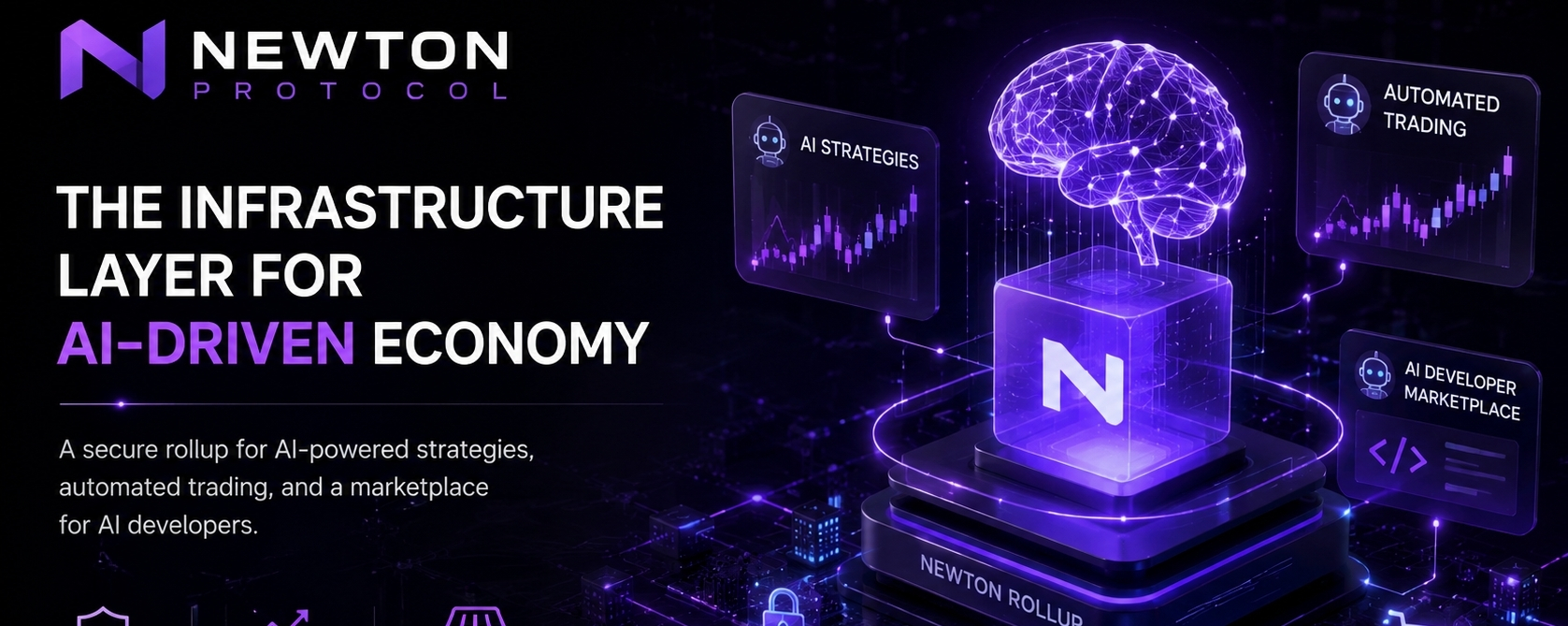
The project describes itself as a secure rollup intended for AI-powered strategies, automated trading systems, and a marketplace where developers can publish AI applications. The rollup architecture is designed to process large volumes of activity more efficiently than executing everything directly on a base blockchain. Heavy computational work remains outside the main chain, while verification data and transaction records are anchored on-chain. In theory, this attempts to balance scalability with transparency.
Another important claim is the creation of an open marketplace for AI developers. The idea is that developers should not only build intelligent applications but also distribute them through an ecosystem where users can discover and utilize different AI agents. If successful, such a marketplace could encourage experimentation and reduce dependence on proprietary platforms. It reflects a broader movement within Web3 toward open participation instead of closed software ecosystems.
Perhaps the most ambitious aspect of Newton Protocol is its emphasis on AI-driven financial automation. The protocol suggests that autonomous trading strategies can operate within infrastructure that records execution in a verifiable manner. This does not necessarily guarantee profitable decisions, but it seeks to make the execution process more transparent than many existing centralized systems.
These objectives address genuine challenges. Verification is becoming increasingly important as AI systems begin making financial decisions with minimal human intervention. Infrastructure that improves auditability could become valuable, particularly for developers building applications where transparency matters as much as computational performance. In this respect, Newton Protocol identifies a real limitation within today's blockchain ecosystem rather than attempting to invent a new problem.
Nevertheless, several questions deserve careful consideration. Verifying execution is fundamentally different from verifying intelligence. Blockchain may prove that specific instructions were followed correctly, but it cannot determine whether those instructions reflected sound reasoning or high-quality machine learning. Model selection, training data, and algorithm design remain outside the scope of blockchain verification. Users may therefore continue relying on developer credibility even if execution becomes more transparent.
The marketplace concept also introduces practical uncertainties. Open ecosystems frequently generate innovation, yet they also attract inconsistent quality. If hundreds of AI applications become available, users will still require effective methods to distinguish reliable systems from poorly designed ones. Reputation mechanisms, independent audits, and community evaluation may ultimately become as important as the protocol itself.
The rollup architecture represents a practical engineering decision, but it is accompanied by familiar trade-offs. Rollups generally improve throughput and reduce transaction costs, making them suitable for applications involving frequent AI interactions. At the same time, they introduce additional infrastructure layers, proving systems, and operational assumptions that users must understand. Greater scalability rarely comes without greater architectural complexity.
Developers building autonomous applications, quantitative trading systems, or AI services may benefit most from this design. By contrast, users expecting blockchain infrastructure alone to solve the broader problems of AI reliability may find that many uncertainties remain beyond the reach of cryptographic verification. Transparency can improve accountability, but it cannot eliminate the unpredictability inherent in intelligent systems.
As artificial intelligence becomes increasingly autonomous, the conversation may gradually move beyond building smarter models toward building environments where those models can operate responsibly. Whether Newton Protocol represents an important step in that direction may depend less on the sophistication of its technology and more on a broader question: can infrastructure itself become a source of trust, or will confidence in AI always depend primarily on the people who build it?