
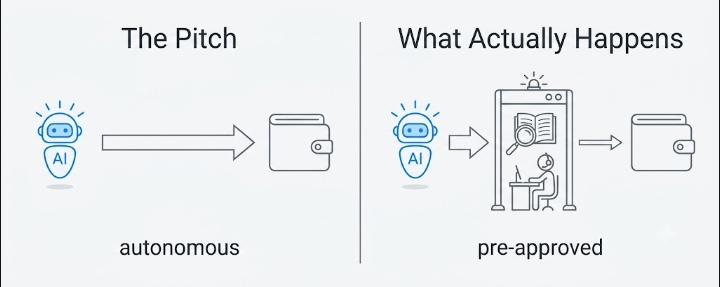
Newton ($NEWT ) is framed everywhere — the project's own materials — as a verifiable automation layer that lets you delegate financial tasks to autonomous agents while keeping cryptographic control. Fine, that's the pitch every agent protocol makes right now. But when you actually read how a transaction moves through the system, the word "autonomous" starts doing a lot of heavy lifting it maybe shouldn't.
Here's the mechanism, stripped down. An agent wants to do something onchain. A lightweight hook in the target smart contract routes that request to Newton's network before it executes. Operators — restaked via EigenLayer — evaluate the request against policies written in Rego, a declarative rules language usually associated with enterprise access control, not crypto. Only after that evaluation produces a cryptographic attestation does the action actually go through.
So the agent isn't really acting autonomously in the moment. It's proposing an action, and a separate operator network is checking that action against predefined rules before letting it settle. I initially read this as "just permissions, like any smart account setup" — but then I hit the line in the litepaper about regulators being able to monitor agent activity through these same policy receipts, getting a "real-time, machine-readable, privacy-preserving view into financial activity." That's when it clicked differently for me. This isn't primarily agent-freedom infrastructure. It's a compliance checkpoint that agents happen to run through.
I'm not saying that's bad, necessarily. Institutions probably need exactly this before they'll let any AI system touch real capital. But it's a different product than "autonomous finance" implies, and I think a lot of people buying the narrative are picturing agents operating independently, when what's actually being built is closer to a permissioning layer with regulator-legible receipts sitting in front of every agent action.
Here's the part that bothers me though. If every meaningful action has to clear an operator-evaluated policy check first, how "autonomous" can an agent economy actually get before that becomes a bottleneck? EigenLayer-restaked operators evaluating Rego policies for every transaction sounds robust on paper, but robust and fast aren't always the same thing, and agentic strategies — arbitrage, liquidations, fast rebalancing — are often exactly the use cases where added latency matters most. I haven't seen throughput numbers that convince me this scales the way high-frequency agent behavior would need it to. Maybe it does. I just don't have that confirmed yet.
There's also a smaller thing sitting in the back of my mind — the transparency report mentions a "structured sale program for project leadership" and a 12-month cliff with 36-month vesting for core contributors and early backers. Not unusual for a token launch, but it's worth remembering alongside the "user sovereignty" language, since sovereignty and insider unlock schedules are two separate conversations that tend to get blended into one clean narrative.
Where this actually matters, I think, is less for retail users automating a DCA strategy and more for institutions that need an audit trail before they'll let any agent near custody. If that's the real target market, the marketing might want to say "compliance infrastructure for agentic finance" instead of just "autonomous finance" — because right now those two phrases are pulling in slightly different directions, and I don't think most people scrolling past the token ticker are catching the distinction.