
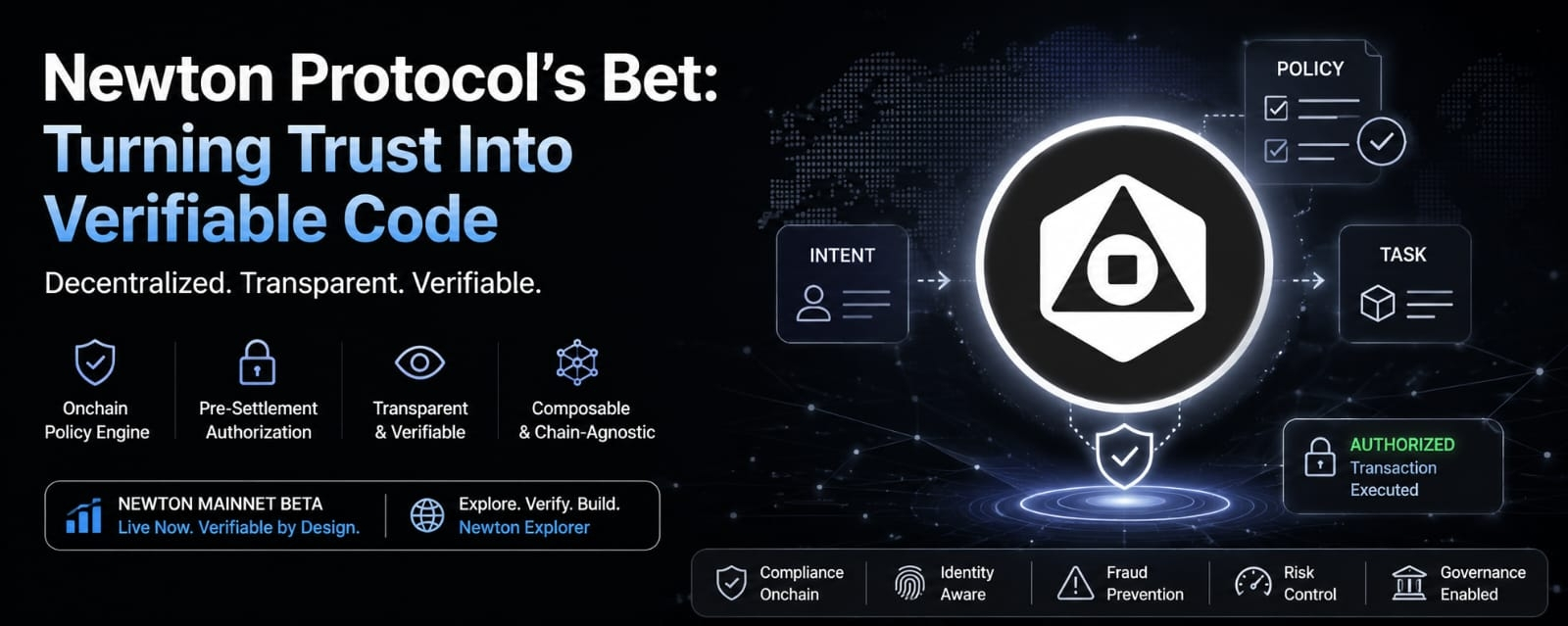
I keep coming back to one simple idea with Newton Protocol: crypto was supposed to reduce our dependence on middlemen, but in practice, we still outsource a lot of trust. We trust interfaces, operators, custodians, risk teams, compliance desks, APIs, dashboards, and sometimes just “the project said so.” Newton’s thesis feels like a response to that contradiction. Not “trust nobody,” because that sounds clean on paper and messy in real life. More like: trust the rules, trust the proofs, and make the system show its work.
I did this little mental exercise while reading through Newton’s structure: imagine a building with security guards at the front door, but every side door, window, and service entrance is open. That is how many onchain systems feel when compliance or risk checks sit only at the frontend. The app may block something, but the smart contract itself might still be reachable another way. Newton tries to move the guardrails closer to the actual transaction, where the rule is not just “please behave,” but “this action must pass policy before execution.” Newton describes itself as a decentralized policy engine for onchain transaction authorization, covering rules like spend limits, sanctions screening, fraud prevention, and compliance checks directly in smart contracts.
The part I noticed immediately is that Newton is not only selling “decentralization” as a slogan. The mechanics matter. A policy is basically a programmable rulebook. An intent is what someone or something wants to do. A task is the evaluation of that intent against the policy. If it passes, it can be authorized. If it fails, it can be blocked or capped. That sounds boring until you realize boring infrastructure is often where real adoption hides. Nobody wants a bridge that looks exciting. They want one that holds weight.
The recent Newton Mainnet Beta makes this conversation more practical. It means the thesis has moved from pitch-deck language into live infrastructure testing. The mainnet beta launch positions Newton as an authorization layer for onchain finance, and the rollout also brought VaultKit, a policy pack designed to help vaults enforce compliance, security, identity, and risk logic before transactions settle. That “before” is doing a lot of work. After-the-fact monitoring is like checking your seatbelt after the crash. Pre-settlement policy enforcement is the seatbelt clicking before the car moves.
Now, I’m still skeptical, and I think that is healthy. Any protocol can describe a beautiful system. The real question is whether builders use it, whether policies are flexible enough, whether operators behave honestly, whether proofs are easy to verify, and whether the cost of all this extra checking is worth it. I noticed that Newton’s docs put heavy emphasis on verifiable trust, privacy-preserving commitments, composability, and chain-agnostic design, but users should still ask: who writes the policies, who updates them, what happens when a rule is wrong, and how transparent are the outcomes?
This is where Newton Mainnet live data becomes important. I would not judge Newton only by announcements. I would watch the actual network activity: tasks, policies, compliant or non-compliant outcomes, and how often the system is being used. Newton Explorer is designed to show protocol information around tasks and policies, including task status, sender, and policy client details. To me, that is the difference between a restaurant menu and a kitchen window. The menu tells you what they claim to serve. The kitchen window shows whether food is actually moving.
On the token side, NEWT is the asset tied to this economy. According to Binance live market data as of July 1, 2026, NEWT is around $0.0468876, ranked about #833, with a market cap near $13.5 million, 24-hour volume around $6.3 million, circulating supply around 287 million NEWT, maximum supply of 1 billion NEWT, and fully diluted market cap near $46.9 million. The same Binance data shows a 24-hour range of roughly $0.0460968 to $0.0476905, with NEWT down about 0.62% over 24 hours.
That market position says something, but not everything. A smaller market cap can mean room for growth, but it can also mean thinner liquidity, sharper volatility, and less margin for disappointment. Volume matters because it tells you whether people are actually trading the asset, but volume alone does not prove adoption. Price matters because it reflects market opinion today, but protocol value depends on usage tomorrow. I have learned the hard way not to confuse a chart bounce with product-market fit.
Fundamentally, NEWT is meant to support payments for protocol services, operator rewards, staking, and governance. Binance also describes NEWT as being used for policy evaluation fees, operator collateral, rewards, and governance participation. That makes the token easier to analyze: if Newton usage grows, look for whether token utility grows with it. If usage stays low while token unlocks or circulating supply rises, price can struggle even when the story sounds strong.
My practical approach would be simple. First, separate Newton the infrastructure from NEWT the market asset. Second, track Mainnet Beta data, not just headlines. Third, check whether real policies are being used beyond demos. Fourth, watch liquidity and volume on Binance before making any market decision. Fifth, never treat “compliance infrastructure” as automatically low-risk. Smart contracts can have bugs, policy logic can fail, and markets can stay irrational longer than your patience.
So the Newton Protocol thesis, at its best, is not about removing trust completely. It is about relocating trust from people behind closed doors into code, proofs, and visible execution. That is powerful if it works. But the burden of proof is still on the protocol.
What do you think: is programmable compliance the missing bridge for onchain finance, or just another complicated layer? Would you trust a policy engine more than a middleman? And when you look at NEWT’s current market data, do you see early infrastructure pricing or a token that still needs stronger proof of demand?