A few years ago, I saw a very simple office mistake.
A new employee was given access to a company card for small purchases.
Coffee.
Software tools.
Travel expenses.
Nothing serious.
The limit was supposed to be clear.
Use it for work.
Do not use it for personal spending.
Ask for approval if the amount is large.
Everyone understood the rule.
But the rule lived in conversation.
Not in the card.
Not in the payment system.
Not at the exact moment money was about to leave.
That is where mistakes happen.
Not because people always have bad intentions.
Sometimes the instruction is unclear.
Sometimes the situation changes.
Sometimes someone clicks too quickly.
Sometimes the system allows too much because nobody turned the rule into enforcement.
This is exactly how I think about AI agents with wallets.
The conversation usually starts with excitement.
An AI agent can trade.
An AI agent can rebalance.
An AI agent can pay.
An AI agent can interact with DeFi while humans sleep.
That sounds powerful.
But the more important question is not what the agent can do.
The more important question is what the agent is allowed to do.
There is a big difference.
A smart assistant without limits is not a strategy.
It is an open door.
Imagine an AI agent managing a small onchain task.
It is allowed to swap tokens when price conditions are met.
It is allowed to pay a service fee.
It is allowed to interact with one approved protocol.
So far, that sounds safe.
But what happens when the prompt changes?
What happens when a malicious instruction enters the workflow?
What happens when a website asks the agent to approve a new spender?
What happens when the agent tries to call a function outside its original task?
What happens when a small automation slowly expands into a larger risk?
This is the uncomfortable part of agentic crypto.
The danger is not only one bad decision.
The danger is permission drift.
At first, the agent only needs one small action.
Then it needs another.
Then it needs broader access.
Then the wallet becomes less controlled than anyone intended.
Humans make this mistake all the time.
We approve apps and forget them.
We give subscriptions card access and stop checking.
We leave old permissions open because they were convenient once.
Now imagine that same habit with AI agents acting onchain.
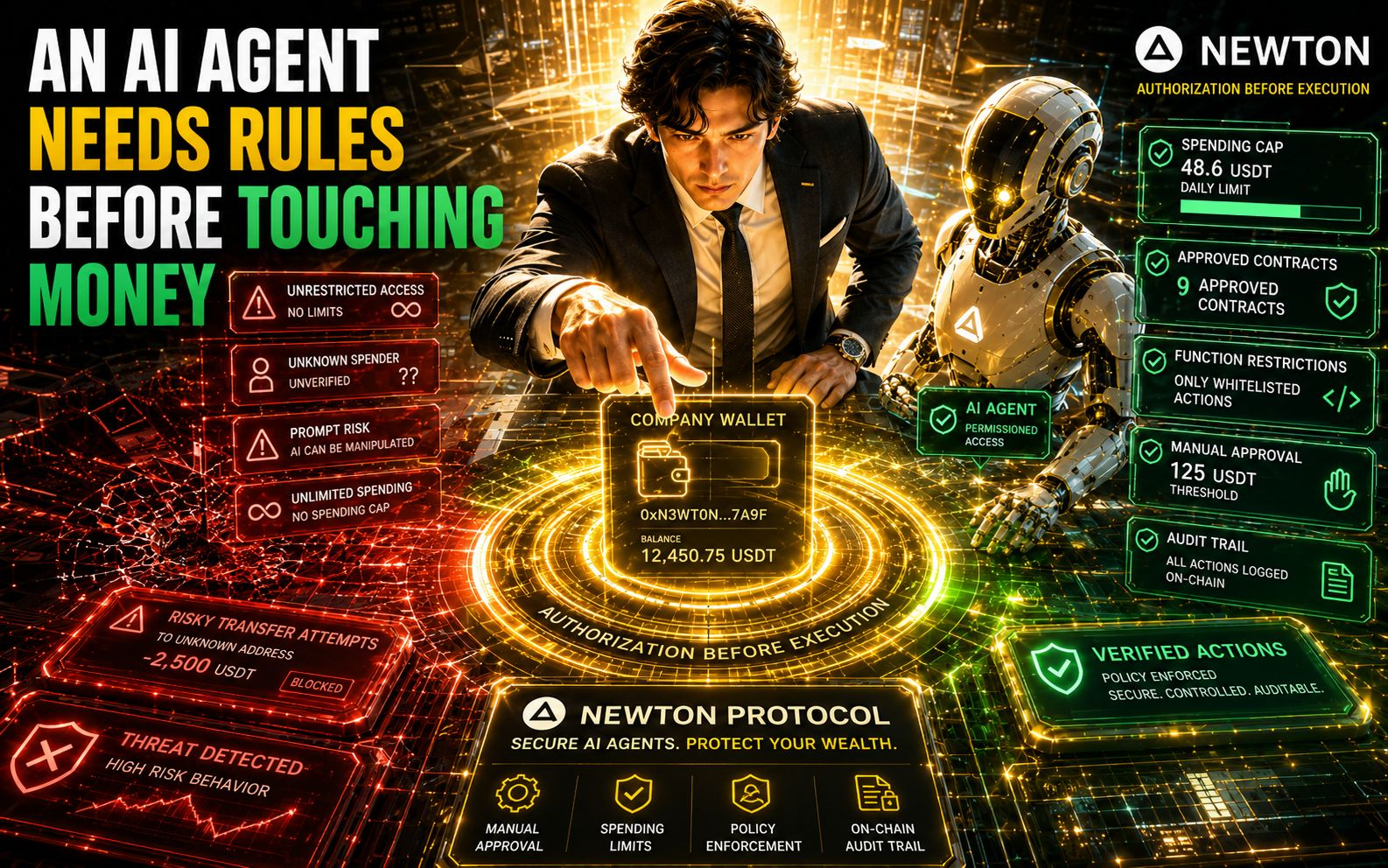
That is why @NewtonProtocol is interesting to me.
Newton does not need to be understood as “another AI hype project.”
The more useful framing is this:
Newton is about policy before execution.
Before an action moves value, it can be checked against rules.
Is the contract approved?
Is the function allowed?
Is the amount below the limit?
Is the destination address acceptable?
Has the agent already acted too many times in a short period?
Does this action require human approval?
These questions are simple.
But putting them before execution changes everything.
Because once an onchain transaction happens, the result is no longer theoretical.
It is not a draft.
It is not a warning.
It is not a recommendation.
It is executed value movement.
That is why the “company card” analogy matters.
You would not give a new employee an unlimited card and say:
“Just be careful.”
You would set limits.
You would define allowed categories.
You would require approval above a threshold.
You would review spending.
You would separate normal actions from risky actions.
AI agents need the same thing.
Not because AI is useless.
Because AI is becoming useful enough to touch real assets.
That is the moment when trust alone becomes too weak.
A chatbot can make a bad suggestion and the user can ignore it.
An AI agent with a wallet can make a bad action and the chain can execute it.
Those are completely different risk levels.
This is where Newton Mainnet Beta becomes relevant.
It brings the idea of authorization closer to the transaction path itself.
Instead of simply hoping that an agent follows instructions, developers can define policies that actions must satisfy before execution.
That creates a much more mature model for AI x crypto.
Not “let agents do everything.”
Not “block agents from doing anything.”
But “give agents useful freedom inside enforceable boundaries.”
That is the balance the market will need.
Because the future will probably include more autonomous systems.
More automated trading.
More recurring payments.
More vault management.
More agent-to-contract interactions.
But every new automated action creates the same question:
Who decides whether this action is allowed?
If the answer is only “the agent decided,” that is not enough.
If the answer is only “the user trusted it,” that is also not enough.
The stronger answer is:
The action had to pass policy before execution.
That is the part I find important about Newton.
It is not trying to make onchain activity more chaotic.
It is trying to make automated activity more accountable.
A good AI agent should not only be fast.
It should be bounded.
A good wallet should not only be programmable.
It should be governed by rules.
A good transaction system should not only ask whether a signature is valid.
It should also ask whether the action is permitted.
That is the real shift.
Crypto already made value programmable.
AI may make actions programmable.
Newton is trying to make permission programmable too.
And for AI agents, that may be the difference between useful automation and uncontrolled risk.
$TAIKO $NFP