

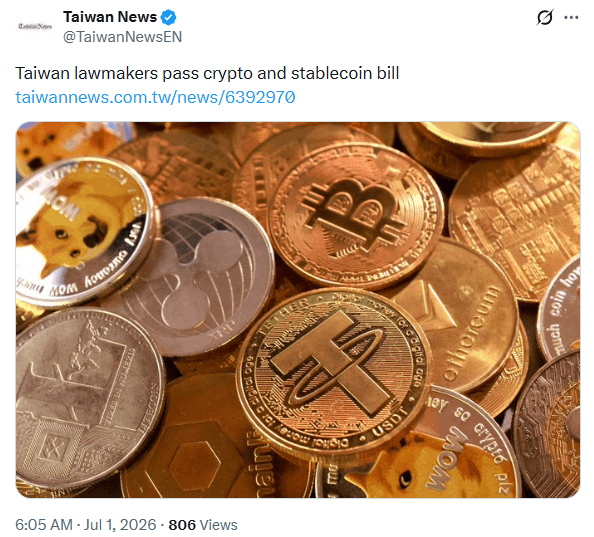
Taiwan has taken a major step toward regulating digital assets. The country's legislature has approved the long-awaited Virtual Asset Service Act (VASA), creating the first comprehensive legal framework for cryptocurrency exchanges, virtual asset service providers, and stablecoin issuers.
The new legislation ends years of regulatory uncertainty by introducing a licensing regime designed to strengthen investor protection, improve market transparency, and align Taiwan with leading global crypto jurisdictions.
Crypto Companies Will Need Licenses
The bill passed its third reading in Taiwan's Legislative Yuan and now awaits the signature of President Lai Ching-te.
According to Taiwan's Financial Supervisory Commission (FSC), oversight of the cryptocurrency industry will expand significantly. The previous framework, which focused primarily on anti-money laundering compliance, will be replaced by broader regulation covering market operations, risk management, and investor protection.
The new law establishes regulatory requirements for seven categories of virtual asset service providers, including cryptocurrency exchanges, trading platforms, custodians, transfer service providers, underwriters, and lending service providers.
Companies will be required to meet strict standards covering cybersecurity, internal controls, financial reporting, customer asset segregation, and digital asset listing procedures.
Existing Firms Will Receive a Transition Period
Companies already operating in Taiwan under existing anti-money laundering registration rules will have 12 months to submit a licensing application and an additional 21 months to complete the approval process once the law takes effect.
If additional time is required, regulators may grant a one-time extension of up to three months.
Firms that fail to obtain a license within the prescribed timeframe will no longer be permitted to provide virtual asset services in Taiwan.
Stablecoin Issuers Face Stricter Oversight
The legislation also introduces significant new requirements for stablecoin issuers.
Any entity wishing to issue stablecoins in Taiwan must receive approval from both the Financial Supervisory Commission (FSC) and the Central Bank of the Republic of China (Taiwan).
Issuers will be required to maintain fully backed reserves, place reserve assets into trust accounts, undergo regular audits, and publicly disclose detailed financial information.
The framework builds upon Taiwan's earlier proposal allowing domestic banks to issue stablecoins pegged to the New Taiwan Dollar.
Violations Could Lead to Prison Sentences and Multi-Million-Dollar Fines
The new law also introduces severe penalties for operating without a license or engaging in market manipulation.
Providing unauthorized cryptocurrency services or issuing stablecoins without approval may result in prison sentences of up to seven years and fines of up to NT$100 million (approximately US$3.1 million).
Even harsher penalties apply to fraud and market manipulation, with offenders facing three to ten years in prison and fines of up to NT$200 million.
Taiwan Moves Closer to Global Regulatory Standards
With the approval of the new legislation, Taiwan's cryptocurrency industry now has its first comprehensive legal framework.
The primary objectives are to strengthen investor protection, encourage long-term industry development, and align Taiwan's regulatory approach with major jurisdictions such as the European Union, Japan, and South Korea.
The Financial Supervisory Commission will now begin drafting the detailed implementing regulations that will define licensing standards, corporate governance requirements, internal control systems, and operational rules for stablecoins.
By adopting the Virtual Asset Service Act, Taiwan joins a growing list of countries seeking to establish comprehensive digital asset regulations while fostering the continued growth of the cryptocurrency industry.
#crypto , #Stablecoins , #CryptoRegulation , #Stablecoins , #CryptoCommunity
Stay one step ahead – follow our profile and stay informed about everything important in the world of cryptocurrencies.
Disclaimer:
The information and opinions presented in this article are for informational and educational purposes only and should not be considered financial or investment advice. Nothing on this page constitutes a recommendation to buy or sell any assets. Cryptocurrency investments are inherently risky and may result in financial loss. Always do your own research before making any investment decisions.