
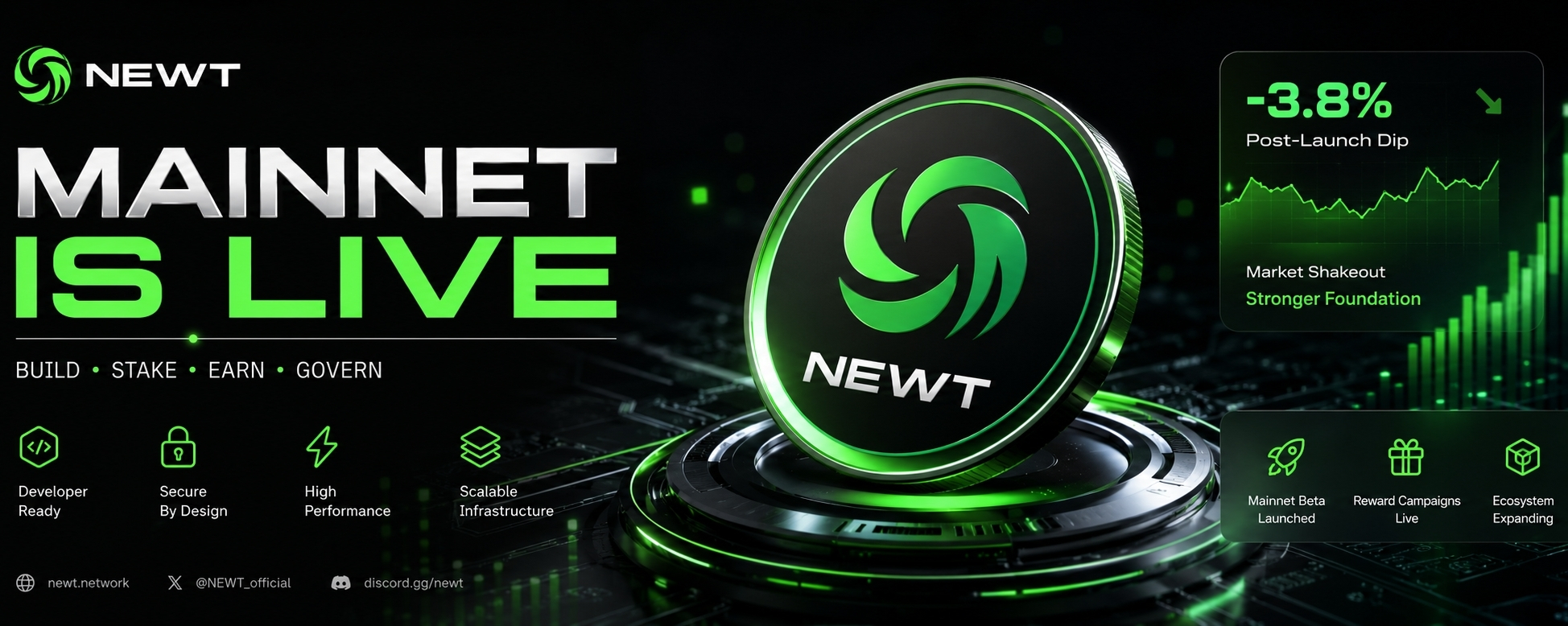

I’ll be honest: when I first saw the numbers, I paused. The Mainnet Beta I’d been tracking for weeks finally went live. The reward campaigns I’d been mapping out for potential yield opened their doors. And yet, almost on cue, the token price slipped 3.8%. On the surface, it felt jarring — like the market had completely shrugged off good news. But as a researcher, I’ve learned to stay suspicious of first impressions, so I closed the price chart and started digging. What I uncovered didn’t look like a broken project. It looked like a market breathing out, shedding short-term pressure, and in the process giving long-term observers like me a cleaner lens through which to assess what actually matters.
Before I even thought about the mainnet itself, I went back and looked at the capital that had been flowing into NEWT in the weeks prior. It didn’t take long to see the pattern. The run-up hadn’t been fueled by concrete revenue or explosive user growth — it had been fueled by anticipation. Developer diaries, testnet demos, and the steady drumbeat of “Mainnet is coming” had already done their work on the price. I’ve seen this cycle so many times that it’s etched into my memory: the market prices the rumor long before the event arrives.
By the time the Mainnet Beta block was confirmed, the buyers who thrive on speculation were already in position. The only thing left for them to do was sell into the confirmation. And that’s exactly what I suspect happened. I don’t read that as a lack of belief in the chain; I read it as disciplined profit-taking in a market where holding through a binary event is rarely rewarded. Then there’s the reward campaign layer, which I approached with equal parts curiosity and caution. I’ve spent enough time inside liquidity mining programs to know they behave more like a temporary faucet than a magic growth wand.
When new incentives go live — especially tokens that can be claimed immediately — a subset of participants rushes in not to explore the ecosystem but to harvest. The moment those rewards became claimable around the mainnet launch, I could almost visualize the flow: claim the tokens, bridge them to a venue with enough liquidity, and swap for something stable. I didn’t need to see every wallet address to recognize the familiar footprint. The quick spike in on-chain movement, the direct paths from claim contracts to exchange deposits, and the resulting sell pressure fit a story I’ve watched unfold across half a dozen chains before.
It’s not a flaw of the project; it’s the rational response of mercenary capital. And from what I observed, that initial dump wave began to lose its bite within a couple of days, which is usually the first sign that the market is digesting the surplus. What really held my attention, though, wasn’t the price drop itself — it was what the volume told me. The 3.8% decline came with a sharp but relatively short-lived burst in trading activity. That pattern, to my eye, isn’t a cascade; it’s a handoff. Heavy distribution, yes, but no runaway panic. I saw bids absorbing the sell flow without the price cratering further, which hinted that a different class of participant was quietly taking the other side.
When a truly bearish breakdown happens, I’m used to seeing volume persist and price continue to slide. Here, I saw a shakeout — rapid, clinical, and then, gradually, a calming. I also took a step back and overlaid NEWT’s move onto the broader market. Bitcoin had been struggling with resistance. Altcoins were drifting sideways. Risk appetite across the board felt thin. In that context, a single-digit pullback after a pre-launch run didn’t strike me as anomalous; it felt like a local event unfolding inside a macro lull, and that distinction matters enormously. With the noise starting to clear, I started thinking about what this Mainnet Beta actually represents — not what the price says it represents.
I’ve watched too many chains launch to applause and then fade into empty blocks. What I look for now is whether the network has a pulse, not just a ticker. The mainnet being live means there’s an environment where real code can run, where developers can deploy without asking permission, and where users can transact directly. That’s a tangible milestone. The short-term traders who sold the news were never going to build on the chain or stake their tokens for governance. Their exit doesn’t subtract from the fact that the infrastructure is now real.
In my research, I’ve noticed that projects delivering working tech during quiet, skeptical markets often build the strongest foundations because they’re forced to prove utility rather than ride a wave of hype. That possibility alone makes me more attentive, not less, after a dip like this one. So how do I personally approach this moment, putting aside the noise and focusing on what I can track? I’m not trying to call a bottom. I’m trying to spot stabilization. I’m watching whether NEWT can settle into a range around the price zone where it originally lifted off during the pre-launch anticipation phase.
If I see volume tapering and daily bars shrinking while the price refuses to make new lows, that’s my signal that the market is finding its footing again. More than that, I’m shifting my attention away from the candlestick chart entirely and onto the chain itself. I want to see which developers are deploying. I want to know whether daily active addresses are growing not because of a one-off incentive spike, but because there’s something genuinely worth using.
A token can recover from a 3.8% dip without breaking a sweat, but a ghost chain with no usage is a far deeper wound. And finally, I’m keeping a close eye on the rhythm of token emissions. If the reward programs gradually evolve from pure inflationary faucets into mechanisms tied to staking, fees, or protocol engagement, that’s the shift I’ve historically associated with a project moving from a farmable asset to a productive one — and that’s a transition I always want to be early in spotting.