
The US and Iran signed an initial deal reopening the Strait of Hormuz, and oil fell as expected. The surprise was that crypto sold off with it, rather than rallying on the de-escalation.
Key Takeaways
The US and Iran signed an initial deal reopening the Strait of Hormuz.
Oil fell on the news, with WTI down 2.49% to $74.83.
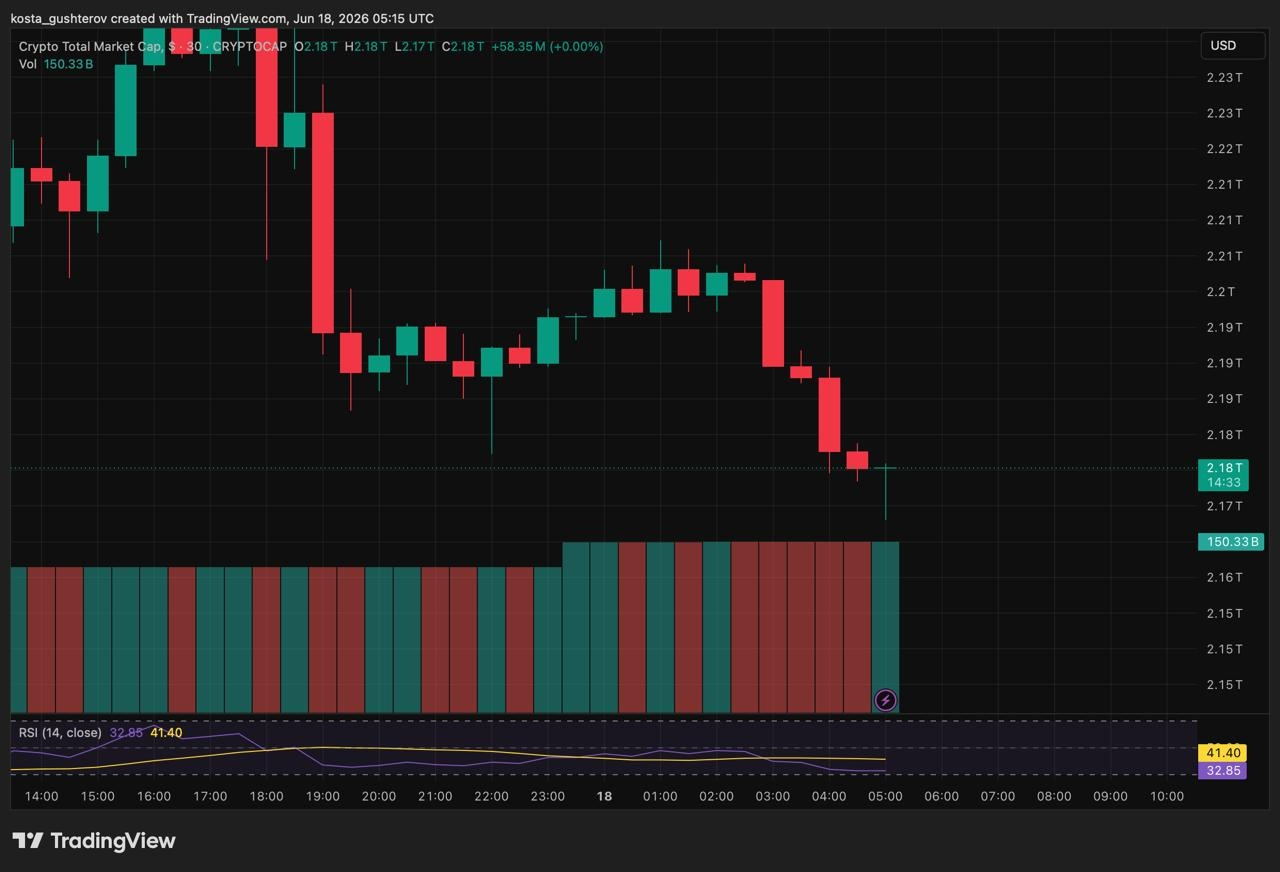
Crypto dropped too: total market cap fell 2.4% to $2.18 trillion.
The nuclear dispute stays unresolved, deferred to a 60-day window.
The agreement does what markets had hoped, removing the single largest economic risk the conflict created. It reopens the Strait of Hormuz and oil responded immediately: WTI crude fell 2.49% to $74.83 and Brent dropped 2.24% to $77.7. That is the textbook reaction to easing energy-supply risk.
Crypto did not follow the script. Rather than treating the de-escalation as the risk-on signal it would normally be, the market sold off, and the pressure was still building in the latest hour. According to CoinMarketCap Bitcoin slipped to $63,677, down 3.34% on the day and 0.70% in the past hour alone, while Ethereum fell 4.11% to $1,722, off another 0.90% on the hour.
The total crypto market capitalization itself dropped roughly 2.4% to about $2.18 trillion.
The weakness was broad: XRP lost 4.22% on the day, Solana 4.12%, and Hyperliquid's HYPE led the majors lower with a 7.33% drop, including a sharp 2.92% slide in the past hour.
Why Good Geopolitical News Did Not Lift Crypto
The instinct is that a peace deal should be bullish for risk assets, so a falling crypto market looks contradictory. The likely explanation is in what the deal actually is, and what it is not.
This agreement reads less like a peace treaty and more like an economic stabilization package. Its primary achievement is defusing the energy threat: by securing the strait's reopening, it lowers the odds of an oil shock that could have driven prices sharply higher and reignited inflation across major economies. Markets were never primarily afraid of the military operations themselves; they were afraid of what those operations could do to oil supply, energy prices, inflation, and growth. The deal addresses exactly those channels, which is why oil, the asset most directly exposed, moved the most.
That same framing might partly explain crypto's muted-to-negative reaction. If the main effect of the deal is to cool oil and ease inflation pressure, the direct benefit flows to energy and rate expectations, not to speculative risk assets.
There may also be an element of investors waiting for the full picture: coming shortly after a hawkish Fed meeting, the deal's real significance for crypto could lie in second-order effects, since cooler oil feeds into the energy-driven inflation the Fed just flagged, and a calmer inflation path is one of the few things that could soften the central bank's stance at coming meetings. Until that link plays out, some may prefer to wait for the final details on the peace deal rather than chase the headline.
The Catch: The Hard Part Was Postponed, Not Solved
The most revealing detail is what the agreement left out. The nuclear dispute, the core of the entire conflict, was not resolved. Instead, both sides agreed to continue negotiations over a 60-day window, with the deal explicitly maintaining the status quo on Iran's nuclear program in the meantime.
That makes this an interim framework rather than a durable settlement. It buys time and prevents further economic damage while the hardest political questions stay open, and it remains fragile precisely because both sides are signaling deterrence rather than trust. For crypto, the implication is that the geopolitical risk premium has been reduced, not removed. The immediate worst case of a prolonged energy war looks like off the table for now, which markets read as a positive, but the underlying strategic standoff has not disappeared, leaving a path for volatility to return if the 60-day talks stumble.