


I was thinking about liquidity, but not in the way crypto usually talks about it in traditional ways 😂
Most discussions focus on capital. How quickly assets can move, where liquidity pools sit, how efficiently markets function. It’s a useful definition, but it feels incomplete once AI enters the picture.
Because intelligence has a liquidity problem too.
That’s the part I keep coming back to.
Every day, enormous amounts of value are created through data, models, and agents. But most of that value remains trapped inside isolated systems. A model performs well in one environment. A dataset improves one application. An agent executes tasks inside a closed workflow.
Useful, yes.
Liquid, not really.
OpenLedger feels like it’s approaching that problem from a different angle.
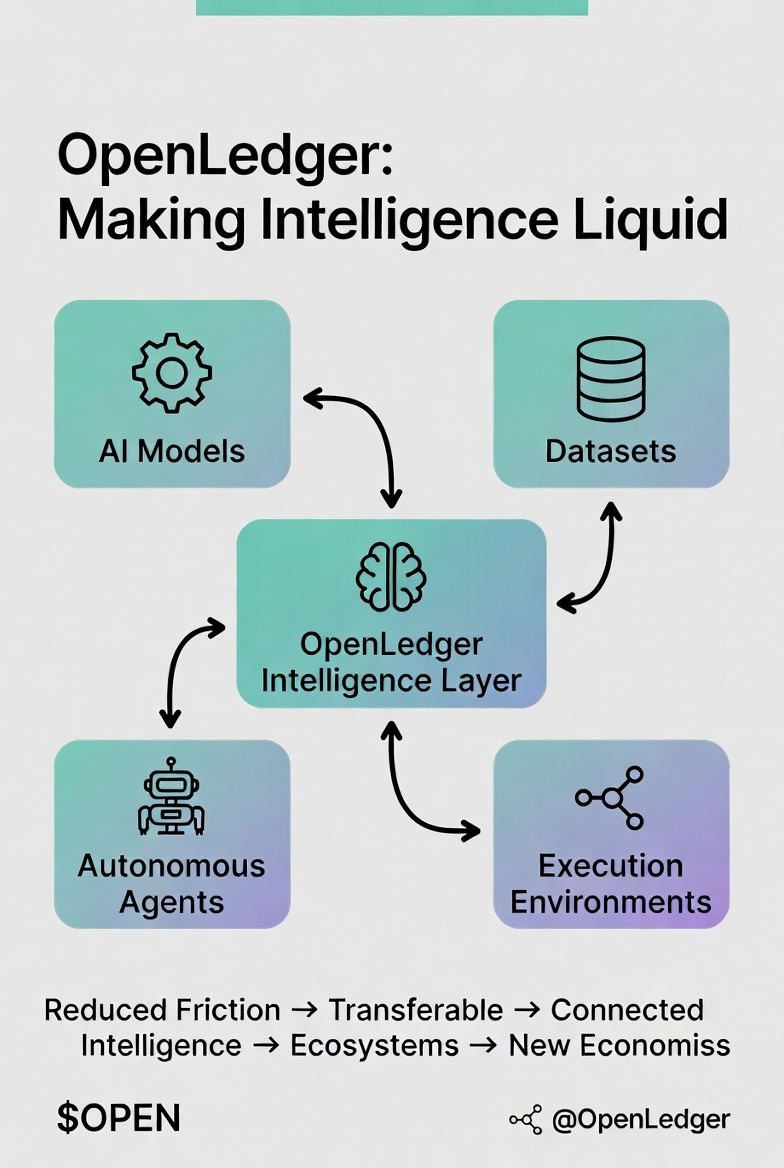
Not just asking how capital moves across networks, but how intelligence itself moves. How data can become economically active beyond its original source. How models can participate in broader ecosystems. How agents can create value that extends beyond a single application.
And that changes the meaning of liquidity entirely.
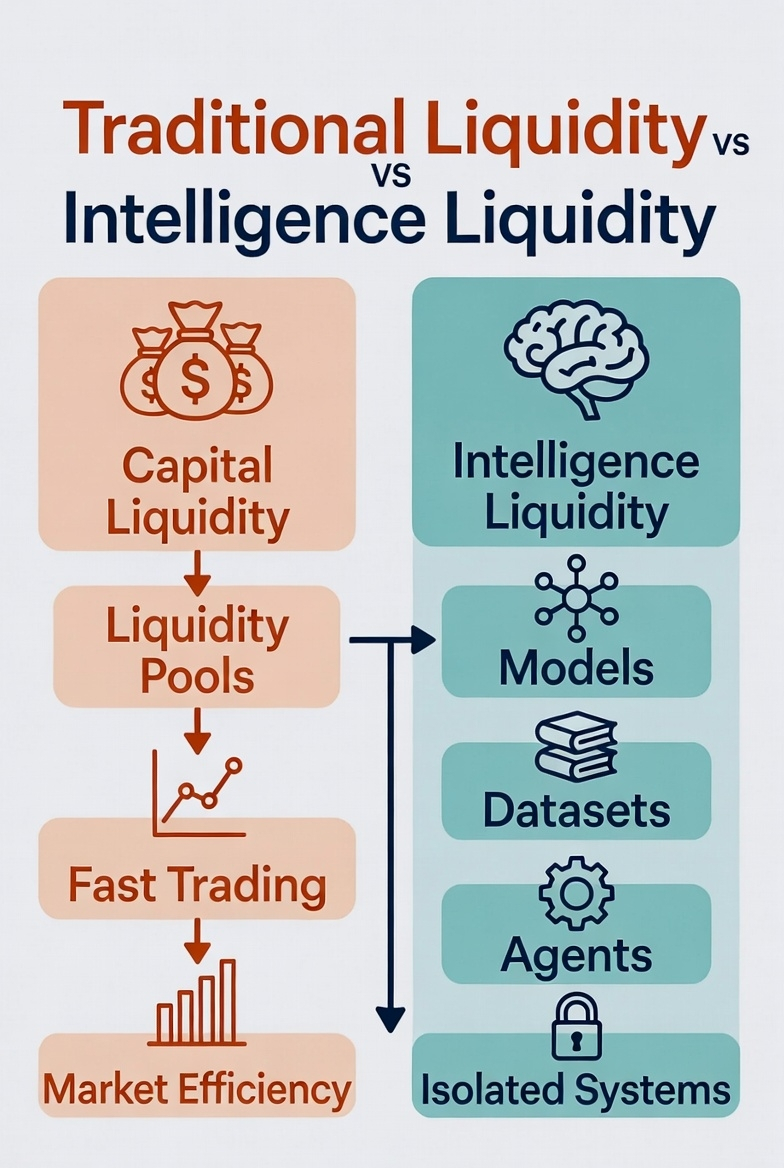
Because liquidity stops being only about assets.
It becomes about utility.
At least from where I’m standing, OpenLedger’s vision of liquidity feels less financial and more structural. The goal isn’t simply making intelligence accessible. It’s making intelligence transferable, reusable, and capable of interacting with other forms of intelligence inside the same economic environment.
And interaction creates compounding effects.
Because isolated intelligence generates outputs.
Connected intelligence generates ecosystems.
That distinction matters more than it first appears.
Once value can move freely between models, agents, and datasets, entirely new behaviors start emerging. Systems reinforce one another. Contributions become easier to monetize. Intelligence stops behaving like a collection of disconnected resources and starts behaving like a network.
But there’s also a challenge there.
Because increasing liquidity changes incentives. What becomes liquid becomes measurable. What becomes measurable becomes optimized. And optimized systems often evolve in ways that nobody fully anticipated
That’s true for capital
And it’s probably true for intelligence too.
I’m not fully convinced where OpenLedger lands long term.
But I do think it’s asking a question that will become increasingly important.
Not how to create more intelligence But how to allow intelligence itself to circulate.
Because value trapped inside isolated systems can only scale so far.
Value that moves tends to create entirely new economies.