
Last night I sat on the balcony in Islamabad, watching the city lights flicker while my neighbor argued loudly on his phone about some family land dispute. Everything was out in the open—voices carrying across rooftops, details spilling without consent. It reminded me how most human interactions rely on selective silence, not total exposure.
This morning I logged into Binance Square and opened the CreatorPad campaign task for Midnight Network. The screen showed the activity table with points and leaderboard, and one of the early actions required following the official @MidnightNtwrk account directly from the campaign page. As I clicked it, the interface refreshed with the updated progress bar, and something shifted in my thinking. The task was simple, almost trivial, yet it forced me to publicly align with a project centered on rational privacy—while the platform itself logged and displayed my participation for everyone to see. That small moment disturbed me more than I expected.
We keep repeating that blockchain’s greatest strength is its transparency, that an immutable public ledger is the ultimate trust machine. But what if that belief has quietly become a cage? What if the insistence on everything being visible by default is exactly what prevents blockchain from handling the messy, private realities of daily life—like medical records, business negotiations, or personal finances? The discomfort hit when I realized how many of us defend radical transparency as ideological purity, yet we’d never accept it in our own relationships or workplaces.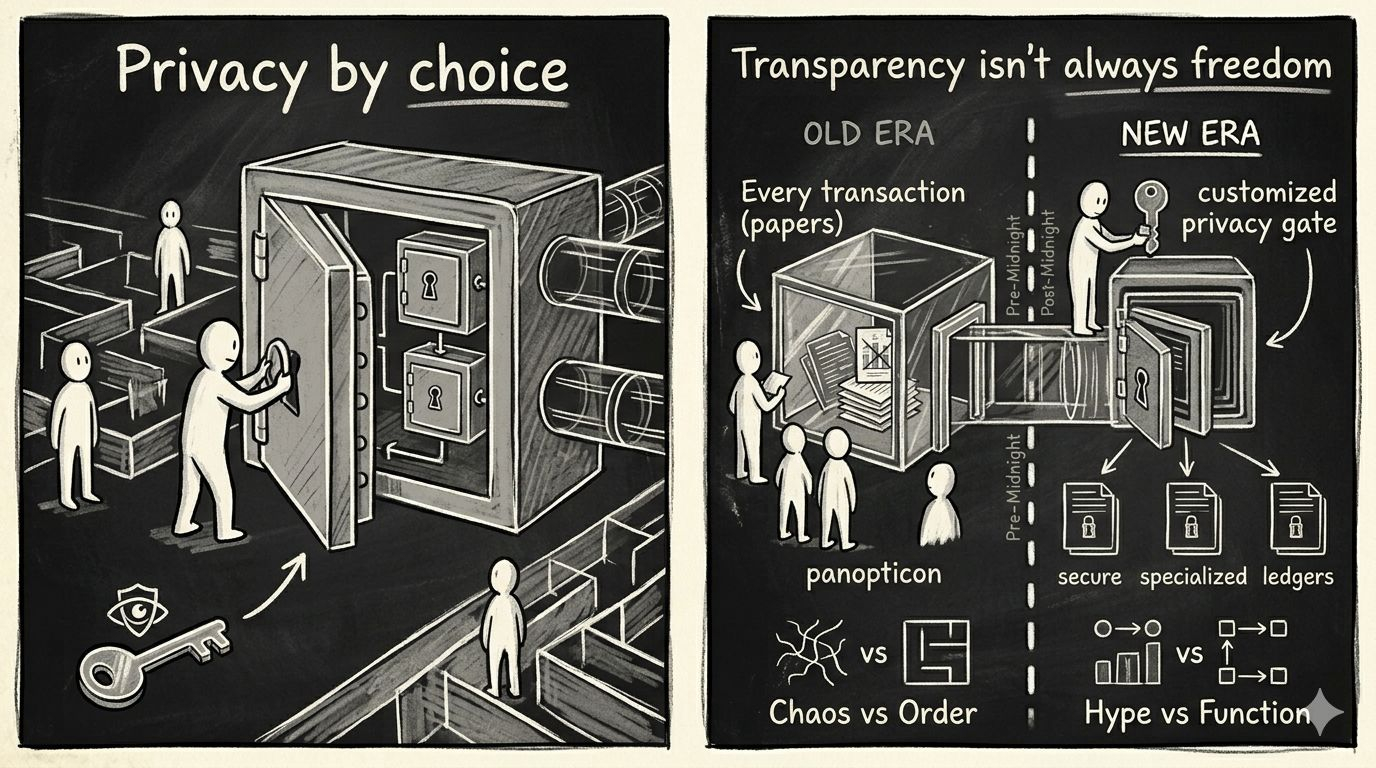
Midnight Network makes that tension impossible to ignore. It treats privacy not as an all-or-nothing choice but as something rational: protect what needs protecting, reveal only what must be verified. The architecture lets developers build applications where sensitive data stays shielded while proofs still satisfy the network. It’s not hiding from accountability; it’s refusing to treat exposure as the price of participation. In that sense, it challenges the unspoken assumption that more visibility always equals more freedom. Sometimes visibility just means more surfaces for control, surveillance, or unintended leakage.
I’ve watched the broader conversation in crypto swing between two extremes—pure anonymity that invites chaos and full transparency that invites exploitation. Both feel like reactions rather than solutions. Midnight sits in the uncomfortable middle, suggesting that real utility emerges when we stop forcing users to choose between utility and dignity. The CreatorPad task itself, with its public follow and point tracking, ironically highlights how even participation in a privacy-focused campaign happens under the gaze of the platform. It’s a small mirror: we’re building tools for selective disclosure while still operating inside systems that broadcast our every click.
The longer I think about it, the more it feels like we’ve confused openness with honesty. A ledger that records everything doesn’t make society more honest; it just makes selective forgetting impossible. Privacy done right isn’t secrecy—it’s the freedom to decide what version of yourself gets shared, when, and with whom. Without that, blockchain risks becoming another layer of the same surveillance economy we claim to escape.
Yet here’s what lingers: if rational privacy really works at scale, why do so many projects still treat it as a niche feature rather than the default? Are we genuinely afraid that giving people control over their data will make the chain less “trustless”—or are we afraid it will expose how much of our current model depends on everyone staying visible? @MidnightNetwork $NIGHT #night