Robots are becoming the kind of presence you notice the way you notice a new neighbor: not because they’re flashy, but because their existence quietly changes the rules of the space. A machine that can move through rooms, pick things up, make decisions, and recover from surprises forces a different kind of attention. People don’t just judge whether it’s “good tech.” They wonder who’s responsible for it, what it’s allowed to do, and what happens when it crosses a line. Most of the systems we have today still answer those questions with the same old move: trust the company, trust the operator, trust the logs in a private dashboard.
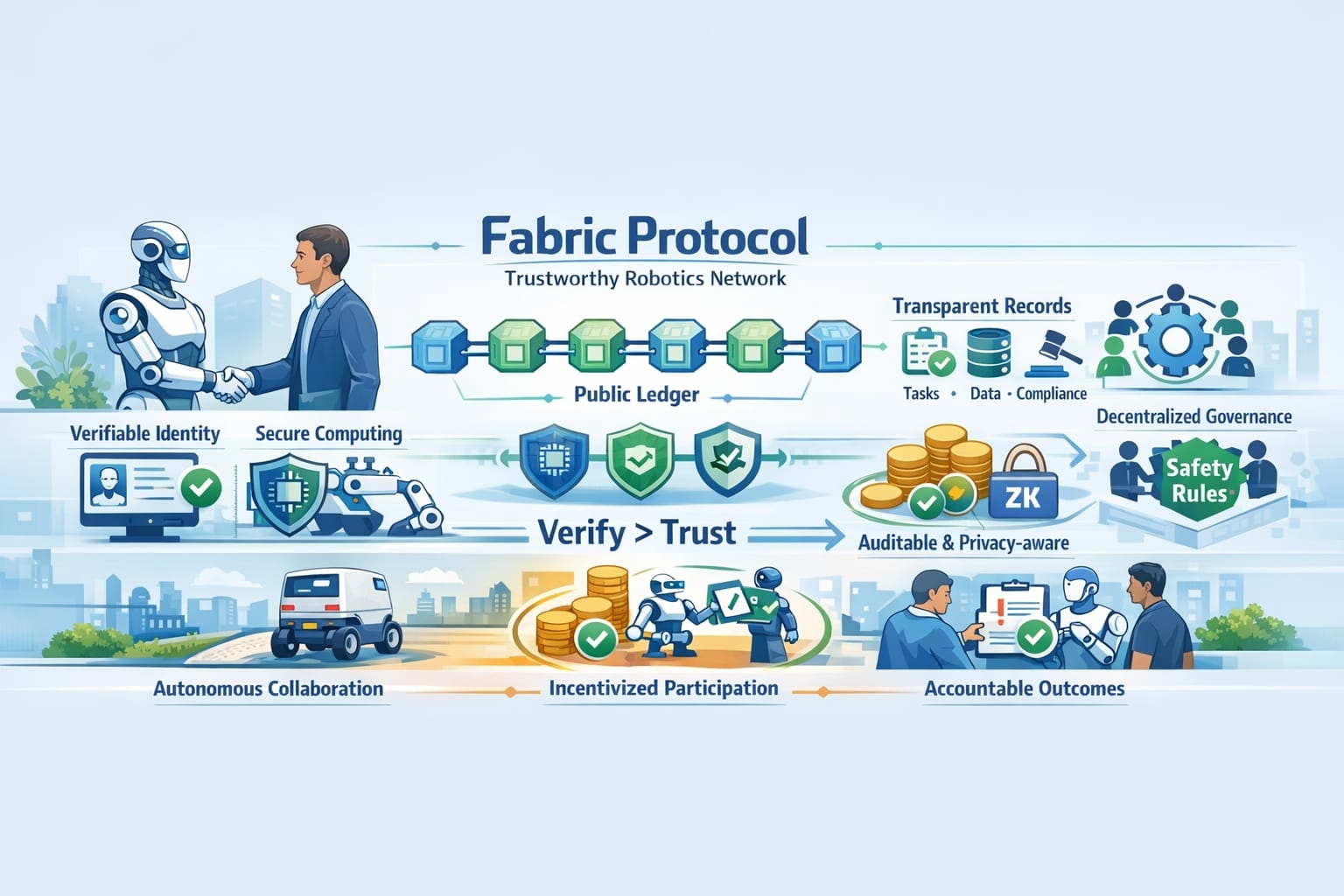
Fabric Protocol is trying to replace that with something less fragile. It’s backed by the Fabric Foundation, a non-profit, and it pitches a simple idea wrapped in ambitious engineering: robots shouldn’t have to be trusted on vibes. They should be able to show proof. Proof of who they are, proof of what software they’re running, proof of what task they agreed to, and proof—at least for the parts that matter most—that they followed the rules while doing it. The protocol’s backbone is a public ledger and a set of verification tools meant to coordinate robot identity, task execution, data exchange, and compliance in a way that isn’t owned by any one vendor. (fabric.foundation)
The reason this matters is almost embarrassingly practical. When a robot is deployed in the real world, you immediately get multiple stakeholders with competing incentives. The person who hired it wants results. The building owner wants safety. The manufacturer wants to protect IP and avoid liability. The operator wants efficiency. Regulators want accountability after something goes wrong, and communities want reassurance before something does. In today’s setup, the “truth” of what happened inside the robot—its logs, its model decisions, its software history—usually belongs to whoever runs the infrastructure. That can be fine when everyone is friendly. It’s a mess when they’re not.
Fabric’s approach is to treat robots less like sealed products and more like participants in a shared environment, the way financial systems treat transactions: not as private stories but as events with receipts. The ledger piece is what gives those receipts durability. It creates a shared record that is hard to rewrite quietly and easier for different parties to refer to when disputes show up. That’s the attraction of a public ledger in robotics: not hype, but the chance to avoid endless arguments over whose database is “the source of truth.” (fabric.foundation; )
But a ledger is only as good as what you put on it. A robot can write beautiful logs and still lie. It can be compromised. It can be impersonated. Its sensors can be spoofed. If you’re building an open network where robots might earn rewards or be selected for tasks, those weaknesses become magnets for abuse. So Fabric leans hard on the concept of verifiable computing: ways to prove that the computation being claimed actually happened under specific conditions, rather than assuming honesty. The whitepaper explicitly points toward hardware-backed verification, like trusted execution environments and similar mechanisms, because without something like that you’re stuck with an honor system. (fabric.foundation)
If that sounds abstract, here’s the plain version. Imagine you’re hiring a robot to do work that has consequences—inside a home, around vulnerable people, or in a place where one mistake can cost real money. You don’t just want a promise. You want to know: is this really the robot it claims to be? Is it running approved software? Did it load the safety policy it said it did? If a robot can produce a cryptographic attestation—basically a signed proof tied to real hardware—that answers those questions, you get a new kind of trust. Not emotional trust. Mechanical trust. The same general idea is discussed widely in trusted execution and remote attestation literature: you establish a root of trust in hardware, then you prove to others what code is running. (Secure Technology Alliance TEE 101; )
It’s also not a coincidence that standards bodies like W3C describe decentralized identifiers as being able to represent “any subject,” not only humans. Robots need identities that don’t collapse the moment they switch operators, cross borders, or change service providers. If a robot’s identity is just “whatever the vendor’s cloud says,” it isn’t portable, and it isn’t resilient. Fabric’s direction lines up with this broader push for cryptographic, decentralized identity frameworks—then tries to adapt it to embodied machines. (W3C DID Core; )
Where Fabric gets especially interesting is how it ties proof to incentives. The whitepaper describes a system where participants are rewarded for verifiable contribution—tasks completed, data provided, compute supplied—rather than passive participation. That sounds like token mechanics, but there’s a deeper point hiding inside it: if the network can’t measure real work, it will be gamed. If it can measure real work, it can start to create a culture where usefulness is rewarded and fraud gets punished. Fabric’s paper argues that work-linked rewards can also help with Sybil resistance, because making lots of fake identities doesn’t help if each identity still has to do real, verifiable work to earn anything. (fabric.foundation)
That’s a tough design space, and Fabric won’t be the first system to discover how creative adversaries can be. But the goal is intelligible. In robotics, the most damaging failure mode isn’t just an accident. It’s a system that can’t tell the difference between competence and performance art—between a robot that actually did the task and an entity that merely produced convincing logs. Research on blockchain and robotics has explored similar themes: distributed ledgers can support coordination and accountability, but you still need mechanisms that tie digital claims to physical reality. (arXiv survey on blockchain and robotics; )
Then there’s the “agent-native” idea, which is easy to misunderstand. It doesn’t mean robots become mystical beings. It means the infrastructure is designed with the assumption that robots will act continuously and autonomously within it. Humans click buttons; robots negotiate tasks, request permissions, fetch policies, post logs, and settle outcomes as part of runtime behavior. Fabric’s vision includes markets for skills and services and a kind of shared layer where robots can evolve collaboratively—less a closed product lifecycle, more a networked ecosystem. (fabric.foundation)
That’s where governance becomes unavoidable. A protocol that coordinates robots is not only a technical artifact; it’s a political one. Someone decides what counts as “verified.” Someone decides what penalties apply to misuse. Someone decides how disputes are handled. The Fabric whitepaper is unusually direct that governance and validator selection are part of the open questions and will be shaped over time. That honesty is good, because governance is where projects like this either earn legitimacy or drift into insider control. (fabric.foundation)
The ethical tension that sits under all of this is simple and sharp: accountability can become surveillance if you aren’t careful. A public record of robot activity could expose patterns about workers, households, or sensitive locations. A reputation system could be weaponized. So any serious “verifiable robotics” network has to learn the art of revealing what matters without leaking what doesn’t. This is part of why verifiable computation research—especially proof systems that can confirm constraints without exposing raw data—keeps getting pulled into these conversations. Surveys of verifiable computation outline the toolkit and tradeoffs, even if robotics will need selective, practical versions rather than heavy proofs everywhere. (Frontiers survey on verifiable computation; )
If Fabric succeeds, it probably won’t look like a dramatic overnight takeover. It will look like boring reliability: a robot can move between operators without losing its identity; task logs are credible across parties; safety policy commitments can be audited; provenance exists for shared skills; disputes are resolved with evidence instead of theater. Those are the sorts of improvements that don’t make for viral videos, but they change what society is willing to tolerate.
There’s also a quieter social implication that I think matters just as much as the cryptography. When a machine becomes capable, people start projecting intention onto it. When a machine becomes scalable, people start fearing that one mistake can replicate across thousands of identical systems. Proof and auditability don’t erase that fear, but they give it a place to land. They let people demand standards instead of performing trust. They make accountability something you can operationalize rather than something you have to negotiate after harm.
Fabric Protocol is ultimately a bet that robots will need a common trust layer the way the internet needed common transport and identity layers. Not because it’s fashionable, but because without shared verification, autonomy becomes socially expensive. A world full of robots where truth is proprietary—always behind one company’s login—is not a future most people will accept for long. Fabric’s proposal is an attempt to make the truth more public, more checkable, and harder to rewrite. Whether it becomes the layer everyone uses or simply helps push the field in that direction, the discomfort it’s responding to is real. And it’s only going to get louder as robots stop being a novelty and start being normal.