

1. The Strategic Imperative: Why Compliance Defines the New Era
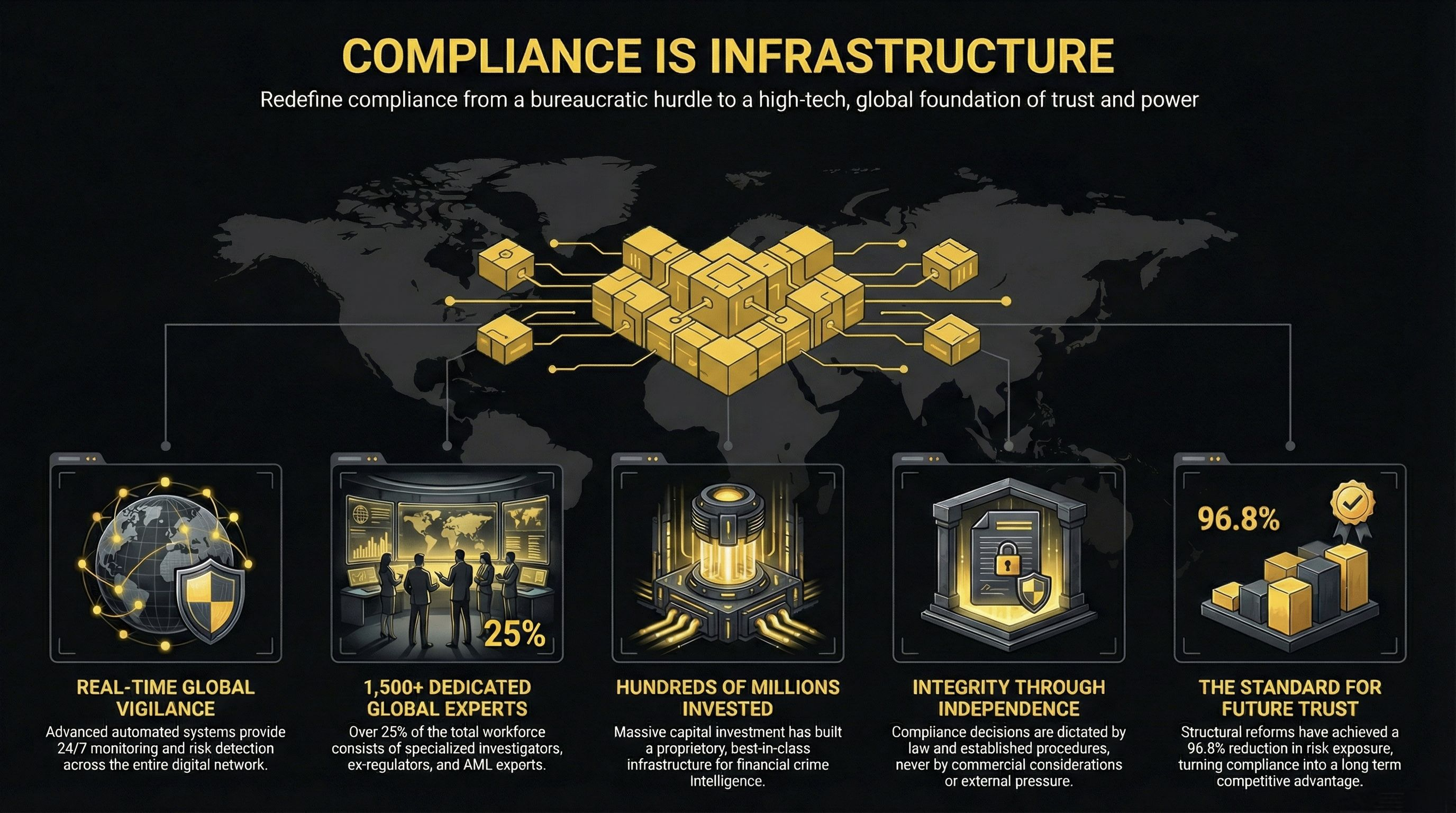
The global digital asset sector has transitioned from its experimental phase into a period of rigorous institutional scrutiny. For years, the industry operated under a "growth-at-all-costs" framework, often bypassing the administrative and structural protocols essential for participating in the global financial system. However, market maturity has dictated a new reality: regulatory compliance is no longer a secondary administrative burden; it is the requisite condition for market participation and the primary driver of institutional trust. In this environment, the viability of an exchange is not dictated by trading volume alone, but by the integrity of its internal controls and its adherence to global standards of conduct.
This evolution is a direct response to the heavy price paid for previous compliance shortfalls. At Binance, those historical deficiencies served as a catalyst for an exhaustive overhaul of our structural protocols. We have moved beyond the reactive compliance models of the past toward a proactive, strategic architecture. This shift represents a transition from treating regulation as an external "shield" to embedding it as the foundational blueprint of the enterprise. My thesis is clear: a robust compliance framework is not a regulatory hurdle to be cleared; it is a critical competitive advantage and the only sustainable pillar for the future of finance. Translating this philosophy into an operational mandate requires an investment in human and technical resources that is unprecedented in the crypto sector.
2. The Anatomy of a Modern Compliance Engine
In the high-velocity world of crypto-assets, standard compliance models frequently fail because they lack the technical sophistication to navigate the complexity of decentralized ledger technology. A functional program must operate at the speed of the blockchain, maintaining 24/7 surveillance over a global, pseudonymized flow of funds. Effective compliance in this context is not defined by the total absence of risk—an impossible standard in any global financial system—but by the rigor with which risk is detected, investigated, and mitigated.
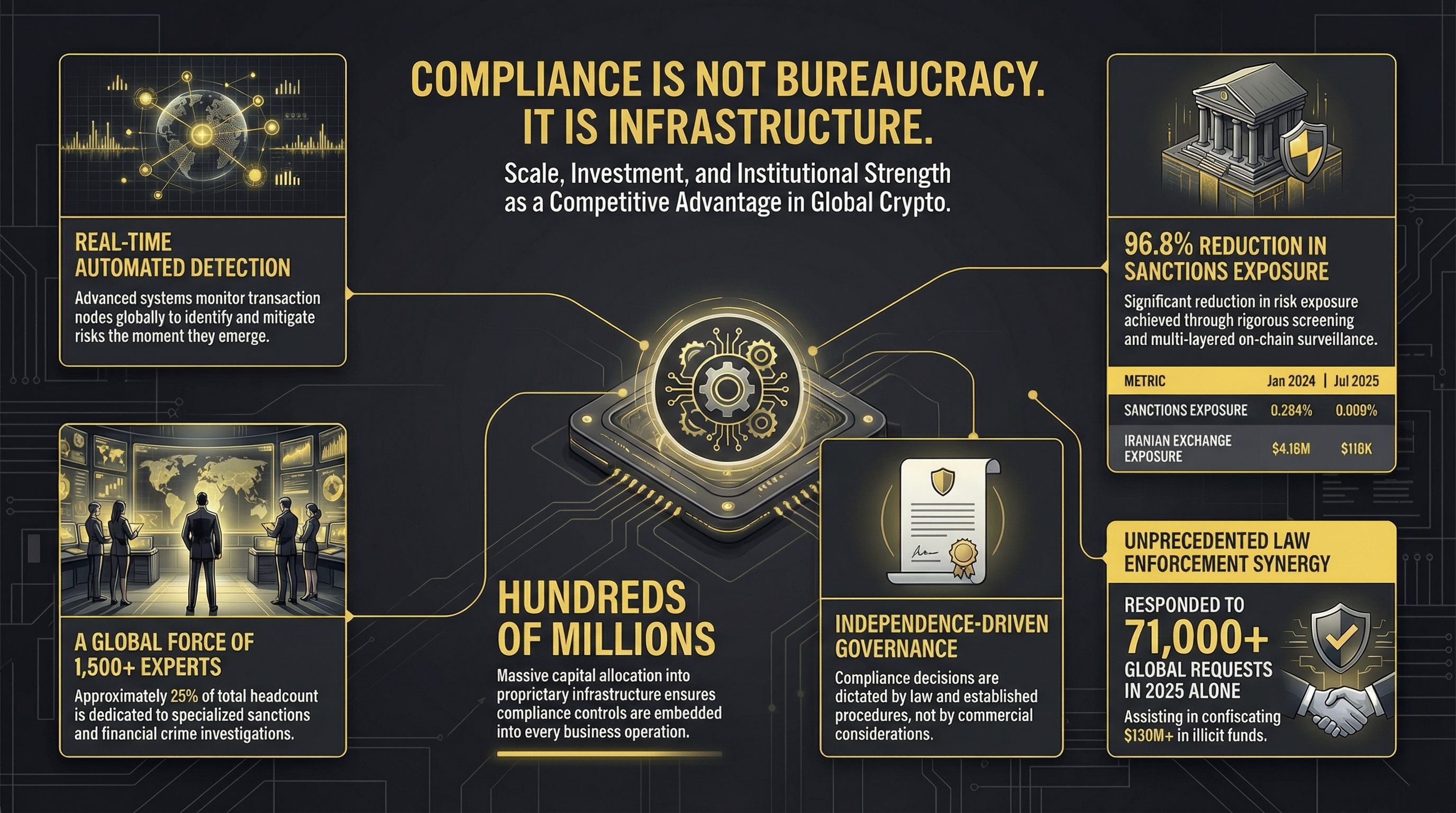
To achieve this, we have developed a compliance engine built on three specialized pillars:
Advanced On-Chain Monitoring & Typology Detection: Unlike traditional banking where transactions are often gated, public blockchains allow assets to move into deposit addresses without prior approval. We counter this through sophisticated "multi-hop" fund flow analysis. Our systems identify complex sequences where illicit actors attempt to obscure the source of funds through multiple intermediary wallets.
Best-in-Class KYC/AML & Sanctions Screening: We subject every user and transaction to rigorous scrutiny. This involves a continuous strengthening of wallet screening and transaction surveillance protocols to ensure that sanctioned entities are systematically excluded from the platform.
Specialized Investigative Units: Technology is a tool, not a solution. We have established dedicated intelligence and financial crime units staffed by experts who surface risks that industry-standard tools frequently miss. For instance, our investigators have successfully identified illicit exposure that was "three layers away" from the original sanctioned source—an evidentiary depth that standard automated alerts are not calibrated to detect.
From a regulatory and prosecutorial perspective, the total absence of alerts is often a red flag indicating a weak or inactive system. Conversely, a functioning compliance engine is characterized by its ability to generate actionable intelligence, offboard high-risk accounts, and report findings to the appropriate authorities. This cycle of detection and action is the evidence of a healthy institutional framework.
3. The Scale of Commitment: Subverting Market Expectations
The strategic necessity of maintaining a global platform requires a scale of resource allocation that subverts typical market expectations for a technology firm. This investment serves as a formidable entry barrier for competitors; a compliance department of this magnitude cannot be "bought" or built overnight. It requires the specialized training of over a thousand experts capable of interpreting complex on-chain behaviors that standard banking analysts would find unrecognizable.
The following data represents the "Hard Data of Trust" underpinning our current operations:
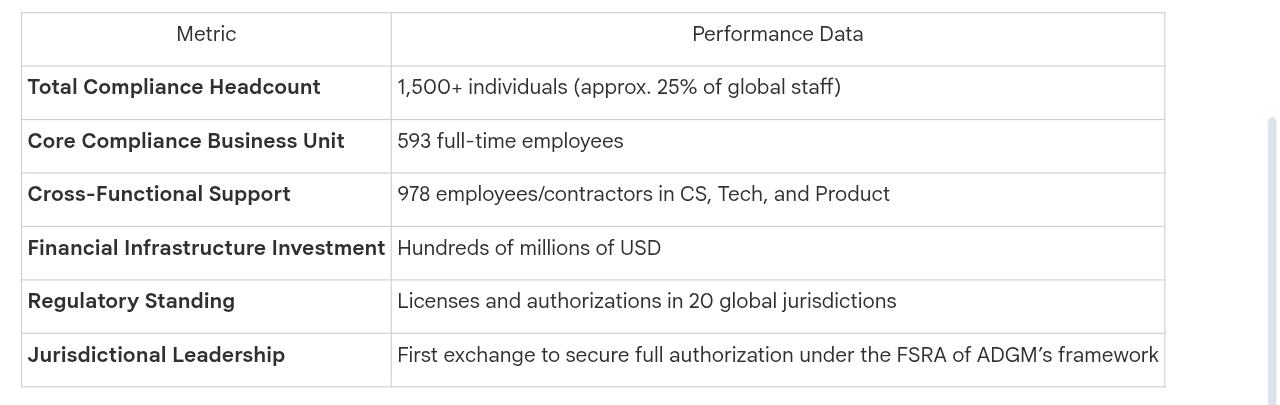
This allocation of a quarter of our global workforce to compliance functions is a deliberate strategic choice. By decoupling the compliance mandate from commercial interests, we ensure that decisions are based strictly on law and established procedures rather than shareholder interference or profit motives. This independence is what allows us to secure world-class authorizations, such as our landmark licensing under the Financial Services Regulatory Authority (FSRA) of the Abu Dhabi Global Market (ADGM).
4. Collaborative Security: The Law Enforcement Nexus
The strategic value of transparency is best demonstrated through proactive cooperation with global justice systems. We view ourselves not merely as a platform, but as a critical partner to law enforcement in the effort to dismantle transnational criminal networks. Our performance metrics for 2025 illustrate the results of this collaborative security model:
Operational Volume: Processed more than 71,000 law enforcement requests.
Asset Interdiction: Assisted in the confiscation of over $131 million in illicit funds.
Exposure Reduction: Sanctions-related exposure was reduced by 96.8%, falling from 0.284% in January 2024 to 0.009% by July 2025.
Capacity Building: Delivered over 160 specialized training sessions to help global authorities tackle crypto-related threats.
It is necessary here to address the Confidentiality Mandate. As a former federal prosecutor, I understand the necessity of investigative integrity. We are often prohibited by law from commenting on specific account closures or active cases. This silence is not a lack of transparency; it is a legal requirement to protect the integrity of ongoing investigations and the rights of the individuals involved. Our adherence to this mandate is a cornerstone of our professional standing with global regulators.
5. Setting the Record Straight: Culture, Trust, and Internal Governance
A mature institution must navigate the noise of speculative reporting with analytical clarity. Recent allegations suggesting a "reckless indifference" to compliance are contradicted by the evidentiary record. To maintain institutional security, we must clarify the facts regarding our internal governance:
The Departure Myth: No employee at Binance has ever been dismissed for raising compliance concerns. On the contrary, our investigative teams are mandated to surface risks as a core function. Departures cited in recent reports were the result of internal policy breaches related to data protection and confidentiality guidelines. Safeguarding user information is a non-negotiable requirement of employment.
Independence of Function: Compliance decisions are handled independently. While the Chief Compliance Officer provides reports to the management committee, the function remains shielded from commercial considerations.
The Iranian Data: To address claims of sanctions negligence, the facts are definitive: Between January 2024 and January 2026, Binance reduced its direct exposure to the top four Iranian exchanges by more than 97.3%, bringing exposure down from $4.19 million to just $110,000. This was achieved through the same "multi-hop" detection capabilities previously described.
We welcome good-faith scrutiny that understands the technical realities of on-chain ecosystems. Inaccurate reporting often fails to recognize that an effective program is one that identifies and shuts down indirect exposure after the activity has concluded, precisely as our systems did in the mid-2025 cases referenced in the media.
6. Conclusion: A Strategic Reflection on the Path Forward
The path forward for Web3 and the broader digital asset ecosystem is inextricably linked to the development of responsible, transparent infrastructure. The era of "experimentation without accountability" has ended. At Binance, we have recognized that our role is to provide the core architecture that organizes the world's crypto, and that architecture must be built on a foundation of uncompromising compliance.
This is a deliberate architecture, not a reaction to external pressure. By investing hundreds of millions of dollars and dedicating 25% of our workforce to this mission, we are making an unbreakable promise to our users and the global community. The data—from the 97.3% reduction in Iranian exchange exposure to the tens of thousands of law enforcement collaborations—speaks to a standard of excellence that is setting the pace for the entire industry.
We will not be distracted by inaccurate narratives or the noise of those who do not understand the complexities of crypto-compliance. Our focus remains on the long-term sustainability of the ecosystem. We have paid the price to learn these lessons, and we have emerged with a framework that is stronger, more independent, and more effective than ever before. This is the new standard for the crypto future: a future that is open, innovative, and, above all, secure.
