
Bitcoin isn’t bleeding because a villain showed up. It’s bleeding because the market got tired, quietly, long before the candle everyone is screaming about.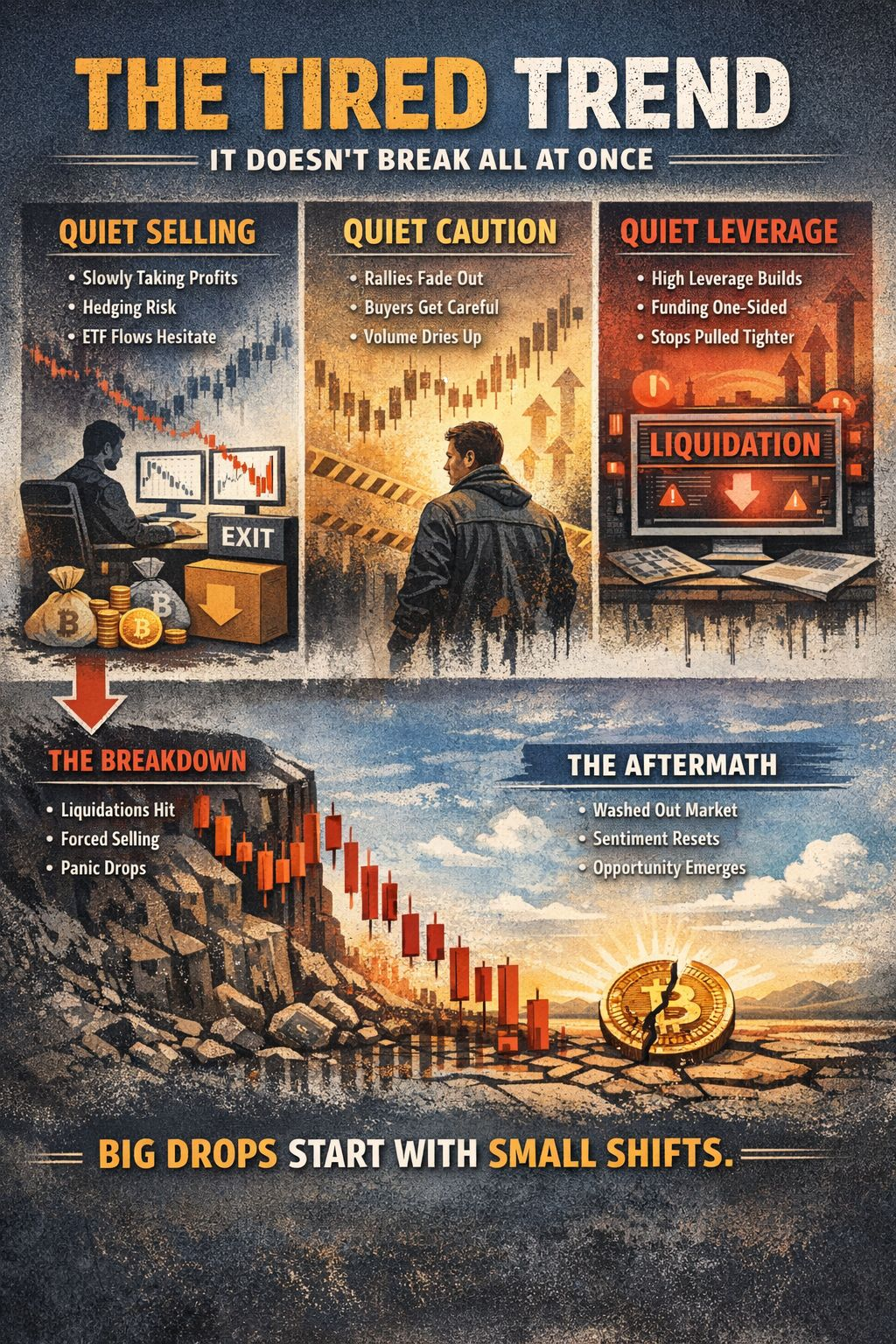
That’s what makes this drop feel so irritating. There’s no single moment you can freeze-frame and point to. No perfect smoking gun. Just a slow shift in the way price behaves when the easy conviction leaves the room.
The project is Bitcoin, and Bitcoin has a talent for turning ordinary market mechanics into mythology. When it rips, people call it inevitability. When it dumps, they call it manipulation. So the rumor mill does what it always does. Pick a name that sounds powerful, stitch it to a chart, and pretend the whole move was planned. Jane Street. Binance. Wintermute. Someone must have pressed the button.
But the truth is usually more boring than the story, and that’s why it’s usually the truth.
A real breakdown rarely starts with the breakdown. It starts with smaller things that feel harmless at the time. Rallies stop stretching. Breakouts look promising, then go soft. Each new high needs more effort and delivers less reward. Buyers still exist, but they’re no longer impatient. They’re careful. They’re waiting for a better price. That’s not drama. That’s a market transitioning from accumulation to distribution.
Distribution is the phase nobody wants to admit is happening while they’re inside it, because it doesn’t feel like danger. It feels like normal choppy trading. It feels like healthy pullbacks. It feels like the market “just needs to cool off.” Meanwhile, the people who were early are doing something very simple. They’re reducing exposure without making a scene.
Big exits don’t look like explosions. They look like routine.
A serious holder doesn’t unload in one loud act. They peel. A bit of spot sold into strength. A bit of leverage cut when it’s convenient. Some risk moved into hedges. Options written to turn time into income while the position gets lighter. If you’ve never managed size, this sounds like theory. If you have, it sounds like Tuesday.
And this is where the conspiracy brain kicks in, because people hate the idea that the market can change direction without permission. They want intent. They want a coordinator. They want to believe someone did this to them, because that’s emotionally easier than accepting the market was already weakening while they were still feeling confident.
There’s also a structural reason the blame stories are louder in this cycle.
Bitcoin is more integrated now. It lives closer to traditional capital, traditional risk desks, traditional reaction speeds. That doesn’t make it fake. It just makes it responsive. U.S. hours matter because that’s when the global risk machine is awake. That’s when portfolios get rebalanced, hedges get adjusted, and liquidity decisions get made across assets. When Bitcoin drops in that window, it can look like a targeted event, but it’s often just Bitcoin moving in the same air as everything else.
That’s a hard thing to accept if you still carry the older mental model of Bitcoin as a separate planet.
Then you add ETFs, and suddenly the market has a new kind of heartbeat.
ETF flows aren’t vibes. They’re a daily mechanism. When flows are positive, there’s a steady bid that people start to rely on without realizing they’re relying on it. It becomes background support. When flows hesitate, the absence is felt immediately. Not because the story changed, but because the floor was partially made of flow, not faith.
Most people miss this nuance: a flow-driven buyer behaves differently than a believer. A believer buys because they want to own the thing. A flow-driven buyer buys because the trade still makes sense relative to alternatives, risk limits, volatility targets, and committee comfort. That buyer can pause without warning. And when that pause happens, the market suddenly feels colder.
Now leverage comes in and turns cold into sharp.
Leverage is like a confidence amplifier. When the market is forgiving, it rewards leverage and trains people to keep using it. Small dips get bought. Rebounds arrive quickly. Traders learn to press. They build size. They run tighter stops. They start treating risk as something they can always exit cleanly.
Until they can’t.
When the structure finally breaks, leverage doesn’t just lose. It accelerates the loss. Liquidations stack. Forced selling appears. The move starts to look coordinated because a lot of positions are being unwound at the same time for the same reason. But again, synchronized doesn’t mean scripted. It just means the same thresholds got hit across the same crowded positioning.
This is why the exchange wallet screenshots are usually noise. Coins moving around doesn’t equal an evil plan. In a mature market, a huge amount of meaningful activity is invisible to the simplistic narratives people trade emotionally. Collateral gets moved. Inventory gets managed. Hedges get rolled. Risk gets trimmed. The public sees motion and assumes intention.
The deeper issue isn’t whether manipulation exists. Of course it exists at the margins. The deeper issue is that focusing on it becomes a way to avoid confronting the actual phase.
If you call every drawdown a conspiracy, you never have to admit you were late. You never have to admit the market was distributing while you were still expecting continuation. You get to stay righteous, and righteousness is comforting when your PnL is bleeding.
But Bitcoin doesn’t care about righteousness. It cares about positioning and liquidity.
And that’s where the boring explanation becomes useful, because it points to practical realities instead of emotional fantasies.
The risk isn’t that one market maker is hunting your stops. The risk is that the marginal buyer gets cautious at the same time the market is over-positioned. The risk is that liquidity looks fine until everyone wants out together. The risk is that narratives lag price, so people keep repeating Q4 confidence while the tape is quietly printing doubt.
The opportunity, if you can call it that, is that boring resets tend to create cleaner conditions later.
When leverage gets flushed, the market gets less fragile. When weak conviction sells, overhead pressure can eventually thin. When everybody stops expecting an immediate V-shaped recovery, price often finds a more honest level. None of that is fun while it’s happening. It feels like betrayal. It feels like the market is punishing you personally.
But it’s not personal. It’s just the market rebalancing risk.
If you want a more grounded way to read this moment, stop asking who did it and start asking what changed.
Did rallies start failing earlier than they used to. Did bounce volume thin out. Did volatility pick up in a way that made hedging more expensive. Did funding stay one-sided for too long. Did the market lean too hard on a flow narrative that could pause at any time. Those are the questions that actually explain pain.
Because the real signal isn’t the big red candle.
The real signal is the weeks when the market stops rewarding optimism the way it used to.
And once you see that, the drop becomes less mysterious. Still brutal, still frustrating, but less mystical. It becomes what it probably is: a tired trend finally admitting it was tired.
I don’t think the lesson here is that Bitcoin is controlled, or that the game is rigged, or that you should fear some invisible desk.
I think the lesson is simpler and more human.
Markets don’t usually break from a single hit. They break from quiet selling, quiet caution, and quiet leverage, until one day the quiet becomes visible.
And if you can accept that, you stop needing a villain to make sense of the weather. You start reading the sky instead.
