
For much of crypto’s history, Layer-1 blockchains have competed for developers. Grant programs, hackathons, ecosystem funds — the battlefield centered around builder mindshare. Traders, meanwhile, adapted to whatever infrastructure emerged. Fogo subtly reverses that hierarchy.
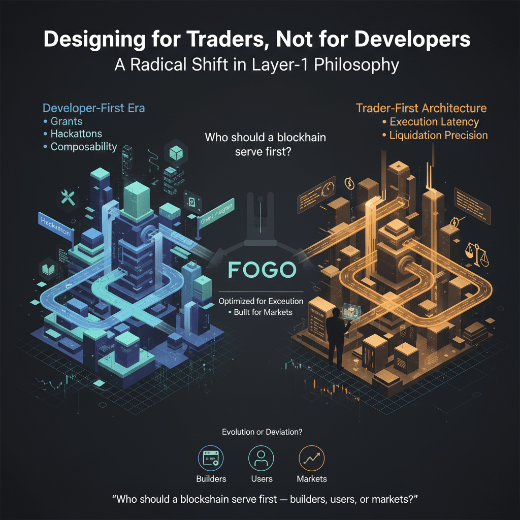
By optimizing around execution latency and deterministic settlement, the network appears to prioritize the needs of active market participants first. Order book efficiency, liquidation precision, and reduced timing uncertainty speak directly to professionals who measure advantage in milliseconds rather than community engagement metrics.
This shift introduces strategic consequences. Developers typically follow liquidity. If traders migrate because execution quality improves, application builders may follow naturally. Yet the opposite risk also exists: a chain too narrowly aligned with trading verticals could struggle to cultivate broader composability beyond financial primitives.
There is also philosophical tension. Blockchains were originally framed as decentralized public infrastructure, not performance engines tailored for capital markets. Designing primarily for traders nudges the identity closer to exchange architecture than generalized computing layer.
Whether that is evolution or deviation depends on perspective. If crypto’s next growth wave is capital-intensive and institutionally driven, Fogo’s trader-first posture may prove prescient. If innovation instead arises from social or consumer applications, specialization could narrow its expansion surface.
In either case, the experiment is instructive. It forces the industry to confront a quiet question: who should a blockchain serve first — builders, users, or markets?
Follow Wendy for more latest updates
#fogo $FOGO #JaneStreet10AMDump
