
#gridtrading
gridtrading
276,495 Aufrufe
1,167 Kommentare
Hot
Zuletzt

Übersetzung ansehen
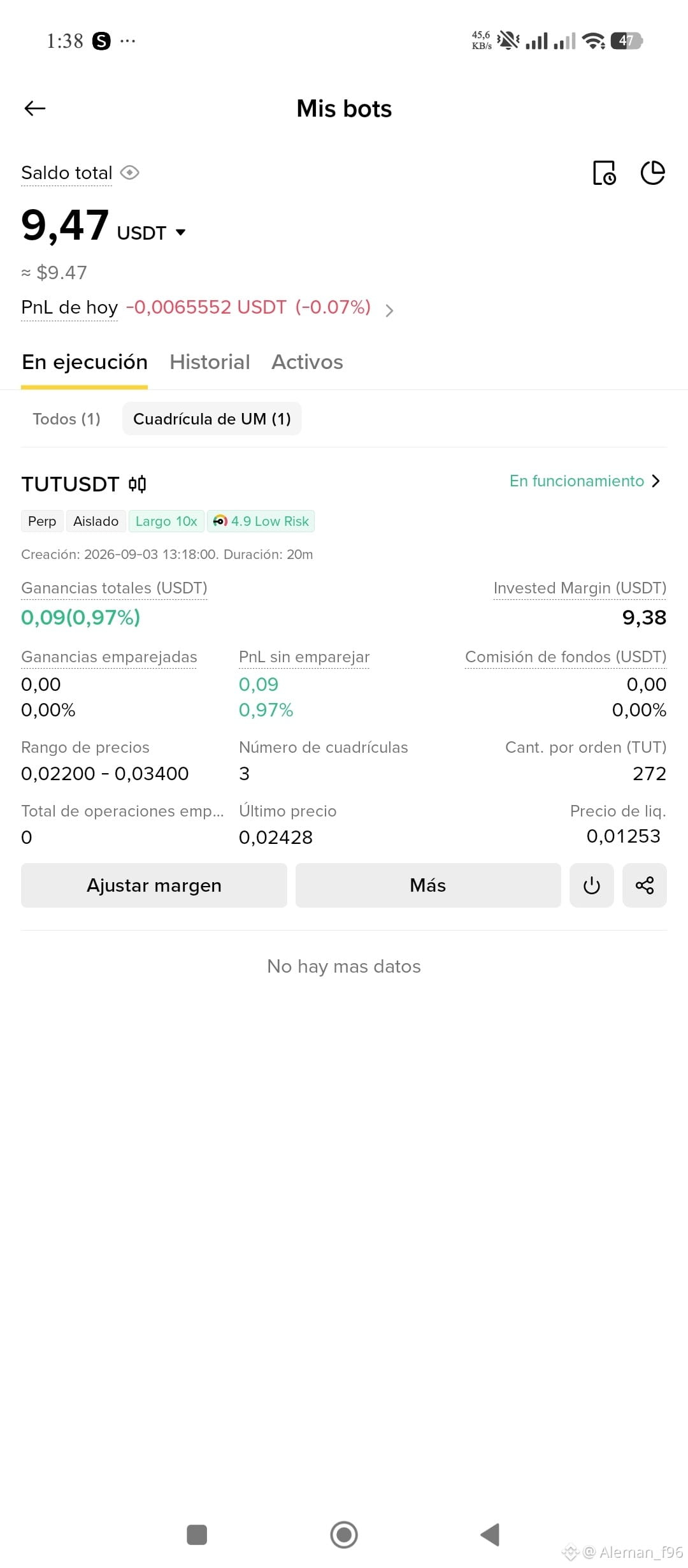
🤖 Poniendo a prueba un Futures Grid Bot con capital bajo ($9.38 USDT).
Decidí montar una estrategia automatizada en $TUT para medir resultados a fin de mes. Si el análisis sale como se espera y buscamos la parte alta del rango (0.034), esta posición a 10x proyecta más de un +100% de rendimiento sobre el capital inicial.
¿Lograremos consolidar las ganancias emparejadas o nos sacará el Stop Loss?
Lo iremos monitoreando. 📈⚡
#Crypto #BinanceSquare #GridTrading #TUTUSDT #TradingBotsExperimento de Fin de Mes: Bot de Cuadrícula en $TUT USDT Perp 🤖💸
Inversión: $9.38 USDT (10x Aislado)
Rango: 0.02200 - 0.03400 USDT
Meta: +130% ROI si el precio completa el recorrido del rango.
A ver cuánto nos deja este bot automatizado en las próximas semanas. ¡Sigue la evolución! 🔥
Decidí montar una estrategia automatizada en $TUT para medir resultados a fin de mes. Si el análisis sale como se espera y buscamos la parte alta del rango (0.034), esta posición a 10x proyecta más de un +100% de rendimiento sobre el capital inicial.
¿Lograremos consolidar las ganancias emparejadas o nos sacará el Stop Loss?
Lo iremos monitoreando. 📈⚡
#Crypto #BinanceSquare #GridTrading #TUTUSDT #TradingBotsExperimento de Fin de Mes: Bot de Cuadrícula en $TUT USDT Perp 🤖💸
Inversión: $9.38 USDT (10x Aislado)
Rango: 0.02200 - 0.03400 USDT
Meta: +130% ROI si el precio completa el recorrido del rango.
A ver cuánto nos deja este bot automatizado en las próximas semanas. ¡Sigue la evolución! 🔥

Übersetzung ansehen
Grid Core — 3 active grids. One shared capital discipline.
Active grids are managed through symbol-specific plans.
Portfolio status
• Active: BMTUSDC · CRVUSDC · FILUSDC
• Open orders: 16 buys · 2 sells
Key metrics
• Closest sell: CRV · 0% away
• Highest pressure: FIL · 14.8%
The portfolio view coordinates capital without forcing identical decisions.
Coordination beats noise.
Not a recommendation. No financial advice.
#GridTrading #RiskManagement #GridCore
Active grids are managed through symbol-specific plans.
Portfolio status
• Active: BMTUSDC · CRVUSDC · FILUSDC
• Open orders: 16 buys · 2 sells
Key metrics
• Closest sell: CRV · 0% away
• Highest pressure: FIL · 14.8%
The portfolio view coordinates capital without forcing identical decisions.
Coordination beats noise.
Not a recommendation. No financial advice.
#GridTrading #RiskManagement #GridCore
Übersetzung ansehen
Grid Core — 4 active grids. No shared shortcut.
Inventory, open orders and risk state are managed together across the portfolio.
Portfolio status
• Active: ETHUSDC · LINKUSDC
• Reducing / paused: SOLUSDC · XRPUSDC
• Open orders: 15 buys · 5 sells
Key metrics
• Closest sell: LINK · 0.5% away
• Highest pressure: ETH · 14.8%
This is a system status note, not an instruction to trade.
Many symbols, one capital discipline.
Not a recommendation. No financial advice.
#GridTrading #RiskManagement #GridCore
Inventory, open orders and risk state are managed together across the portfolio.
Portfolio status
• Active: ETHUSDC · LINKUSDC
• Reducing / paused: SOLUSDC · XRPUSDC
• Open orders: 15 buys · 5 sells
Key metrics
• Closest sell: LINK · 0.5% away
• Highest pressure: ETH · 14.8%
This is a system status note, not an instruction to trade.
Many symbols, one capital discipline.
Not a recommendation. No financial advice.
#GridTrading #RiskManagement #GridCore
Übersetzung ansehen
Grid Core Daily Recap — 2026-09-02
The day combined normal grid management with controlled exposure reduction.
Numbers that matter
• Return on sold basis: +0.41%
• Net after fees: +1.39 USDC
• Activity: 23 normal sells · 2 controlled exits · 0 Hard-SL fills
• Portfolio now: 2 active grids · 21 open orders · 2 completed cycles
• Main driver: normal grid sells (+1.09 USDC)
Controlled exits are shown separately so inventory reduction is not mistaken for normal grid harvesting.
Data: Binance myTrades with fee conversion.
Where should the next recap go deeper: realized edge, fees or exit handling?
Not a recommendation.
No financial advice.
#GridTrading #RiskManagement #GridCore
The day combined normal grid management with controlled exposure reduction.
Numbers that matter
• Return on sold basis: +0.41%
• Net after fees: +1.39 USDC
• Activity: 23 normal sells · 2 controlled exits · 0 Hard-SL fills
• Portfolio now: 2 active grids · 21 open orders · 2 completed cycles
• Main driver: normal grid sells (+1.09 USDC)
Controlled exits are shown separately so inventory reduction is not mistaken for normal grid harvesting.
Data: Binance myTrades with fee conversion.
Where should the next recap go deeper: realized edge, fees or exit handling?
Not a recommendation.
No financial advice.
#GridTrading #RiskManagement #GridCore
Grid Core — 3 aktive Grids. Eine gemeinsame Kapital-Disziplin.
Jedes Symbol bleibt an sein eigenes Inventar, seine Orders und seinen Risikostatus gebunden.
Portfoliostatus
• Aktiv: ETHUSDC · TRUMPUSDC · XRPUSDC
• Offene Orders: 19 Käufe · 8 Verkäufe
Kennzahlen
• Nächstes Verkaufssignal: ETH · 0,6% entfernt
• Höchster Druck: TRUMP · 44,4%
• Größter Drawdown: TRUMP · 0,4%
Die Portfolioansicht koordiniert das Kapital, ohne identische Entscheidungen aufzuzwingen.
Koordination soll Unterschiede bewahren, nicht auslöschen.
Keine Empfehlung. Keine Finanzberatung.
#GridTrading #RiskManagement #GridCore
Jedes Symbol bleibt an sein eigenes Inventar, seine Orders und seinen Risikostatus gebunden.
Portfoliostatus
• Aktiv: ETHUSDC · TRUMPUSDC · XRPUSDC
• Offene Orders: 19 Käufe · 8 Verkäufe
Kennzahlen
• Nächstes Verkaufssignal: ETH · 0,6% entfernt
• Höchster Druck: TRUMP · 44,4%
• Größter Drawdown: TRUMP · 0,4%
Die Portfolioansicht koordiniert das Kapital, ohne identische Entscheidungen aufzuzwingen.
Koordination soll Unterschiede bewahren, nicht auslöschen.
Keine Empfehlung. Keine Finanzberatung.
#GridTrading #RiskManagement #GridCore
Grid Core — 3 aktive Grids. Eine gemeinsame Kapital-Disziplin.
Bestand, offene Orders und der Risikostatus werden gemeinsam über das gesamte Portfolio hinweg verwaltet.
Portfolio-Status
• Aktiv: SUIUSDC · TRUMPUSDC · XRPUSDC
• Offene Orders: 27 Käufe · 6 Verkäufe
Kennzahlen
• Nächstes Verkaufssignal: TRUMP · 0,8% entfernt
• Höchster Druck: XRP · 24,8%
• Größter Drawdown: XRP · 0,3%
Jedes Symbol behält seinen eigenen Plan, während das Kapital koordiniert bleibt.
Die Koordination soll Unterschiede bewahren, nicht auslöschen.
Keine Empfehlung. Keine Finanzberatung.
#GridTrading #RiskManagement #GridCore
Bestand, offene Orders und der Risikostatus werden gemeinsam über das gesamte Portfolio hinweg verwaltet.
Portfolio-Status
• Aktiv: SUIUSDC · TRUMPUSDC · XRPUSDC
• Offene Orders: 27 Käufe · 6 Verkäufe
Kennzahlen
• Nächstes Verkaufssignal: TRUMP · 0,8% entfernt
• Höchster Druck: XRP · 24,8%
• Größter Drawdown: XRP · 0,3%
Jedes Symbol behält seinen eigenen Plan, während das Kapital koordiniert bleibt.
Die Koordination soll Unterschiede bewahren, nicht auslöschen.
Keine Empfehlung. Keine Finanzberatung.
#GridTrading #RiskManagement #GridCore
Grid Core Daily Recap — 2026-09-01
Zahlen, die zählen
• Rendite auf verkaufter Basis: +0,38%
• Netto nach Gebühren: +1,55 USDC
• Aktivität: 32 normale Verkäufe · 3 kontrollierte Ausstiege · 0 Hard-SL-Füllungen
• Portfolio jetzt: 3 aktive Grids · 21 offene Orders · 6 abgeschlossene Zyklen
• Haupttreiber: normale Grid-Verkäufe (+1,87 USDC)
Der Tag vereinte das normale Grid-Management mit der kontrollierten Reduktion der Exposition.
Das realisierte Ergebnis unterscheidet Routineverkäufe von der gezielten Reduktion der Exposition.
Daten: Binance myTrades mit Gebührenumrechnung.
Welche Ebene sollte als Nächstes klarer sein: Budgetnachweis, Abstimmung oder Sell-Refresh?
Keine Empfehlung.
Keine Finanzberatung.
#GridTrading #RiskManagement #GridCore
Zahlen, die zählen
• Rendite auf verkaufter Basis: +0,38%
• Netto nach Gebühren: +1,55 USDC
• Aktivität: 32 normale Verkäufe · 3 kontrollierte Ausstiege · 0 Hard-SL-Füllungen
• Portfolio jetzt: 3 aktive Grids · 21 offene Orders · 6 abgeschlossene Zyklen
• Haupttreiber: normale Grid-Verkäufe (+1,87 USDC)
Der Tag vereinte das normale Grid-Management mit der kontrollierten Reduktion der Exposition.
Das realisierte Ergebnis unterscheidet Routineverkäufe von der gezielten Reduktion der Exposition.
Daten: Binance myTrades mit Gebührenumrechnung.
Welche Ebene sollte als Nächstes klarer sein: Budgetnachweis, Abstimmung oder Sell-Refresh?
Keine Empfehlung.
Keine Finanzberatung.
#GridTrading #RiskManagement #GridCore
Grid Core — Portfolio-Gitterstatus erfasst.
Die Statuskarte fasst die aktive Grid-Arbeit zusammen, ohne ein neues Signal hinzuzufügen.
Portfolio-Status
• Aktiv: SUIUSDC · TRUMPUSDC · XRPUSDC
• Offene Orders: 21 Käufe · 7 Verkäufe
Kennzahlen
• Nächstes Sell: SUI · 0,5% entfernt
• Höchster Druck: TRUMP · 48,3%
• Größter Drawdown: TRUMP · 0,1%
Offene Orders und der Bestand bleiben über den exchange-bestätigten Status verwaltet.
Transparenz ohne Hinterherlaufen.
Keine Empfehlung. Keine Finanzberatung.
#GridTrading #RiskManagement #GridCore
Die Statuskarte fasst die aktive Grid-Arbeit zusammen, ohne ein neues Signal hinzuzufügen.
Portfolio-Status
• Aktiv: SUIUSDC · TRUMPUSDC · XRPUSDC
• Offene Orders: 21 Käufe · 7 Verkäufe
Kennzahlen
• Nächstes Sell: SUI · 0,5% entfernt
• Höchster Druck: TRUMP · 48,3%
• Größter Drawdown: TRUMP · 0,1%
Offene Orders und der Bestand bleiben über den exchange-bestätigten Status verwaltet.
Transparenz ohne Hinterherlaufen.
Keine Empfehlung. Keine Finanzberatung.
#GridTrading #RiskManagement #GridCore
Grid Core — Statusaktualisierung zum Portfolio-Raster.
Vorräte, offene Orders und der Risikostatus werden gemeinsam über das gesamte Portfolio verwaltet.
Portfolio-Status
• Aktiv: SUIUSDC · TRUMPUSDC · XRPUSDC
• Reduzieren / pausiert: ICPUSDC
• Offene Orders: 28 Käufe · 6 Verkäufe
Kennzahlen
• Nächster Verkauf: ICP · 0% entfernt
• Höchster Druck: SUI · 19,9%
• Größter Drawdown: XRP · 0,1%
Die Portfolioansicht hält Vorräte, Orders und Risiko in einem einzigen Rahmen.
Portfoliosteuerung vor frischer Exposition.
Keine Empfehlung. Keine Finanzberatung.
#GridTrading #RiskManagement #GridCore
Vorräte, offene Orders und der Risikostatus werden gemeinsam über das gesamte Portfolio verwaltet.
Portfolio-Status
• Aktiv: SUIUSDC · TRUMPUSDC · XRPUSDC
• Reduzieren / pausiert: ICPUSDC
• Offene Orders: 28 Käufe · 6 Verkäufe
Kennzahlen
• Nächster Verkauf: ICP · 0% entfernt
• Höchster Druck: SUI · 19,9%
• Größter Drawdown: XRP · 0,1%
Die Portfolioansicht hält Vorräte, Orders und Risiko in einem einzigen Rahmen.
Portfoliosteuerung vor frischer Exposition.
Keine Empfehlung. Keine Finanzberatung.
#GridTrading #RiskManagement #GridCore
Grid Core — Der Portfolio-Snapshot zeigt ein verwaltetes Exposure-Level, keine Aufforderung zum Handeln.
Offene Orders und Bestand bleiben symbol-spezifisch, während die Kapitalsteuerung global bleibt.
Portfolio-Status
• Aktiv: LINKUSDC · TRUMPUSDC · ZECUSDC
• Reduzierend / pausiert: ICPUSDC
• Offene Orders: 26 Käufe · 6 Verkäufe
Kennzahlen
• Nächstes Sell: TRUMP · 1% entfernt
• Höchster Druck: TRUMP · 18,4%
• Größter Drawdown: ICP · 0,9%
Das System erfasst den Druck über Symbole hinweg, ohne ihre Pläne zu einem zu flatten.
Nützliches Reporting trennt Status von Meinung.
Keine Empfehlung. Keine Finanzberatung.
#GridTrading #RiskManagement #GridCore
Offene Orders und Bestand bleiben symbol-spezifisch, während die Kapitalsteuerung global bleibt.
Portfolio-Status
• Aktiv: LINKUSDC · TRUMPUSDC · ZECUSDC
• Reduzierend / pausiert: ICPUSDC
• Offene Orders: 26 Käufe · 6 Verkäufe
Kennzahlen
• Nächstes Sell: TRUMP · 1% entfernt
• Höchster Druck: TRUMP · 18,4%
• Größter Drawdown: ICP · 0,9%
Das System erfasst den Druck über Symbole hinweg, ohne ihre Pläne zu einem zu flatten.
Nützliches Reporting trennt Status von Meinung.
Keine Empfehlung. Keine Finanzberatung.
#GridTrading #RiskManagement #GridCore
Grid Core Daily Recap — 2026-08-31
Zahlen, die zählen
• Rendite auf Basis des verkauften Volumens: -2,04%
• Netto nach Gebühren: -6,24 USDC
• Aktivität: 24 normale Verkäufe · 0 kontrollierte Exits · 3 Hard-SL-Fills
• Portfolio jetzt: 2 aktive Grids · 25 offene Orders · 10 abgeschlossene Zyklen
• Haupttreiber: Hard-SL-Risiko-Exit (-7,64 USDC)
Ein Hard-SL-Ereignis dominierte den Tag Mehr als die routinemäßige Grid-Ernte.
Die Zusammenfassung hält den Verlust sichtbar, statt ihn hinter der Aktivität zu verstecken.
Daten: Binance myTrades mit Gebührenumrechnung.
Welche Kennzahl sollte transparenter werden: verkaufte Kostenbasis, Gebühren oder aktive Exponierung?
Keine Empfehlung.
Keine Finanzberatung.
#GridTrading #RiskManagement #GridCore
Zahlen, die zählen
• Rendite auf Basis des verkauften Volumens: -2,04%
• Netto nach Gebühren: -6,24 USDC
• Aktivität: 24 normale Verkäufe · 0 kontrollierte Exits · 3 Hard-SL-Fills
• Portfolio jetzt: 2 aktive Grids · 25 offene Orders · 10 abgeschlossene Zyklen
• Haupttreiber: Hard-SL-Risiko-Exit (-7,64 USDC)
Ein Hard-SL-Ereignis dominierte den Tag Mehr als die routinemäßige Grid-Ernte.
Die Zusammenfassung hält den Verlust sichtbar, statt ihn hinter der Aktivität zu verstecken.
Daten: Binance myTrades mit Gebührenumrechnung.
Welche Kennzahl sollte transparenter werden: verkaufte Kostenbasis, Gebühren oder aktive Exponierung?
Keine Empfehlung.
Keine Finanzberatung.
#GridTrading #RiskManagement #GridCore
Grid Core — Mehrere Grids bleiben unter Portfoliomanagement.
Offene Orders warten weiterhin auf vordefinierten Levels über die aktiven Grids hinweg.
Portfolio-Status
• Aktiv: LINKUSDC · TRUMPUSDC
• Reduzieren / pausiert: ICPUSDC · PENGUUSDC
• Offene Orders: 18 Käufe · 5 Verkäufe
Wichtige Kennzahlen
• Nächster Verkauf: LINK · 0,8% entfernt
• Höchster Druck: PENGU · 95%
• Größter Drawdown: ICP · 1,3%
Keine neuen Maßnahmen werden erfunden, nur um den Status geschäftig wirken zu lassen.
Viele Symbole, eine Kapitaldisziplin.
Keine Empfehlung. Keine Finanzberatung.
#GridTrading #RiskManagement #GridCore
Offene Orders warten weiterhin auf vordefinierten Levels über die aktiven Grids hinweg.
Portfolio-Status
• Aktiv: LINKUSDC · TRUMPUSDC
• Reduzieren / pausiert: ICPUSDC · PENGUUSDC
• Offene Orders: 18 Käufe · 5 Verkäufe
Wichtige Kennzahlen
• Nächster Verkauf: LINK · 0,8% entfernt
• Höchster Druck: PENGU · 95%
• Größter Drawdown: ICP · 1,3%
Keine neuen Maßnahmen werden erfunden, nur um den Status geschäftig wirken zu lassen.
Viele Symbole, eine Kapitaldisziplin.
Keine Empfehlung. Keine Finanzberatung.
#GridTrading #RiskManagement #GridCore

Strategie (Grid Trading)
🤖 Den neutralen Markt mit dem Grid Trading arbeiten lassen
Wenn der Kurs eines Assets seitwärts schwankt, ohne klare Richtung, kann das manuelle Trading schnell ermüdend werden. Genau hier kommt das Spot Grid ins Spiel:
Es teilt eine Preisspanne in mehrere Ebenen auf.
Es kauft automatisch günstig und verkauft teuer bei jeder kleinen Kursbewegung.
Ideal, um in Konsolidierungsphasen passives Renditepotenzial auf stabilen Handelspaaren zu generieren.
#GridTrading #BinanceBots #Automation #PassiveIncome @AIGENSYN
🤖 Den neutralen Markt mit dem Grid Trading arbeiten lassen
Wenn der Kurs eines Assets seitwärts schwankt, ohne klare Richtung, kann das manuelle Trading schnell ermüdend werden. Genau hier kommt das Spot Grid ins Spiel:
Es teilt eine Preisspanne in mehrere Ebenen auf.
Es kauft automatisch günstig und verkauft teuer bei jeder kleinen Kursbewegung.
Ideal, um in Konsolidierungsphasen passives Renditepotenzial auf stabilen Handelspaaren zu generieren.
#GridTrading #BinanceBots #Automation #PassiveIncome @AIGENSYN
Grid Core — 4 aktive Grids. Eine gemeinsame Kapitaldisziplin.
Aktive Symbole werden über die bestehende Grid-Struktur verwaltet.
Portfolio-Status
• Aktiv: NEARUSDC · SUIUSDC
• Reduzieren / pausiert: ICPUSDC · PENGUUSDC
• Offene Orders: 16 Käufe · 4 Verkäufe
Wichtige Kennzahlen
• Nächster Sell: NEAR · 0,5% entfernt
• Höchster Druck: PENGU · 95%
• Größter Drawdown: ICP · 1,6%
Dies ist ein Systemstatus-Hinweis, keine Handlungsanweisung zum Handel.
Koordination schlägt Rauschen.
Keine Empfehlung. Keine Finanzberatung.
#GridTrading #RiskManagement #GridCore
Aktive Symbole werden über die bestehende Grid-Struktur verwaltet.
Portfolio-Status
• Aktiv: NEARUSDC · SUIUSDC
• Reduzieren / pausiert: ICPUSDC · PENGUUSDC
• Offene Orders: 16 Käufe · 4 Verkäufe
Wichtige Kennzahlen
• Nächster Sell: NEAR · 0,5% entfernt
• Höchster Druck: PENGU · 95%
• Größter Drawdown: ICP · 1,6%
Dies ist ein Systemstatus-Hinweis, keine Handlungsanweisung zum Handel.
Koordination schlägt Rauschen.
Keine Empfehlung. Keine Finanzberatung.
#GridTrading #RiskManagement #GridCore
Grid Core Tagesrückblick — 2026-08-30
Der Tag wurde durch einen Risk-Exit statt durch die normale Grid-Ernte definiert.
Das Ergebnis wird als Risk-Control Damage Control gemeldet, nicht als normales Grid-Einkommen.
Kennzahlen, die zählen
• Rendite auf verkaufter Basis: -1,35%
• Netto nach Gebühren: -4,47 USDC
• Aktivität: 17 normale Verkäufe · 2 kontrollierte Exits · 4 Hard-SL-Fills
• Portfolio jetzt: 2 aktive Grids · 14 offene Orders · 9 abgeschlossene Zyklen
• Haupttreiber: Hard-SL Risk Exit (-5,72 USDC)
Daten: Binance myTrades mit Gebührenumrechnung.
Was sollte der nächste Rückblick verständlicher erklären: Fills, Gebühren oder Risk Control?
Keine Empfehlung.
Keine finanzielle Beratung.
#GridTrading #RiskManagement #GridCore
Der Tag wurde durch einen Risk-Exit statt durch die normale Grid-Ernte definiert.
Das Ergebnis wird als Risk-Control Damage Control gemeldet, nicht als normales Grid-Einkommen.
Kennzahlen, die zählen
• Rendite auf verkaufter Basis: -1,35%
• Netto nach Gebühren: -4,47 USDC
• Aktivität: 17 normale Verkäufe · 2 kontrollierte Exits · 4 Hard-SL-Fills
• Portfolio jetzt: 2 aktive Grids · 14 offene Orders · 9 abgeschlossene Zyklen
• Haupttreiber: Hard-SL Risk Exit (-5,72 USDC)
Daten: Binance myTrades mit Gebührenumrechnung.
Was sollte der nächste Rückblick verständlicher erklären: Fills, Gebühren oder Risk Control?
Keine Empfehlung.
Keine finanzielle Beratung.
#GridTrading #RiskManagement #GridCore
Grid Core — Das Portfolio funktionierte weiterhin zwischen sichtbaren Fills.
Das Kernsystem verfolgt aktiv den Bestand, offene Orders und den Risikostatus zusammen.
Portfolio-Status
• Aktiv: ICPUSDC · PENGUUSDC · TRUMPUSDC
• Offene Orders: 32 Käufe · 5 Verkäufe
Kennzahlen
• Nächstes Sell: ICP · 1,1% entfernt
• Höchster Druck: TRUMP · 26,2%
• Größter Drawdown: TRUMP · 0,9%
Das Kapital bleibt koordiniert, statt auf jede Bewegung zu reagieren.
Stilles Ausführen ist immer noch Ausführen.
Keine Empfehlung. Keine finanzielle Beratung.
#GridTrading #RiskManagement #GridCore
Das Kernsystem verfolgt aktiv den Bestand, offene Orders und den Risikostatus zusammen.
Portfolio-Status
• Aktiv: ICPUSDC · PENGUUSDC · TRUMPUSDC
• Offene Orders: 32 Käufe · 5 Verkäufe
Kennzahlen
• Nächstes Sell: ICP · 1,1% entfernt
• Höchster Druck: TRUMP · 26,2%
• Größter Drawdown: TRUMP · 0,9%
Das Kapital bleibt koordiniert, statt auf jede Bewegung zu reagieren.
Stilles Ausführen ist immer noch Ausführen.
Keine Empfehlung. Keine finanzielle Beratung.
#GridTrading #RiskManagement #GridCore
Grid Core — 3 aktive Grids. Keine gemeinsame Verknüpfung.
Aktive Grids werden über symbol-spezifische Pläne verwaltet.
Status des Portfolios
• Aktiv: ICPUSDC · PENGUUSDC · PUMPUSDC
• Offene Orders: 27 Käufe · 6 Verkäufe
Kennzahlen
• Nächster Verkauf: ICP · 0% entfernt
• Höchster Druck: PUMP · 14,8%
Jedes Symbol behält seinen eigenen Plan, solange das Kapital koordiniert bleibt.
Die Koordination sollte Unterschiede bewahren, nicht auslöschen.
Keine Empfehlung. Keine Finanzberatung.
#GridTrading #RiskManagement #GridCore
Aktive Grids werden über symbol-spezifische Pläne verwaltet.
Status des Portfolios
• Aktiv: ICPUSDC · PENGUUSDC · PUMPUSDC
• Offene Orders: 27 Käufe · 6 Verkäufe
Kennzahlen
• Nächster Verkauf: ICP · 0% entfernt
• Höchster Druck: PUMP · 14,8%
Jedes Symbol behält seinen eigenen Plan, solange das Kapital koordiniert bleibt.
Die Koordination sollte Unterschiede bewahren, nicht auslöschen.
Keine Empfehlung. Keine Finanzberatung.
#GridTrading #RiskManagement #GridCore
Grid Core — Das Portfolio ist aktiv, ohne dem Markt hinterherzulaufen.
Der Kern verfolgt aktives Inventar, offene Orders und den Risikostatus gemeinsam.
Portfolio-Status
• Aktiv: ETHUSDC · PENGUUSDC
• Reduzierend / pausiert: SOLUSDC · SUIUSDC
• Offene Orders: 8 Käufe · 7 Verkäufe
Kennzahlen
• Nächster Verkauf: SOL · 0,2% entfernt
• Höchster Druck: PENGU · 80,5%
• Größter Drawdown: SUI · 0,2%
Es wird keine neue Aktion erfunden, nur damit der Status beschäftigt wirkt.
Ruhige Ausführung ist dennoch Ausführung.
Keine Empfehlung. Keine Finanzberatung.
#GridTrading #RiskManagement #GridCore
Der Kern verfolgt aktives Inventar, offene Orders und den Risikostatus gemeinsam.
Portfolio-Status
• Aktiv: ETHUSDC · PENGUUSDC
• Reduzierend / pausiert: SOLUSDC · SUIUSDC
• Offene Orders: 8 Käufe · 7 Verkäufe
Kennzahlen
• Nächster Verkauf: SOL · 0,2% entfernt
• Höchster Druck: PENGU · 80,5%
• Größter Drawdown: SUI · 0,2%
Es wird keine neue Aktion erfunden, nur damit der Status beschäftigt wirkt.
Ruhige Ausführung ist dennoch Ausführung.
Keine Empfehlung. Keine Finanzberatung.
#GridTrading #RiskManagement #GridCore
Grid Core Tagesrückblick — 2026-08-29
Der Tag umfasste eine kontrollierte Exit-Aktivität.
Das erzielte Ergebnis unterscheidet Routinetrennungen von einer gezielten Reduktion der Exponierung.
Zahlen, die zählen
• Rendite auf verkaufter Basis: +0,07%
• Netto nach Gebühren: +0,28 USDC
• Aktivität: 15 normale Sells · 4 kontrollierte Exits · 0 Hard-SL-Fills
• Portfolio jetzt: 3 aktive Grids · 27 offene Orders · 5 abgeschlossene Zyklen
• Haupttreiber: normale Grid-Sells (+1,15 USDC)
Daten: Binance myTrades mit Gebührenumrechnung.
Was würde den nächsten Rückblick hilfreicher machen: Fill-Qualität, Kapitalnutzung oder Risikooentscheidungen?
Keine Empfehlung.
Keine Finanzberatung.
#GridTrading #RiskManagement #GridCore
Der Tag umfasste eine kontrollierte Exit-Aktivität.
Das erzielte Ergebnis unterscheidet Routinetrennungen von einer gezielten Reduktion der Exponierung.
Zahlen, die zählen
• Rendite auf verkaufter Basis: +0,07%
• Netto nach Gebühren: +0,28 USDC
• Aktivität: 15 normale Sells · 4 kontrollierte Exits · 0 Hard-SL-Fills
• Portfolio jetzt: 3 aktive Grids · 27 offene Orders · 5 abgeschlossene Zyklen
• Haupttreiber: normale Grid-Sells (+1,15 USDC)
Daten: Binance myTrades mit Gebührenumrechnung.
Was würde den nächsten Rückblick hilfreicher machen: Fill-Qualität, Kapitalnutzung oder Risikooentscheidungen?
Keine Empfehlung.
Keine Finanzberatung.
#GridTrading #RiskManagement #GridCore
Grid Core — 3 aktive Grids. Eine gemeinsame Kapital-Disziplin.
Aktive Grids werden über symbol-spezifische Pläne verwaltet.
Portfolio-Status
• Aktiv: PENGUUSDC · SUIUSDC
• Reduzieren / pausiert: WLDUSDC
• Offene Orders: 13 Käufe · 6 Verkäufe
Kennzahlen
• Nächstes Sell: SUI · 0,7% entfernt
• Höchster Druck: WLD · 55,7%
• Größter Drawdown: WLD · 0,6%
Die Portfolio-Ansicht koordiniert das Kapital, ohne identische Entscheidungen zu erzwingen.
Portfoliokontrolle vor neuer Exponierung.
Keine Empfehlung. Keine Finanzberatung.
#GridTrading #RiskManagement #GridCore
Aktive Grids werden über symbol-spezifische Pläne verwaltet.
Portfolio-Status
• Aktiv: PENGUUSDC · SUIUSDC
• Reduzieren / pausiert: WLDUSDC
• Offene Orders: 13 Käufe · 6 Verkäufe
Kennzahlen
• Nächstes Sell: SUI · 0,7% entfernt
• Höchster Druck: WLD · 55,7%
• Größter Drawdown: WLD · 0,6%
Die Portfolio-Ansicht koordiniert das Kapital, ohne identische Entscheidungen zu erzwingen.
Portfoliokontrolle vor neuer Exponierung.
Keine Empfehlung. Keine Finanzberatung.
#GridTrading #RiskManagement #GridCore
Anmelden und weiter Inhalte entdecken