
There are times when I read a project’s materials not to look for something new, but to check whether they are repeating a very old mistake. When I got to the architecture section of Openledger, I paused for quite a while, because this time the focus did not seem to be on telling a flashy story about moving across many chains, but on trying to make omnichain execution something that is born together with the system itself through LayerZero.
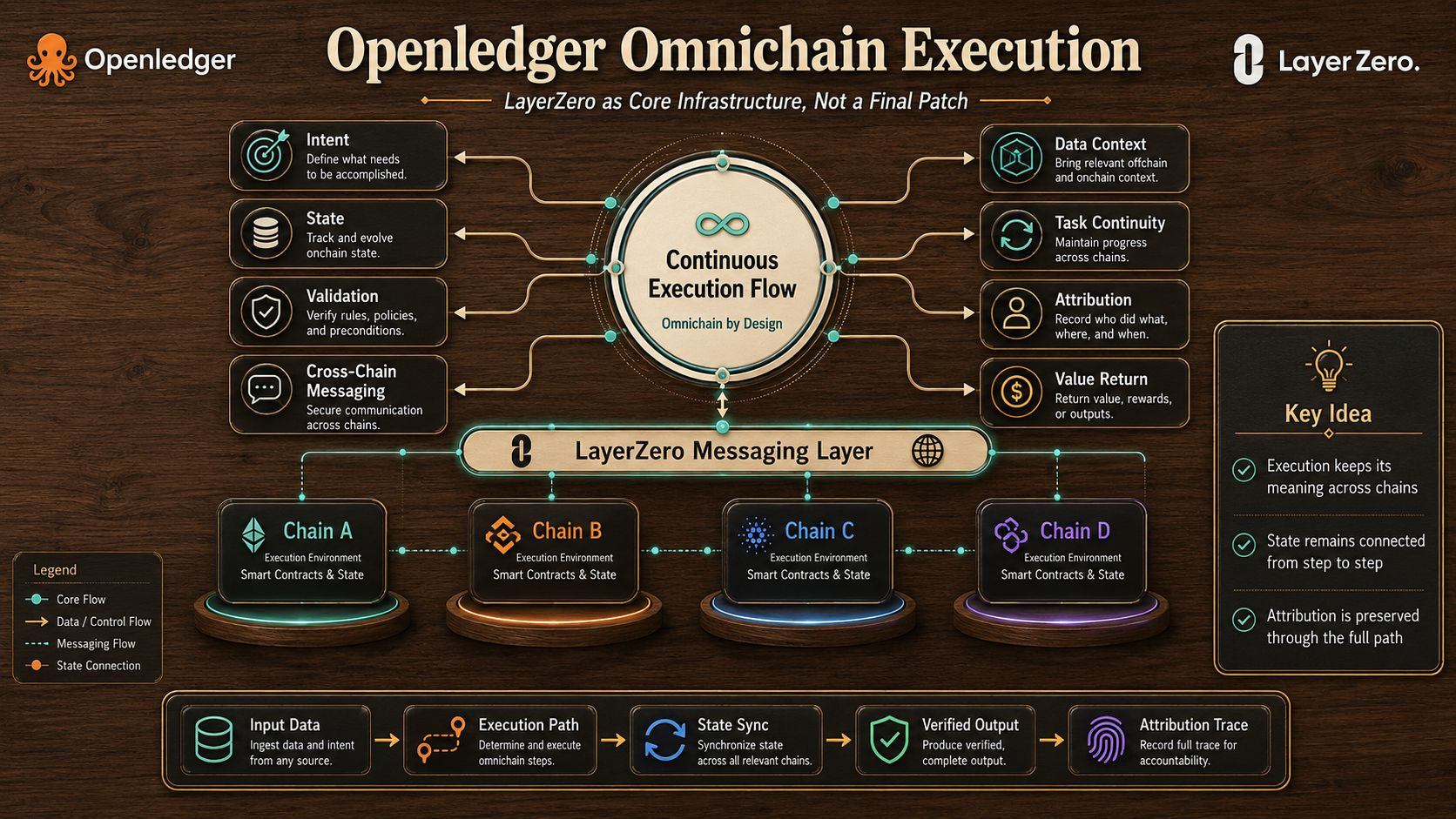
What kept me reading was not a new promise about scale. What made the project feel worth studying was the way Openledger treats execution as a continuous flow with context, rather than a chain of chopped up steps connected by bridges at the end. For an action to remain whole, it has to carry its original intent, its validation conditions, its intermediate states, and its final outcome. Once those elements stop moving together when crossing the boundary between environments, the system may still run, but its logic starts to hollow out.
After several market cycles, I think this is exactly the part the market has avoided the most. Anyone who has spent enough time tracing logs knows that failures rarely begin with a dramatic breakdown. They usually come from a delayed signal, a confirmation that arrives in the right direction but at the wrong moment, or a state transition that makes the action behind it lose its understanding of the action before it. Strangely enough, the more people talk about seamless experience, the more many systems reveal that they never treated execution as an architectural problem. Openledger does the opposite by putting that question on the table from very early on.
I see the role of LayerZero in this story as a test of how serious the design really is. Many teams only bring in cross chain connectivity when the product is almost finished, treating it as an extra layer added after the main body has already been built. That approach makes sense if the goal is simply to be present in more places, but it does not solve the continuity problem of execution. Openledger chooses the harder direction, letting the connectivity layer participate directly in preserving the meaning of state as it crosses multiple chains. To be honest, the difference comes down to whether a system treats execution as its backbone or not.
What makes this even more worth discussing is that the direction does not stand alone. It fits into Openledger’s broader ambition around data, tasks, and value being held inside one shared logic. When a system wants to connect input data to output, and then send value back to the right source that helped produce that result, execution cannot be treated as a secondary pipe. If an action loses part of its context at every stage, then sooner or later attribution becomes nothing more than a story told after everything is already done.
I appreciate this because it reveals a different building attitude. The market is used to optimizing for the launch moment, while questions about execution order, state consistency, and the ability to trace an action backward are often pushed to a later stage. Once the system grows, builders discover that the hardest part is not adding one more domain, but preserving the meaning of an action after it has crossed an old boundary. Openledger is worth watching precisely because it goes straight into that dry, heavy, and low glamour part of the work.
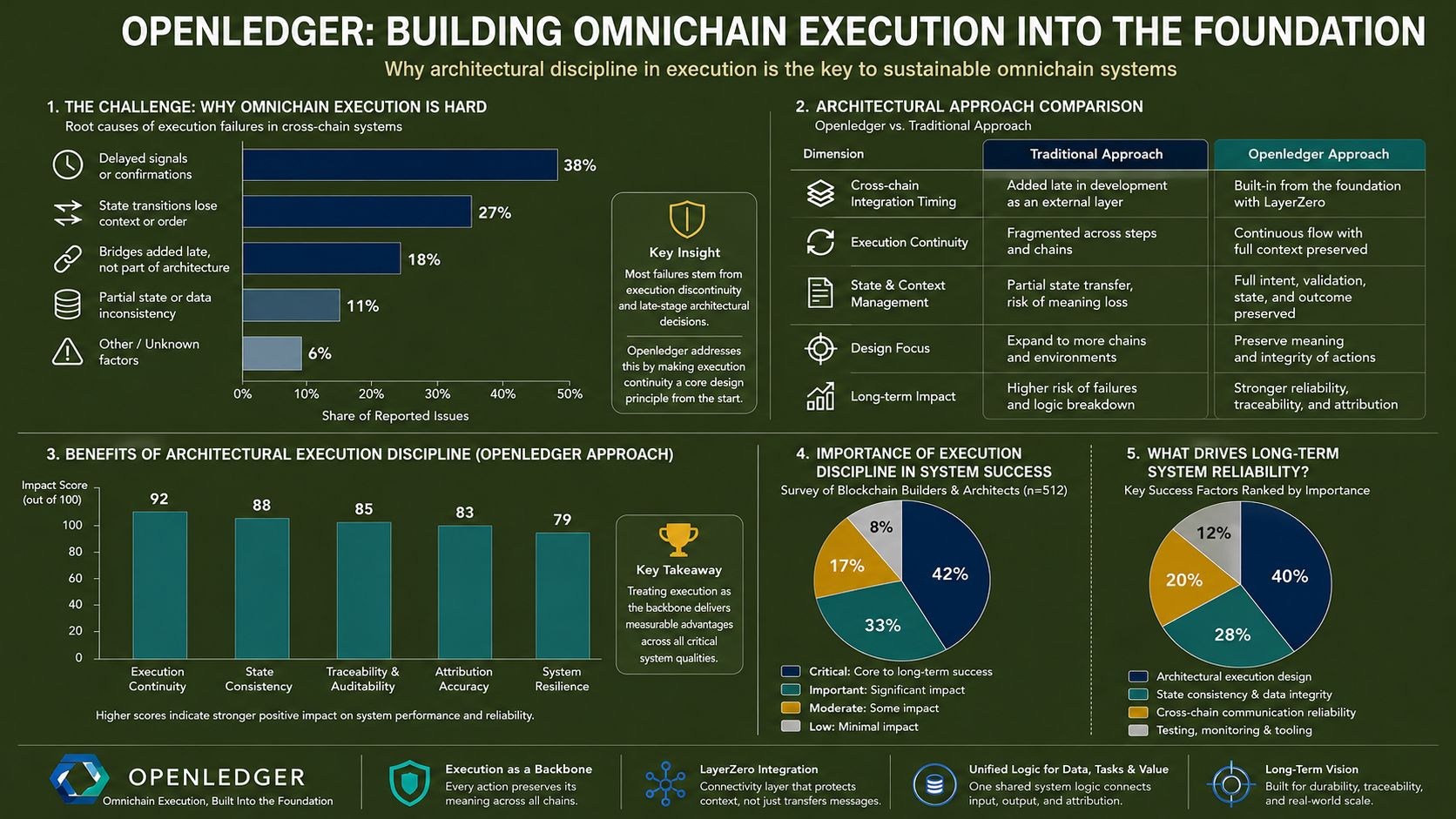
Of course, I do not see this as an easy path to win. The more execution is pulled into the center, the greater the testing cost, the broader the error surface, and the heavier the pressure to maintain architectural discipline. LayerZero opens the way for a better design approach, but no one serious about building products believes that having a cross chain messaging layer alone will make everything seamless by itself. No one would have thought that the driest part of a blueprint is often where the life span of a system is decided. Openledger caught my attention because the project accepts the burden of that difficult part instead of pushing it onto the user or postponing it to a later version.
What stays with me about this problem is not how far the ambition goes, but the way a system forces itself to remain honest about the path of every action. Openledger is choosing the harder road by using LayerZero to place omnichain execution into the foundation itself, so the continuity of execution does not turn into a late stage patch job. I think that if this discipline is preserved, the project will create a difference not through the number of environments it reaches, but through the fact that each task keeps its original meaning throughout the entire journey. Could that very architectural choice make Openledger one of the rare examples showing that omnichain execution has to be built as part of a system’s nature rather than as a belated add on.