
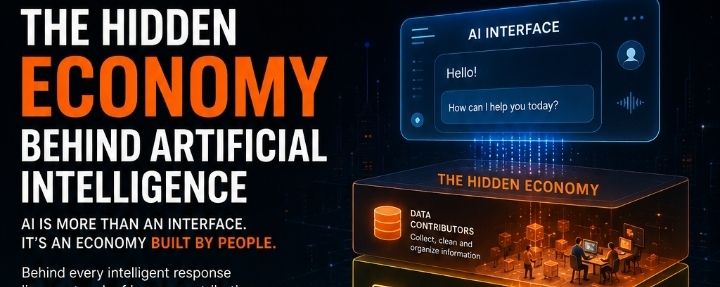
Most people see AI as a product. A chatbot, an assistant, a trading tool, or an automated system that gives answers in seconds. But the more I learn about projects like @OpenLedger, the more I think the real story of AI is not the interface people interact with. The real story is the invisible economy operating underneath it.
Every AI system depends on layers of human contribution. Data contributors organize information. Developers optimize models. Validators improve outputs. Communities test systems and identify weaknesses. Yet most of this work becomes invisible once the final model is released. The intelligence is visible, but the people shaping it disappear from the conversation.
That structure may have worked during the early phase of AI, but it becomes harder to justify as AI systems grow more powerful and more economically valuable. If millions of people contribute value to these systems, should ownership and rewards remain centralized forever?
This is where OpenLedger starts to feel different from many AI projects in crypto. Instead of focusing only on launching another AI narrative, the project is trying to build infrastructure around attribution, transparency, and decentralized collaboration. The concept of Proof of Attribution is especially interesting because it creates a system where contributions can be tracked and verified on-chain instead of being absorbed into a black box.
I also think the market underestimates how important specialized AI will become over the next few years. General-purpose models are impressive, but real-world industries often require focused intelligence trained on reliable and domain-specific data. Healthcare, finance, cybersecurity, and legal systems all depend on precision and explainability. OpenLedger seems to recognize that future earlier than many projects currently chasing hype cycles.
At the same time, decentralized AI infrastructure will not succeed automatically. There are still difficult questions around governance, security, contributor incentives, and scalability. Autonomous AI systems operating across decentralized environments introduce risks that cannot be ignored. Trust will become one of the most important parts of the entire ecosystem.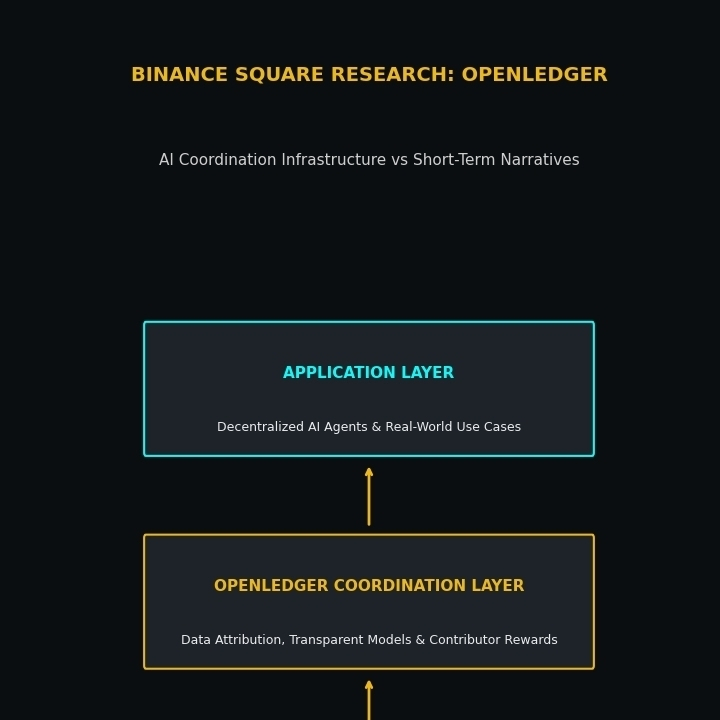
What interests me most is the long-term shift happening behind the scenes. The internet economy was built around centralized platforms controlling data and monetization. AI could completely reshape that structure by turning intelligence itself into the new economic layer. If that transition continues, platforms focused on coordination, attribution, and transparent ownership may eventually become foundational infrastructure instead of niche experiments.
That’s why I’m paying attention to @OpenLedger right now. Not because I expect instant hype or short-term excitement, but because the project is exploring ideas that could become increasingly important as AI economies mature.
The future of AI may not only depend on how intelligent the systems become. It may also depend on whether the people behind those systems are finally recognized, rewarded, and remembered.
